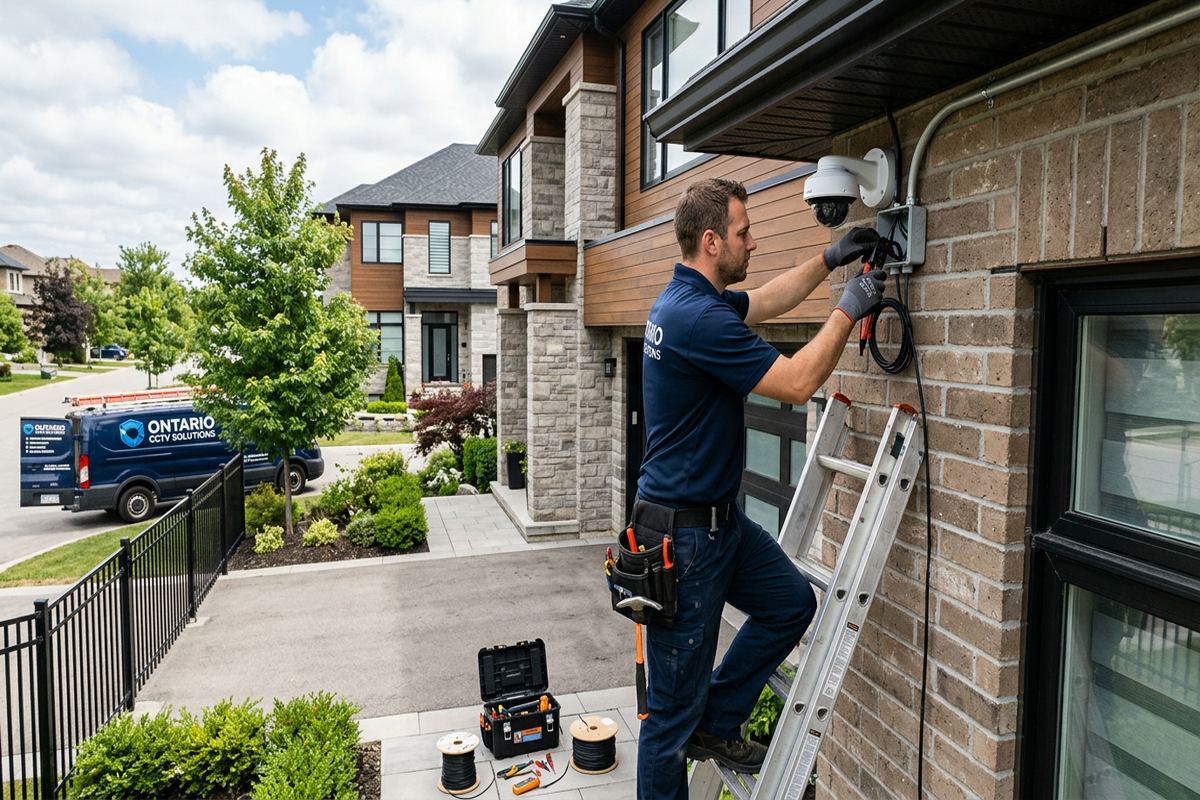
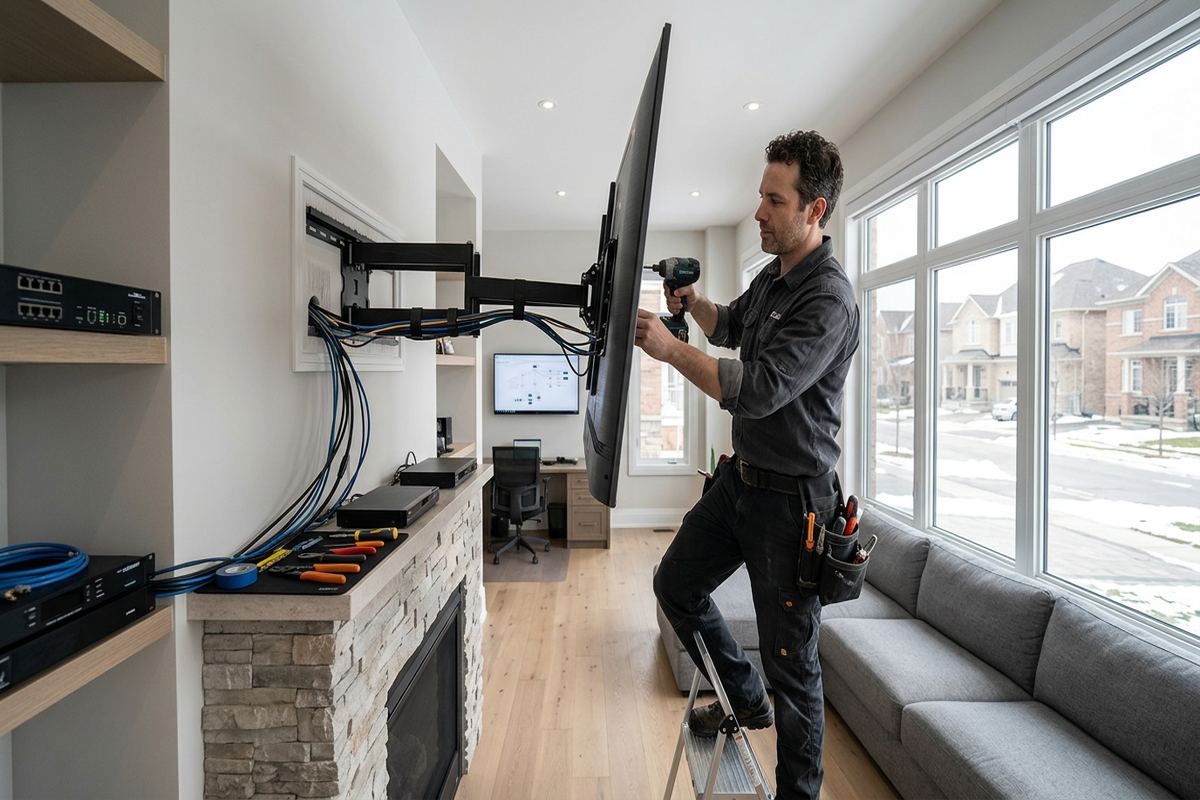
UnifiedLink provides TV wall mounting for homes, seasonal properties and businesses across Fort Erie. We assess the wall, viewing area, equipment and cable path before recommending a mount. Installation can include secure fastening, concealed wiring, connected-device setup and a clear handover using your own credentials. Interior and weather-rated exterior display projects are available.
TV Wall Mounting for Fort Erie Properties
A properly mounted television depends on more than screen size. UnifiedLink checks the wall structure, stud or masonry location, mounting height, viewing distance and required movement before work begins. Fort Erie properties include older houses, newer frame construction, cottages, storefronts and industrial units, so attachment methods vary considerably. We also account for nearby receptacles, HDMI sources, network connections and sound equipment. This planning avoids unsuitable fasteners, awkward viewing angles and exposed cables that could have been routed cleanly from the outset.
Interior walls can conceal framing changes, plumbing, electrical wiring, insulation or masonry behind finished surfaces. A stud finder alone does not confirm that every proposed anchor point is suitable. Our assessment considers the display weight, mount design and forces created when a full-motion arm extends away from the wall. Where blocking is absent or the finish is fragile, the installation approach may need adjustment. The objective is a stable mounting surface without avoidable damage to drywall, plaster, tile, brick or surrounding millwork.
Each project starts with a site assessment before pricing. The written scope identifies the display and mounting equipment, intended placement, cable routes, included configuration, exclusions, equipment ownership and applicable warranty details. This is especially useful when several parties are involved, such as a landlord, condominium manager, general contractor or business tenant. It also provides one reference for decisions about concealed wiring, electrical work by the appropriate trade, network connections, soundbars and source devices. UnifiedLink remains the accountable contractor for the defined low-voltage work.
- Fixed, tilting and full-motion mount installation
- Drywall, wood framing and masonry assessment
- Viewing height and glare review
- Soundbar and peripheral placement
- Written scope before installation
Planning Placement in Fort Erie Homes
Room layout should determine screen placement rather than an unused patch of wall. We review primary seating, viewing distance, natural light, reflections and furniture circulation before marking the mounting position. In lakefront and seasonal homes around Fort Erie, rooms may have large windows, compact floor plans or walls shared with fireplaces and mechanical chases. A slightly different height or wall can improve visibility while simplifying cable routing. The final position is confirmed on site so the customer can see the proposed outline before holes are drilled.
Older housing can present plaster, lath, irregular framing or renovations layered over original construction. Newer frame homes more often have predictable stud spacing, but built-in cabinetry, vapour barriers and insulated exterior walls still require care. Brick and concrete need anchors selected for the substrate and load, not generic hardware supplied for every wall type. Around Bridgeburg and established residential areas, an assessment can identify conditions that are not evident from photographs. We avoid treating all finished walls as though their internal construction is identical.
Fireplace mounting requires specific review because heat, mantle depth and viewing height can conflict. We consider the fireplace type, manufacturer clearances, wall construction and practical cable path, but we do not override appliance instructions. If the only available position is too high or exposes equipment to unsuitable heat, we explain alternatives. These may include another wall, a different mount or revised furniture placement. Power extensions must not be concealed inside walls; where a new receptacle is necessary, that work should be completed by the appropriate electrical contractor.
- Seating and sightline review
- Window glare and reflection planning
- Fireplace clearance considerations
- Older plaster and lath assessment
- Position approval before drilling
Mount Selection and Secure Fastening
The correct bracket depends on the television’s mounting pattern, weight, size and intended movement. Fixed mounts keep the screen close to the wall, while tilting models can improve the angle when installation must be higher. Full-motion arms provide access and directional adjustment but place greater leverage on the attachment points. We verify mount compatibility and inspect customer-supplied hardware before use. If a bracket is damaged, incomplete or unsuitable for the wall, it is identified before installation rather than adapted with uncertain components.
Fastening methods are chosen after the supporting material is confirmed. Wood studs, structural blocking, concrete and sound masonry each require different hardware and drilling methods. Hollow drywall is not treated as equivalent to structural framing, particularly for an articulated mount. Tile and stone finishes also need controlled drilling to reduce the chance of cracking, followed by anchoring into an appropriate backing material. The written scope records unusual mounting conditions so the customer understands whether reinforcement, access openings or another trade is required before the display can be installed.
Alignment is checked at the wall plate and again after the television is attached. Walls and ceilings are not always square, especially in renovated or older buildings, so visual alignment with cabinetry may differ slightly from a purely level reference. We discuss that distinction when it matters. Safety locks, retaining screws and manufacturer-supplied straps are installed where applicable. The screen is then moved through its intended range to confirm that connectors, cables and nearby surfaces are not pinched, strained or contacted during normal adjustment.
- VESA pattern and weight verification
- Mount movement matched to the room
- Anchors selected for confirmed substrate
- Safety locks installed where applicable
- Movement and cable-clearance testing
Fort Erie, Ontario
TV wall mounting in Fort Erie, scoped in writing first
Book a site assessment and get equipment, routes, exclusions, and warranty on paper before anything is installed.
Concealed Cabling and Device Connections in Fort Erie
A clean installation requires a cable plan as well as a mounting plan. We identify each source device, including streaming players, receivers, game systems, computers, digital signage players and sound equipment, then determine where those components will sit. Cable length, connector direction, service access and future replacement all affect the route. Where construction permits, low-voltage cables can be concealed in the wall using continuous labelled runs. Surface raceway is a practical alternative when wall access is restricted, masonry is present or the customer wants a less invasive method.
Power and low-voltage signal wiring have different requirements. Standard television power cords and extension cords are not routed loosely inside wall cavities. If power is unavailable behind the proposed display, the scope can coordinate placement requirements for a licensed electrical contractor. HDMI, Ethernet, optical audio and approved in-wall signal cables are planned to avoid sharp bends and unnecessary couplers. In Fort Erie businesses, labelled endpoints also make later troubleshooting easier when media players, cable boxes or network equipment are stored away from the screen.
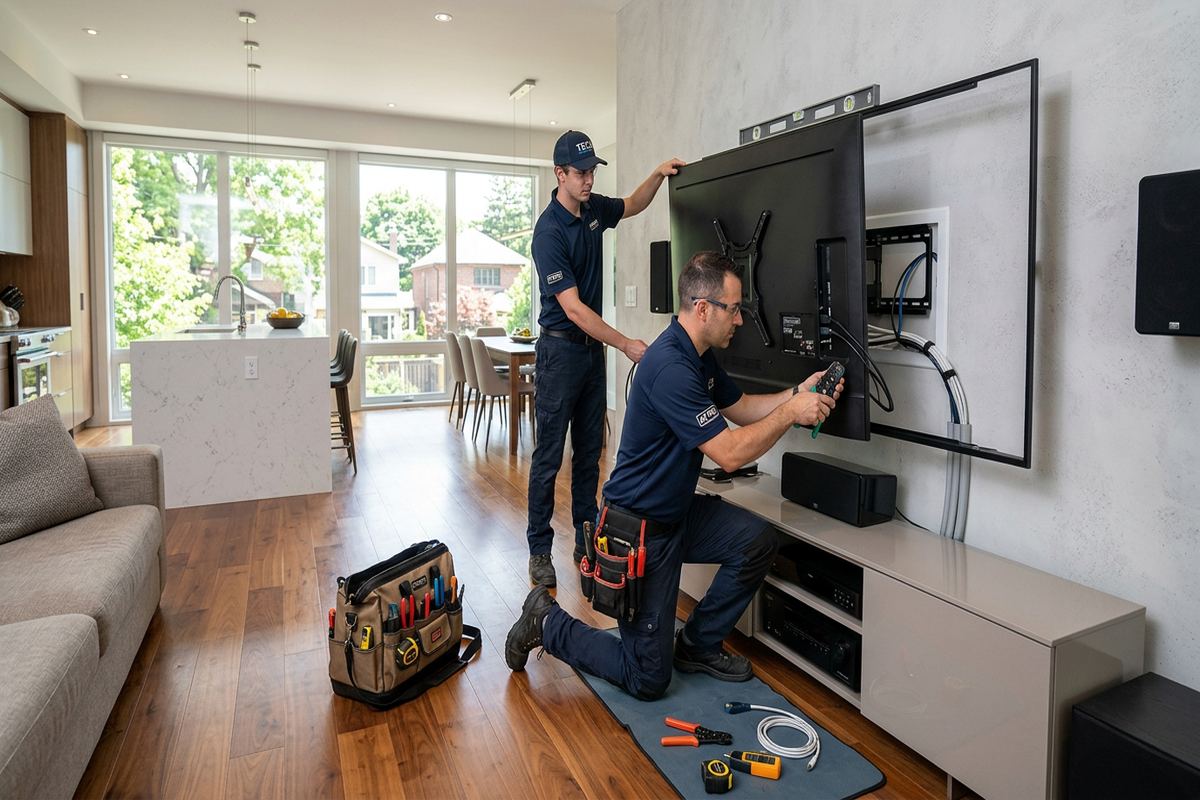
Connected equipment is configured on site within the agreed scope. This may include selecting inputs, enabling appropriate display settings, connecting Ethernet or Wi-Fi, pairing a remote and confirming audio output. Customers retain their own account credentials; passwords are not embedded in an installer-controlled account. At handover, we identify cable labels, demonstrate basic operation and provide an as-built record showing relevant device placement and cable routes. This documentation is useful when furniture moves, equipment changes or another contractor needs to understand the completed installation.
- Continuous labelled low-voltage cable runs
- In-wall or surface-raceway options
- HDMI, Ethernet and audio connections
- Customer-owned account credentials
- As-built cable and device record
Exterior TV Mounting for Local Conditions
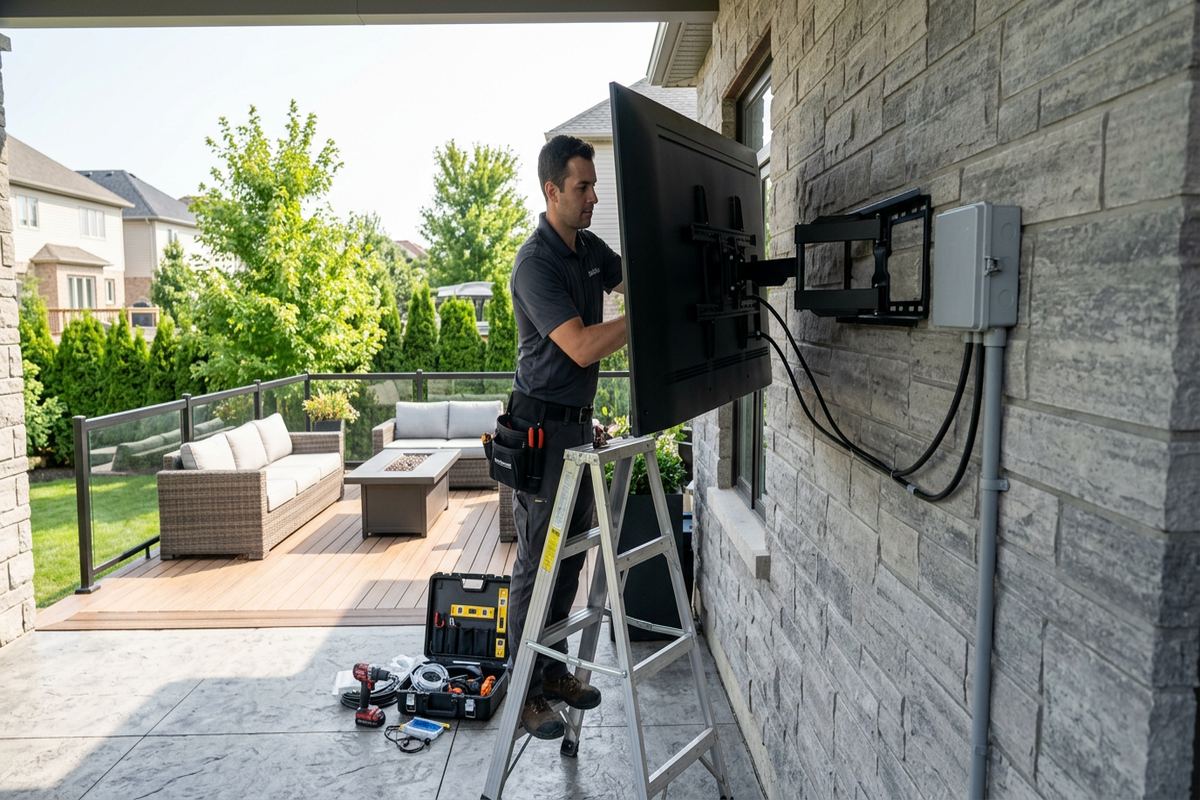
Border-adjacent businesses and lakefront and seasonal homes make weather-rated exterior gear standard for appropriate Fort Erie projects. An indoor television placed under a shallow roof is not automatically suitable for outdoor use. The display, mount, enclosure, connectors and supporting hardware must match the exposure and manufacturer requirements. We review rain direction, wind-driven moisture, sunlight, temperature variation and physical access before proposing placement. Covered patios can still experience condensation and wind exposure, while commercial entrances may also require tamper resistance and controlled access to connected equipment.
Freeze-thaw cycles can affect masonry, sealants and penetrations. Exterior mounting therefore requires careful substrate inspection, suitable corrosion-resistant fasteners and sealing methods compatible with the wall assembly. Penetrations should shed water rather than trap it behind siding, brick or exterior finishes. Cable entries need drip management and weather-rated fittings where applicable. We do not assume that an existing hole or outdoor receptacle is appropriate simply because it is close to the screen. Conditions are documented before the exterior mounting method and route are finalized.
Seasonal properties in Crystal Beach and Ridgeway may be unoccupied for extended periods, making shutdown procedures and equipment protection important. We can explain how to isolate connected devices, inspect visible seals and remove detachable accessories according to manufacturer guidance. Exterior televisions still require suitable maintenance and cannot be made immune to weather through installation alone. The handover distinguishes installer workmanship from equipment limitations and environmental damage. For businesses, the plan can also address operating schedules, secure media-player locations and screen visibility without placing controls where the public can easily access them.
- Weather-rated displays and mounts specified
- Corrosion-resistant exterior fastening
- Sealed penetrations and managed cable entries
- Freeze-thaw conditions considered
- Seasonal shutdown guidance at handover
Business Display Mounting in Fort Erie
Commercial displays need to support a defined operational purpose. Fort Erie storefronts, border-adjacent businesses, offices and service counters may use screens for menus, information, presentations, monitoring or digital signage. We review visibility, mounting height, expected operating hours and who needs access to controls. A residential-style placement may be unsuitable in a public area where impact, tampering or cable access are concerns. Equipment location is coordinated with counters, shelving, sprinkler components and existing services without representing that low-voltage work replaces required building, electrical or fire-system approvals.
Commercial strips and industrial units often combine masonry perimeter walls with framed interior partitions. The visible finish does not always reveal whether a wall can support an articulated display or whether services run behind it. Site assessment helps establish an appropriate mounting method and a route back to the network or media source. In Stevensville or Douglastown units with open ceilings, cabling may follow existing pathways where permitted. Finished customer areas may instead call for concealed drops or neat surface raceway that remains accessible for maintenance.
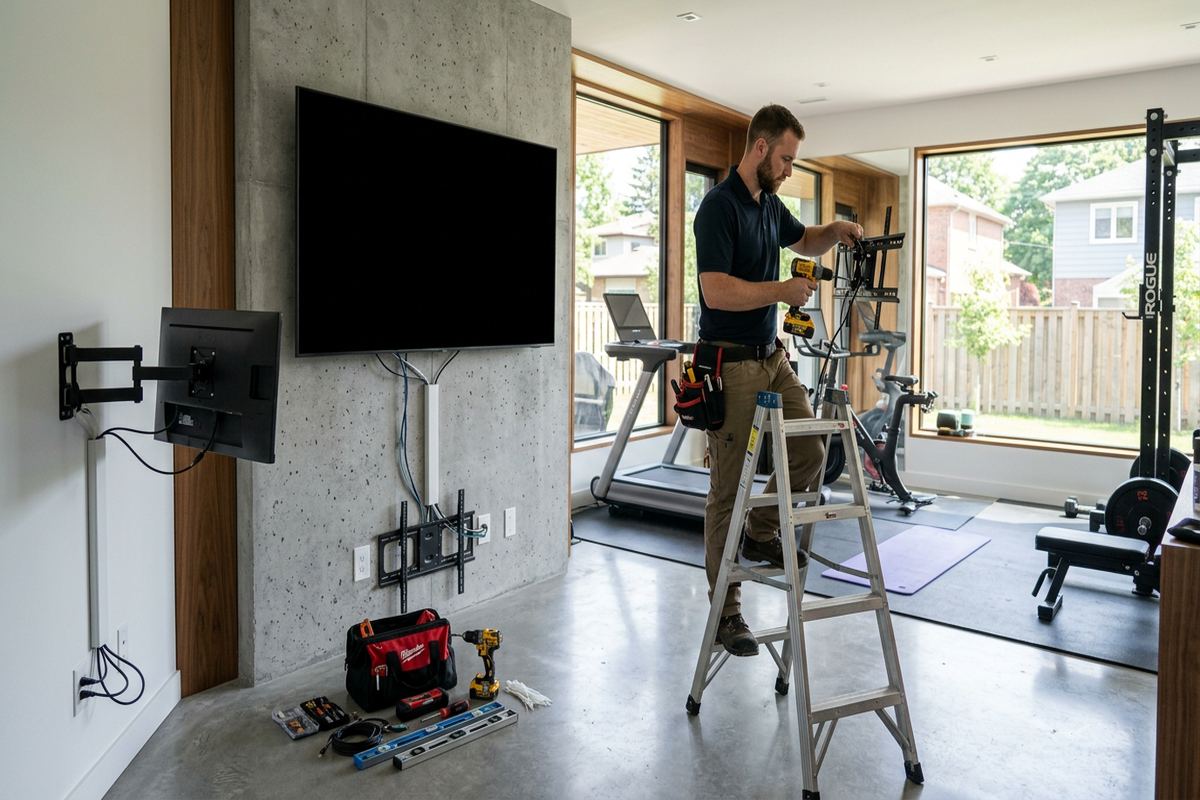
Multi-display projects require consistent placement and clear records. We can establish reference heights, spacing and orientation while allowing for differences in wall construction. Each cable is labelled at both ends, and source equipment is identified in the as-built record. On-site configuration can confirm input selection, network connectivity and basic content playback, but content creation and third-party subscriptions are included only when stated in writing. One accountable contractor manages the defined mounting, low-voltage cabling, configuration and handover, reducing gaps between separate installers.
- Storefront and service-counter displays
- Digital signage screen mounting
- Public-area tamper considerations
- Consistent multi-screen alignment
- Labelled commercial cable routes
Approvals, Access and Installation Preparation
Permission should be confirmed before drilling in a rented, managed or shared property. Tenants may need written landlord approval, while condominium owners can face rules concerning common elements, exterior walls, sound transmission and work hours. UnifiedLink can provide a proposed equipment and cable-routing scope for review, but the customer remains responsible for securing property approvals unless the written scope states otherwise. This step is particularly important for exterior displays, masonry penetrations and routes crossing shared spaces. Work proceeds only after the required access and permissions are available.
Preparation keeps the installation focused and protects nearby belongings. The display, remote, stand components and customer-supplied mount should be available for inspection, along with any source devices to be connected. Furniture and fragile items need enough clearance for safe handling. If the site is a seasonal home, arrangements should include reliable property access and confirmation that power and internet service are active when configuration is requested. Parking, loading restrictions, elevator booking and permitted work hours should be shared before the appointment.
Photographs can support early discussion but do not replace an on-site assessment when wall structure or cable routing is uncertain. We may ask for screen model information, wall dimensions and images of the room to identify obvious constraints. Final pricing follows the assessment and written scope rather than assumptions based only on television size. Requests sent during business hours are answered the same day, while after-hours requests are answered the next business day. Site assessment timing depends on the requested service and travel distance.
- Landlord or condominium approval confirmed
- Display model and mount available
- Furniture cleared around work area
- Power and internet active for setup
- Site assessment before pricing
Testing and Handover for Fort Erie Installations
Installation is not complete when the screen is simply hanging on the wall. We confirm that retaining hardware is engaged, the display is stable and any permitted movement operates without cable strain. Connected sources are tested through the intended inputs, and audio is checked through the television, soundbar or receiver included in the scope. Network-connected features are verified using the customer’s service and credentials. Exterior projects also receive a visible review of penetrations, fittings and cable entries before the work area is cleaned.
During handover, the customer is shown how to select sources, use the mount safely and access connected equipment. Full-motion screens should be moved from the frame or approved handling points rather than pulled by a corner. We explain any limits involving tilt, extension, cable slack or nearby furniture. For Fort Erie seasonal properties, the discussion can include manufacturer-based shutdown and storage steps. Business users can identify who will control settings and content devices, helping prevent accidental input changes or loss of access credentials.
The final record reflects what was actually installed. It identifies equipment placement, labelled low-voltage routes, relevant configuration details, exclusions and equipment ownership. Warranty information in the written scope separates installer workmanship from manufacturer coverage and customer-supplied products. If conditions required an approved change during installation, that change is documented rather than left as an informal decision. This practical closeout gives homeowners, property managers and businesses a reference for future renovations, troubleshooting or display replacement without relying on memory or hidden, unlabelled cabling.
- Mount stability and movement checked
- Inputs, audio and network tested
- Operating limits explained
- Work area cleaned after installation
- As-built record supplied
Fort Erie neighbourhoods we cover
- Bridgeburg
- Crystal Beach
- Ridgeway
- Stevensville
- Douglastown
TV wall mounting in Fort Erie — common questions
Can you mount a TV on brick or concrete?
Yes, provided the masonry is sound and suitable for the proposed load. Fort Erie properties can include brick, block and poured concrete surfaces, each requiring different anchors and drilling methods. We inspect the substrate before pricing and confirm whether the finish, mortar condition or wall construction creates any limitations. Full-motion mounts may require a different approach because they apply greater leverage than fixed brackets.
Can you hide the TV cables inside the wall?
Often, but the available route depends on framing, insulation, fire blocking, masonry and nearby services. We use continuous labelled low-voltage cable runs where in-wall routing is suitable. Television power cords and ordinary extension cords are not concealed in wall cavities. If a receptacle is needed behind the display, electrical work should be completed by the appropriate contractor. Surface raceway is available when concealed routing is impractical.
Do you install televisions above fireplaces?
A fireplace installation is considered only after reviewing the appliance requirements, heat exposure, mantle depth, wall construction and viewing height. Some Fort Erie rooms have limited wall space, but that does not make every fireplace location appropriate. We do not override fireplace or television manufacturer clearances. If the position is too hot, too high or difficult to cable safely, we will explain practical alternatives.
Can you mount an outdoor TV at my seasonal home?
Yes, when the equipment and mounting location are suitable for exterior use. Lakefront and seasonal conditions around Fort Erie require weather-rated displays, mounts, connectors and related gear. We assess moisture exposure, sunlight, wind, freeze-thaw conditions, wall penetrations and cable entry points. Covered areas still need exterior-rated components. Handover can also include manufacturer-based shutdown and inspection guidance for periods when the property is unoccupied.
Do I need landlord or condo approval?
Possibly. Fort Erie tenants should obtain landlord permission before permanent wall fastening or concealed cabling. Condominium rules may also apply to exterior walls, common elements, work hours and cable routes. We can provide a written proposed scope for approval, including equipment placement and expected routing. Unless otherwise stated in writing, the customer is responsible for obtaining permissions and arranging building access before installation begins.
Will you connect my streaming devices and soundbar?
Connected-device setup can be included in the written scope. We can attach or place compatible soundbars, connect HDMI or audio cables, select inputs, test playback and connect supported equipment to the customer’s network. Configuration uses credentials controlled by the customer, not an installer-owned account. At handover, we demonstrate basic operation and identify labelled cables so devices can be serviced or replaced later.
Coverage in Fort Erie is confirmed against the address before we quote. See everything we install in Fort Erie or the province-wide tv wall mounting page.