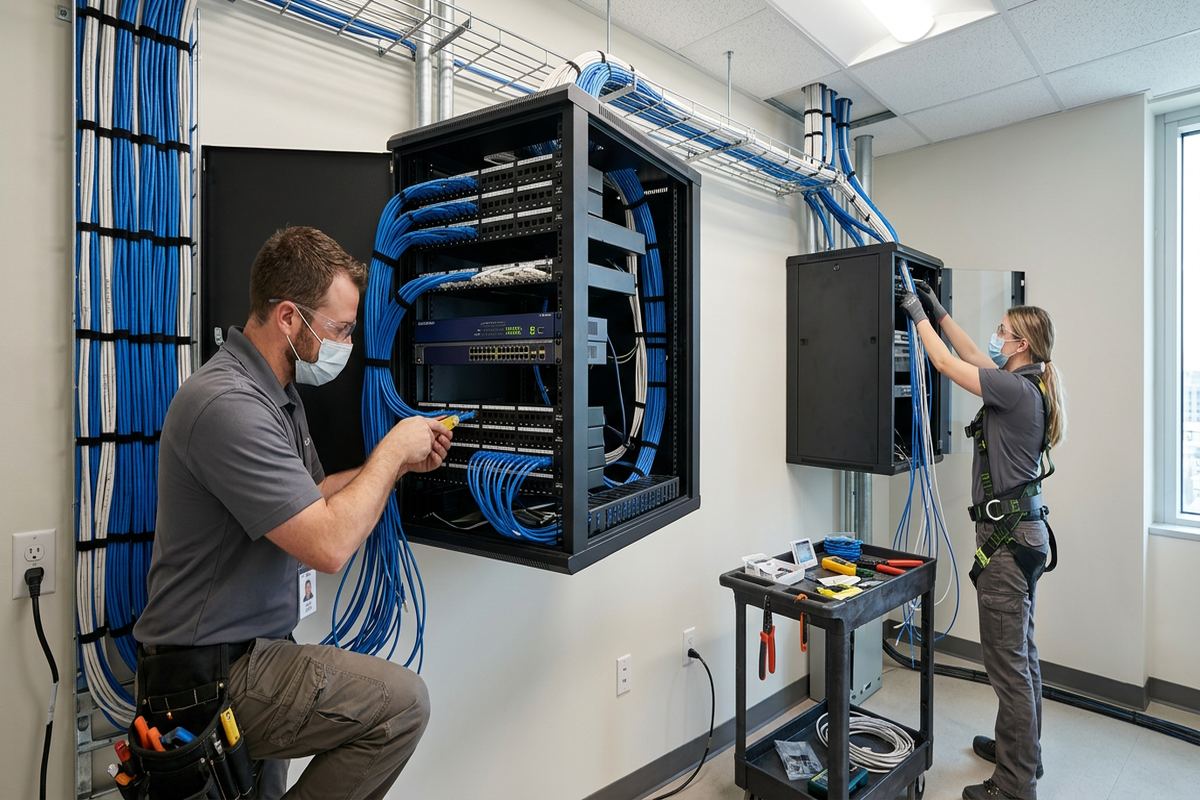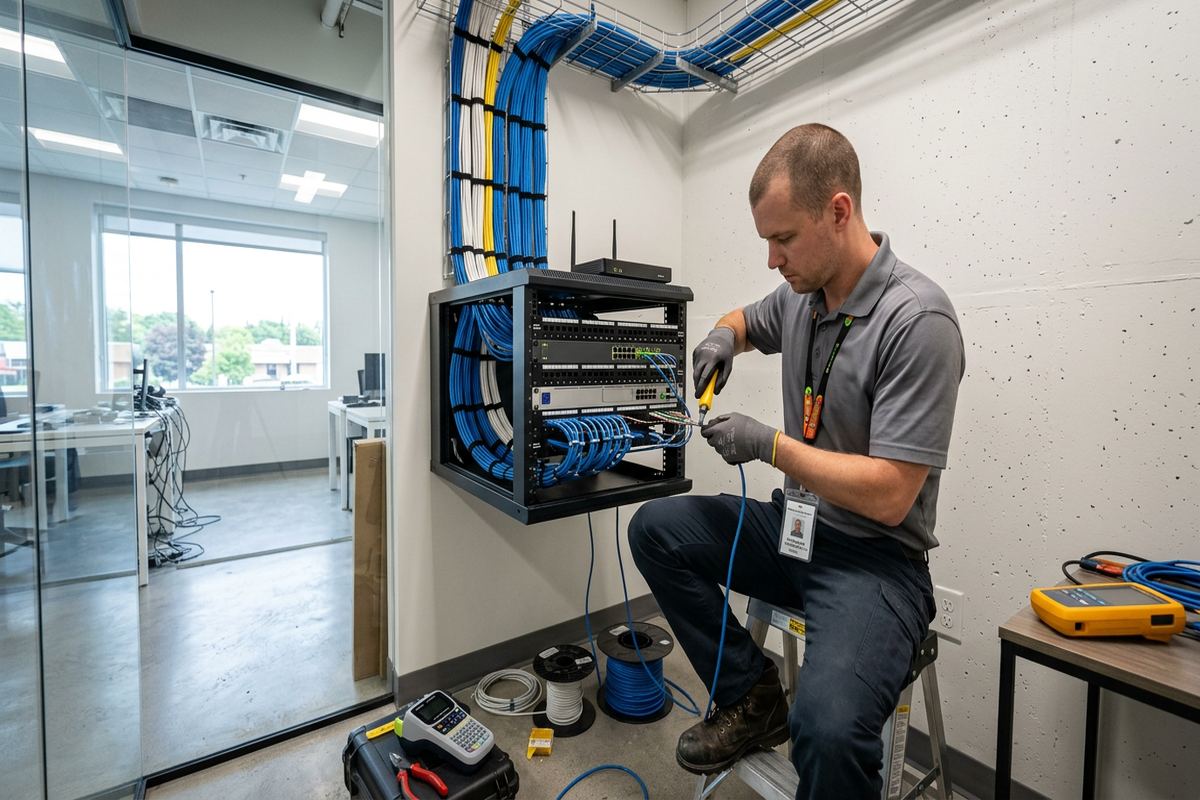
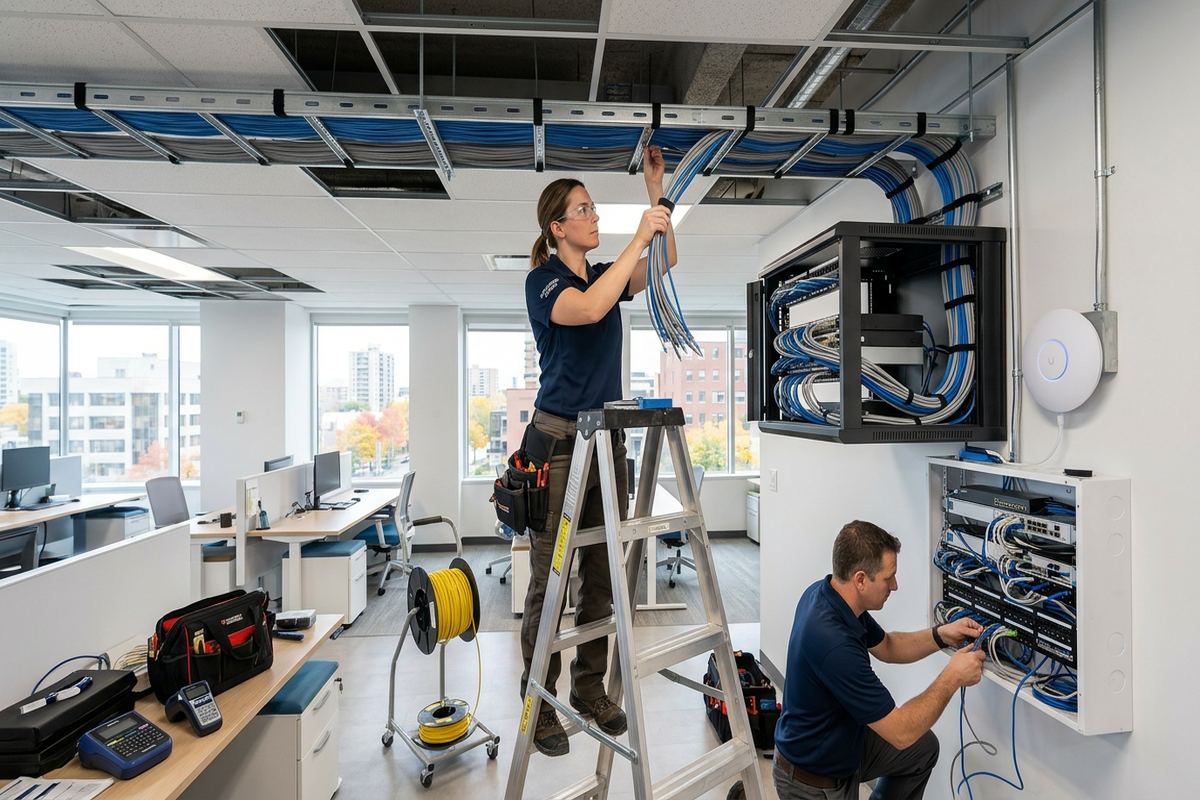
UnifiedLink installs structured cabling, network racks, switches and business Wi-Fi for commercial properties in Fort Erie. Each project begins with a site assessment and a written scope covering equipment, cable routes, device locations, exclusions, ownership and warranty. Installation includes labelled cable runs, on-site configuration and practical handover documentation.
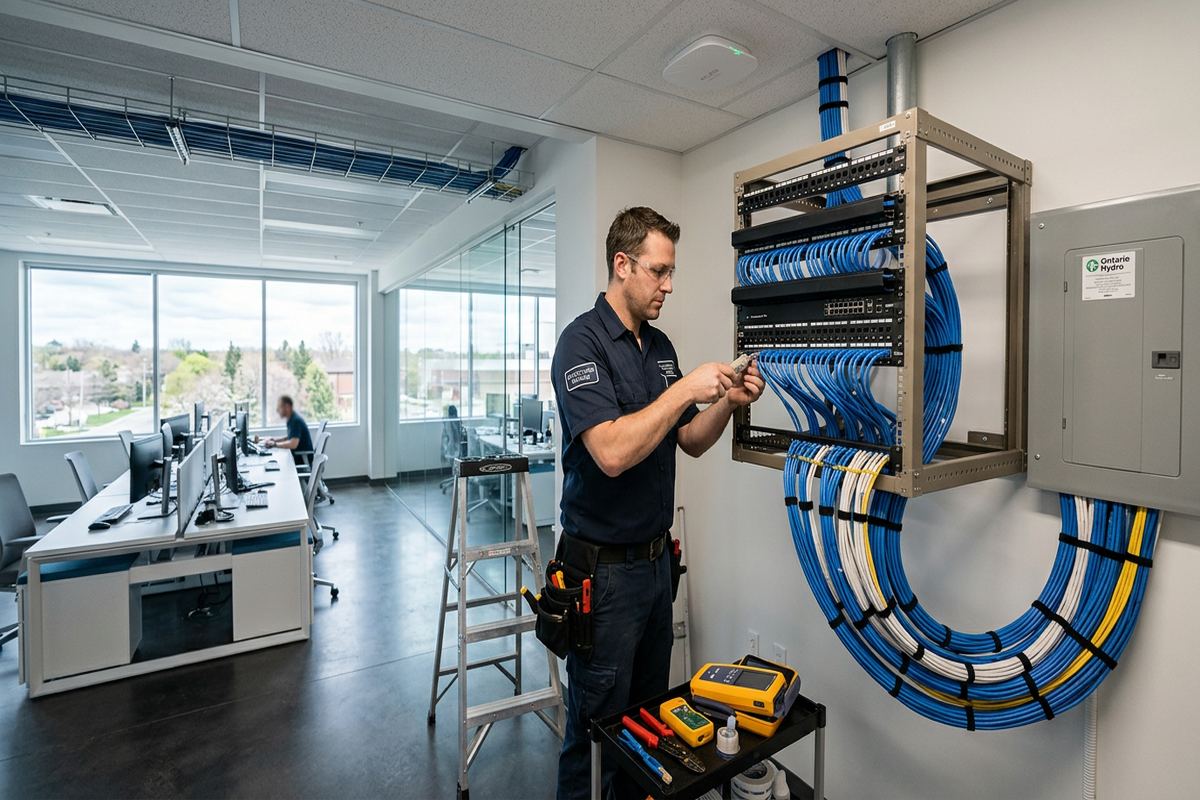
Commercial Network Installation for Fort Erie Properties
A commercial network must support daily operations without becoming difficult to trace, expand or repair. UnifiedLink plans and installs structured cabling, network racks, switches, wireless access points and related infrastructure for Fort Erie offices, shops, restaurants, warehouses and mixed-use properties. The design considers the number of users, connected devices, internet service location, building layout and expected growth. Rather than placing equipment wherever a cable happens to reach, we establish sensible distribution points and routes. This creates an organized physical network that can support computers, phones, payment terminals, cameras, access control and other connected systems.
Fort Erie properties vary widely, from older masonry storefronts in Bridgeburg to frame buildings, commercial strips and industrial units elsewhere in the municipality. Those differences affect drilling methods, cable support, pathway selection and access point placement. Thick masonry can weaken wireless signals, while additions and renovated interiors often hide interrupted pathways or mixed construction. A site assessment identifies these conditions before pricing. We then prepare a written scope that defines equipment, cable routes, device placement, exclusions, equipment ownership and warranty, reducing uncertainty before installation begins and giving property stakeholders a clear basis for approval.
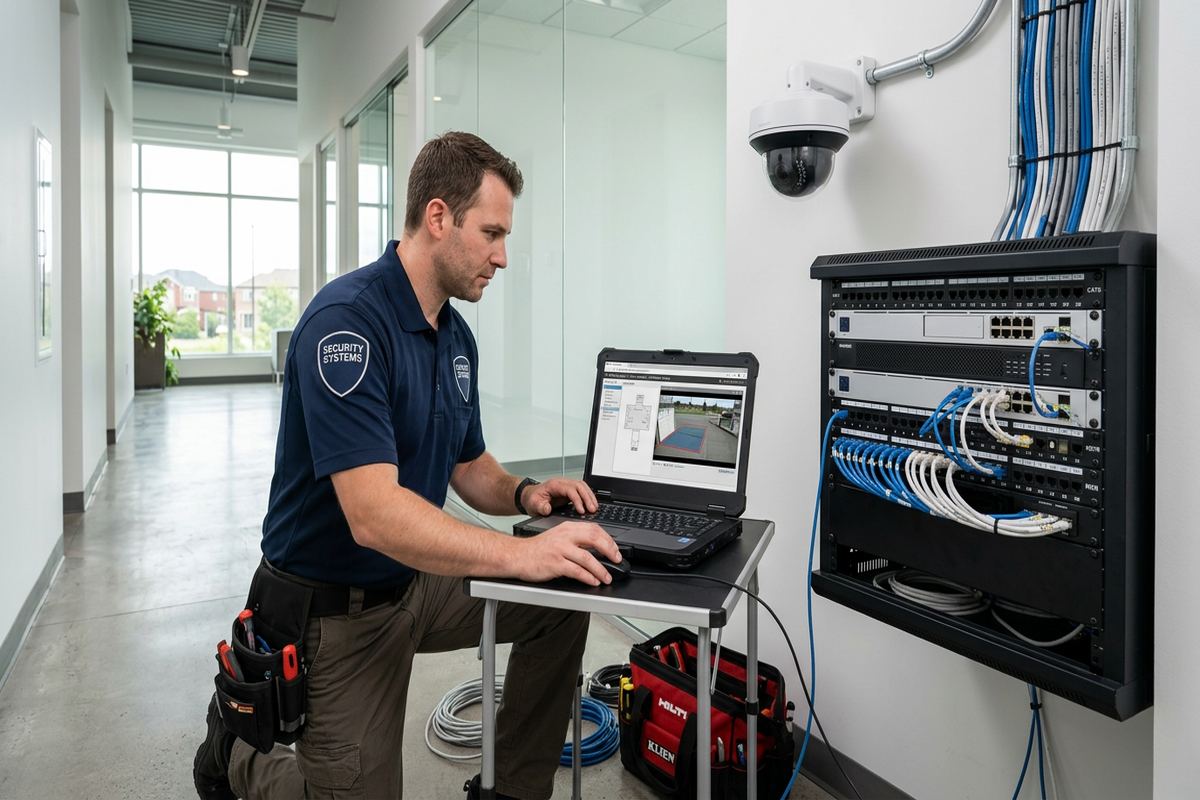
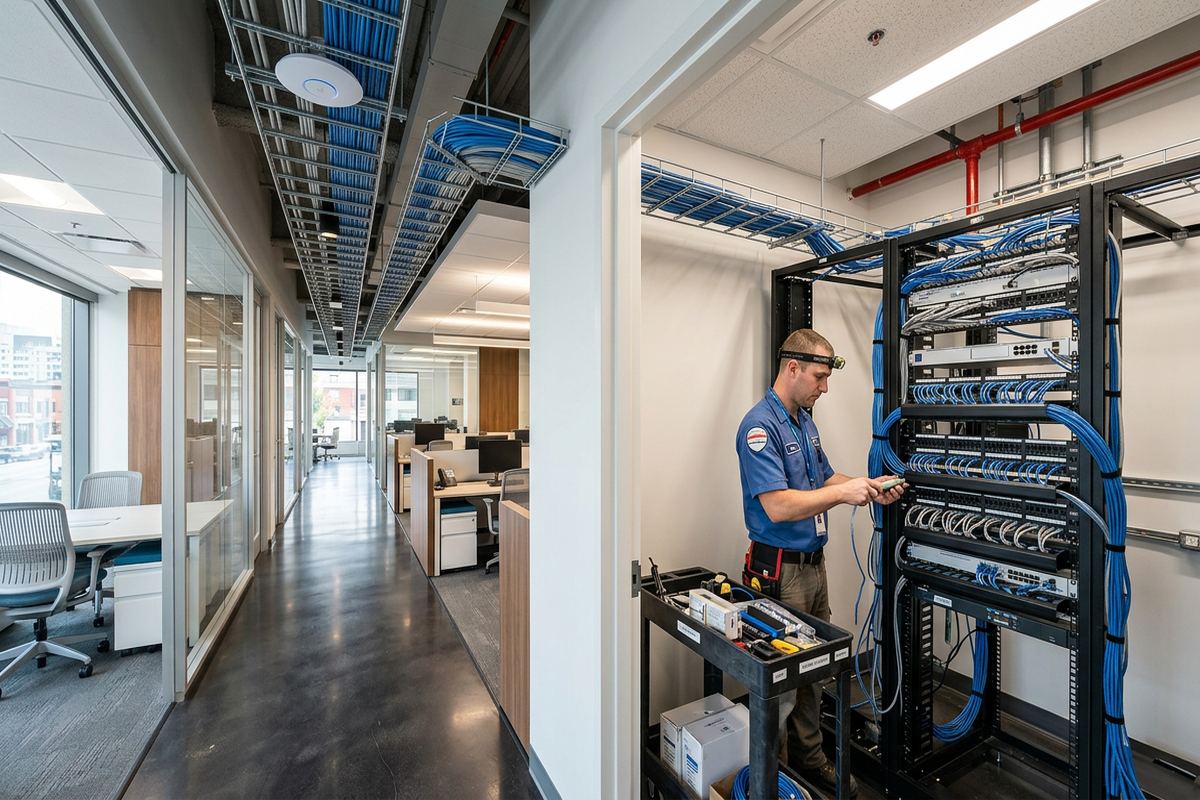
One accountable contractor can handle the cabling, rack assembly, network hardware installation, wireless configuration and handover. This avoids gaps between separate trades when a connection fails or a planned location proves unsuitable. Continuous labelled cable runs are installed between approved endpoints and the network rack or cabinet, with routing chosen to protect the cable and preserve service access. Following installation, UnifiedLink completes on-site configuration within the agreed scope. The customer receives control through their own credentials, along with an as-built record showing installed devices, cable identifiers and relevant network details for future maintenance.
- Structured copper and fibre cabling
- Network rack and cabinet installation
- Managed switch installation and configuration
- Business Wi-Fi access point deployment
- Testing, labelling and as-built documentation
Planning a Fort Erie Business Network
Good network planning begins with what the business actually needs to connect. A small professional office may prioritize reliable workstations, voice services and secure staff Wi-Fi, while a retail or hospitality property may also require payment terminals, guest access, digital displays and surveillance traffic. We document current equipment, likely additions and operational priorities before proposing outlets or hardware. This helps separate essential connections from optional improvements. It also prevents the common mistake of designing only for today’s desk count when ceiling devices, printers, cameras, controllers and building systems may require additional switch capacity or dedicated network segmentation later.
Internet service equipment is only one part of the network. The modem or provider handoff must connect to a suitable router, switches, patch panels and wireless system, all located where power, ventilation and service access are reasonable. In Fort Erie, the best rack location may not be the room where the internet provider originally entered the building. Long improvised patch cords, crowded utility spaces and inaccessible shelves make troubleshooting harder. During assessment, we review the demarcation point, available pathways and possible rack locations, then identify whether the provider handoff should remain, be extended or be coordinated separately.
Network capacity is planned around endpoint count, bandwidth needs, power requirements and physical distances. Power over Ethernet can supply compatible access points, phones, cameras and controllers, but the switch must have enough power budget and suitable ports. Copper runs must also remain within applicable channel limitations, so larger or spread-out properties may need intermediate distribution or fibre links. The written scope records these decisions instead of leaving them to installation day. Where future phases are expected, spare rack space, pathways or cable capacity can be included deliberately rather than assumed without confirming their practical value.
- Endpoint and device inventory
- Internet handoff and rack planning
- PoE capacity review
- Copper distance and fibre assessment
- Allowance for practical expansion
Structured Cabling and Network Racks
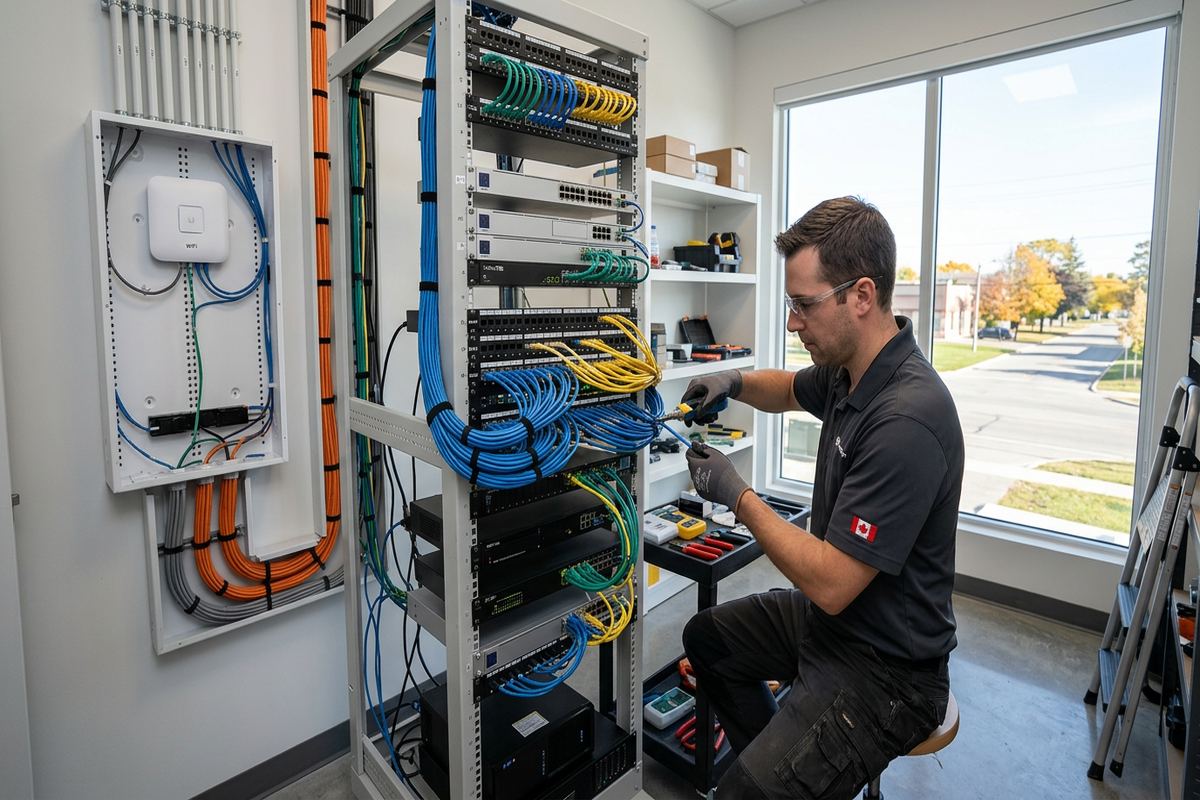
Structured cabling provides permanent, predictable links between network equipment and device locations. UnifiedLink installs continuous labelled runs rather than joining short cable sections behind walls or above ceilings. Each approved run terminates at an appropriate outlet, patch panel or device endpoint, and identifiers are kept consistent at both ends. Cable routes are selected to avoid unnecessary exposure, sharp bends and interference from electrical equipment. Where existing pathways can be reused safely, they may reduce disruption. Where they cannot, the scope can include new supports, surface raceway, conduit coordination or another suitable route based on the building.
Rack organization matters because even a working network becomes costly to manage when patch cords, power supplies and switches are piled together. We plan cabinets and racks around equipment depth, ventilation, patching, power and access for servicing. Wall-mounted cabinets can suit smaller offices or retail spaces, while floor-standing racks may be more appropriate for larger installations. Patch panels provide a fixed termination point for horizontal cabling, and shorter patch cords connect those ports to switches. Clear labelling links rack ports to rooms and devices, allowing future technicians or property staff to identify connections without tracing every cable manually.
Older buildings around Bridgeburg and Ridgeway can include masonry walls, finished ceilings, narrow basements and renovations completed at different times. Newer frame construction may offer easier cavities but still requires careful routing around insulation, vapour barriers and finished surfaces. We do not assume that drawings reflect accessible conditions. The assessment checks representative routes and identifies areas where concealed obstructions may require an alternate approach. Any landlord, condominium or property-management approvals remain part of project planning, especially where routes cross common spaces, penetrate exterior walls or affect shared telecommunications rooms and base-building infrastructure.
- Continuous point-to-point cable runs
- Patch panels with matching labels
- Wall-mounted or floor-standing racks
- Cable supports and pathway planning
- Serviceable patch cord organization
Fort Erie, Ontario
Commercial network installation in Fort Erie, scoped in writing first
Book a site assessment and get equipment, routes, exclusions, and warranty on paper before anything is installed.
Business Wi-Fi Design in Fort Erie
Reliable business Wi-Fi depends on access point placement, not simply purchasing a powerful router. Walls, shelving, coolers, machinery, neighbouring networks and the number of active devices all influence coverage and capacity. UnifiedLink reviews the usable floor area, construction materials and likely device locations before selecting mounting points. Ceiling-mounted access points often provide more even coverage than equipment placed inside an office or mechanical room. Where a property has several distinct areas, multiple coordinated access points can distribute demand and maintain consistent settings without relying on consumer extenders that create separate, difficult-to-manage wireless zones.
Fort Erie commercial properties may need separate wireless access for staff, guests, payment systems or operational devices. Those uses should not automatically share the same network permissions. When supported by the selected router, firewall and switches, network separation can limit unnecessary access between device groups. Guest access can be isolated from internal resources, while managed devices can use their own defined network. Configuration details depend on the equipment and business requirements, so they are documented in the scope. Handover uses the customer’s own administrative credentials rather than leaving long-term control tied to an installer’s personal account.
Outdoor and semi-outdoor coverage requires equipment selected for the environment. Border-adjacent businesses, lakefront properties and seasonal homes make weather-rated exterior gear a standard consideration in Fort Erie. Exterior access points need suitable temperature and moisture ratings, secure mounting and carefully sealed cable entries. Freeze-thaw cycles can open poorly sealed penetrations, while wind-driven rain can reach connections mounted under shallow overhangs. We evaluate the proposed mounting surface, cable approach, drip path and service access. Indoor equipment is not placed outside merely because it is sheltered from direct rainfall, and exterior coverage expectations are defined before installation.
- Planned access point locations
- Staff and guest network separation
- PoE-powered access points
- Weather-rated exterior wireless equipment
- Customer-controlled administration credentials
Exterior Cabling and Local Building Conditions
Exterior network work in Fort Erie must account for winter temperatures, moisture, ultraviolet exposure and repeated freeze-thaw movement. Cable, fittings, junction points and equipment housings are selected according to where they will operate. An exterior-rated cable does not remove the need for proper support or sealing, and indoor cable should not be exposed along a wall or roofline. Penetrations are positioned to reduce water entry and sealed using methods suitable for the substrate. A downward cable approach or drip loop may be used where appropriate, helping keep water from following the cable toward a connector or building opening.
Mounting methods differ between masonry and frame construction. Brick, block and poured concrete require suitable anchors and careful drilling to avoid damaged faces, joints or concealed services. Frame walls may provide simpler fastening locations, but cladding, drainage planes and vapour control layers must still be considered. On lakefront or exposed sites, wind can place additional stress on projecting equipment and loosely supported cable. We choose mounting positions that balance network performance with physical protection and future service access. The written scope identifies notable exterior work so the customer can review visible routes and device locations before installation.
Seasonal properties and detached buildings around Crystal Beach or Stevensville may sit unused for periods or have network equipment in spaces with changing temperature and humidity. Hardware should be located in an environment allowed by its operating specifications, with stable power and reasonable ventilation. A detached office, workshop or outbuilding may require a buried or aerial pathway, but that route must be assessed rather than assumed. Fibre can be useful between buildings because it supports longer links and avoids a conductive copper connection. Pathway ownership, excavation, permits and electrical coordination are identified as applicable project considerations.
- Exterior-rated cable and enclosures
- Sealed building penetrations
- Masonry-appropriate anchors and drilling
- Freeze-thaw and moisture planning
- Fibre options between buildings
Network Switching, Segmentation and Configuration
Switch selection affects how many devices can connect, how much power is available and which management features the network can use. A basic unmanaged switch may be adequate in a limited installation, but commercial environments often benefit from managed switching, network monitoring and virtual LAN support. UnifiedLink matches switch port count and PoE capacity to documented endpoints, including reasonable allowance where approved. Uplink speeds and switch locations are considered where many devices share a connection. Equipment is mounted and patched so indicator lights, ports and power connections remain accessible instead of being buried behind unrelated hardware or loose cabling.
Segmentation can separate business systems according to function and access requirements. Office computers, guest Wi-Fi, payment devices, cameras and building controls may each have different communication needs. Virtual LANs and firewall rules can provide that separation when the router, switches and wireless platform support it. These controls are not applied from a generic template without understanding required services, since excessive restrictions can interrupt printing, casting, cloud access or device discovery. During configuration, we confirm the agreed network groups and essential connections. More specialized cybersecurity policy, compliance review or managed monitoring can be identified separately when outside the installation scope.
Handover is designed to leave the Fort Erie property owner or authorized business representative in control. Administrative accounts are established with the customer’s own credentials, and temporary access used for installation is removed or addressed as agreed. The as-built record identifies installed hardware, cable references, access point locations and relevant configuration details without publishing sensitive passwords unnecessarily. Staff can also be shown basic restart, connection and escalation procedures included in the scope. This documentation is particularly useful for landlords, multi-unit operators and seasonal properties where the person arranging service may not be present whenever future work occurs.
- Managed and unmanaged switch options
- PoE port and power budgeting
- VLAN-capable network design
- On-site device configuration
- Customer credentials and as-built records
Installation in Active Fort Erie Workplaces
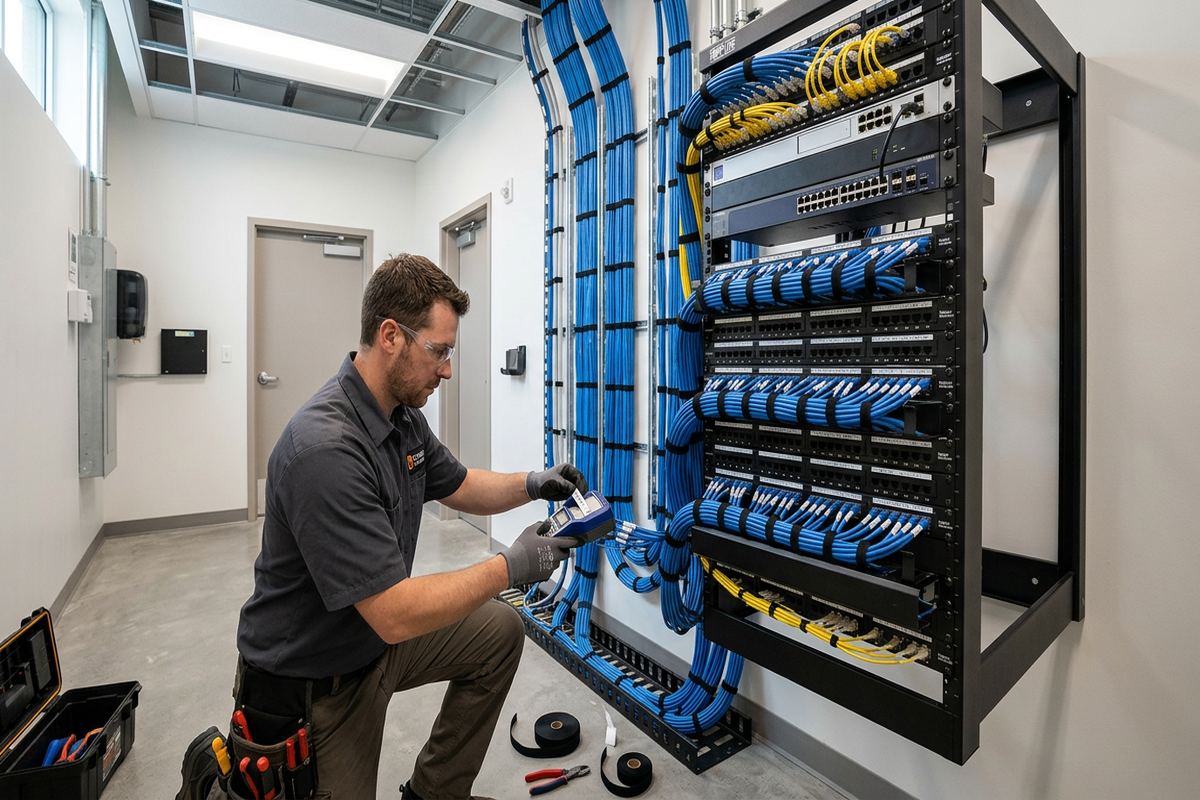
Commercial network work often takes place while a business remains operational. Before installation, we review access windows, occupied areas, ceiling restrictions, noise-sensitive activities and any equipment that cannot be disconnected without coordination. Retail spaces may need work planned around customer traffic, while offices may require staged outlet changes by room. Industrial units can introduce lift access, high ceilings, machinery and restricted zones. The scope identifies known constraints and responsibilities so work can proceed in a controlled sequence. Any shutdown or service interruption needed for cutover is discussed rather than introduced without notice during normal operations.
Tenant improvements require clear authorization. A business leasing space may control its computers and network equipment but not have permission to drill masonry, enter shared ceiling areas or mount devices on the exterior. Condo commercial units can have similar restrictions involving common elements and telecommunications rooms. UnifiedLink can provide route and placement information for the customer to submit to a landlord, condominium corporation or property manager. Approval remains necessary before affected work proceeds. This helps prevent a technically sound installation from conflicting with lease conditions, appearance standards, fire separations or access policies maintained by the property owner.
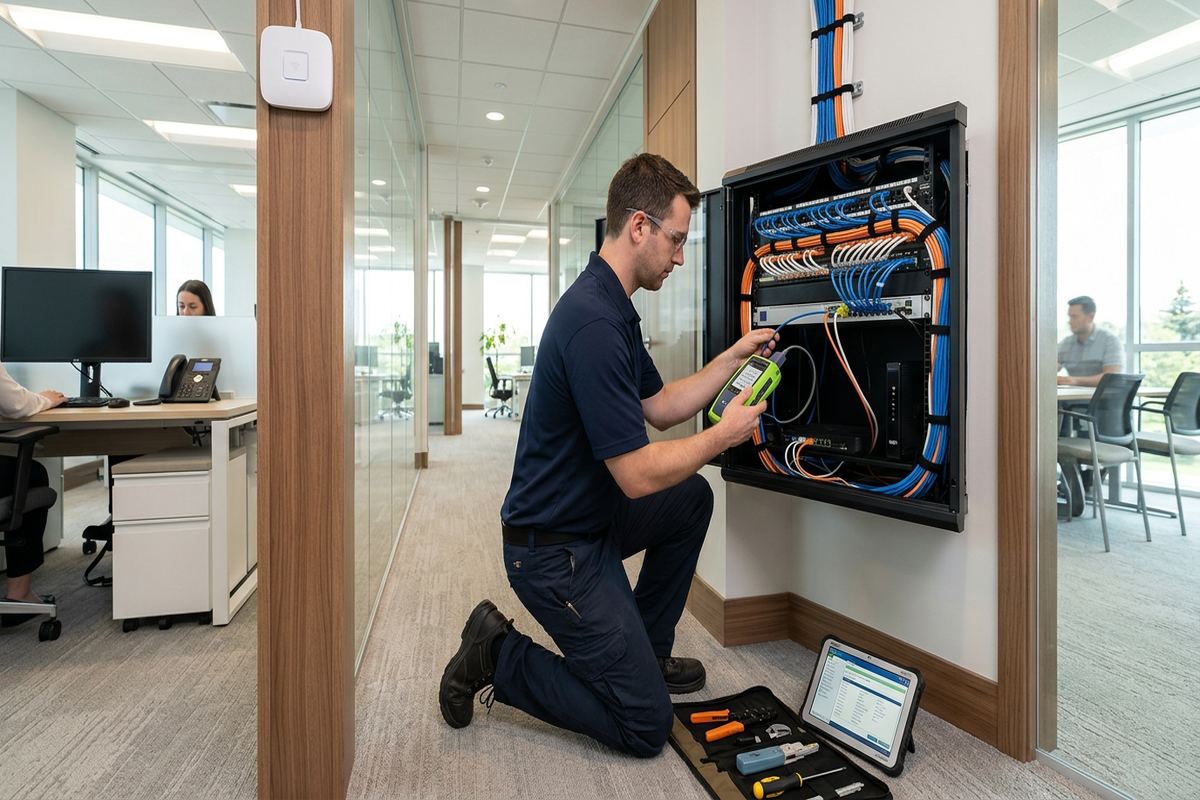
Testing occurs after termination and again as devices are connected. Cable verification helps identify wiring faults, split pairs or incorrect labels before they become operational problems. Network testing then confirms that agreed endpoints receive the intended connection and, where applicable, PoE. Wireless checks review access point operation and practical coverage in the defined areas, although performance also depends on client devices, internet service and changing radio conditions. Deficiencies within the installation scope are addressed before handover. Existing equipment or cabling that limits results is documented so the customer can decide whether replacement or a separate remediation phase is appropriate.
- Work sequencing for occupied premises
- Planned network cutovers
- Landlord and condo approval support
- Cable and endpoint verification
- Documented existing-system limitations
Commercial Network Upgrades Across Fort Erie
Not every Fort Erie project requires a complete replacement. An existing network may have usable cabling, cabinets or access points alongside undocumented additions and obsolete hardware. We assess what is present, identify visible condition and test relevant links before recommending reuse. Keeping suitable infrastructure can limit disruption, but reuse should be based on evidence rather than appearance alone. Old cable categories, damaged terminations, crowded pathways or unknown intermediate joins may restrict performance. The written scope distinguishes retained equipment from new work and states any exclusions, helping the customer understand which existing components remain outside the installer’s ownership or warranty.
Growth can be handled in phases when the underlying design supports it. A business might begin with a rack cleanup and critical cable replacements, then add managed switching, improved Wi-Fi or links to another area. Commercial strips and subdivided industrial units around Fort Erie often change layouts as tenants move or operations expand. Clearly labelled backbone routes and patch panels make those changes easier to plan. Douglastown properties and sites farther from the main commercial areas may also need travel and access considered when arranging assessment. Site assessment timing depends on the service and travel distance, rather than a fixed universal appointment promise.
To start, the customer can provide the property address, business type, approximate floor area, current concerns and a list of systems that need network access. Photos of the communications area can help establish context, but they do not replace an on-site assessment where routes and construction must be confirmed. Requests sent during business hours are answered the same day, while after-hours requests are answered the next business day. After assessment, UnifiedLink provides pricing with a written scope covering equipment, routes, locations, exclusions, ownership and warranty. This gives the Fort Erie customer a defined installation plan before work is authorized.
- Assessment of reusable infrastructure
- Rack cleanup and cable remediation
- Phased network upgrade planning
- Defined exclusions and equipment ownership
- Site assessment before pricing
Fort Erie neighbourhoods we cover
- Bridgeburg
- Crystal Beach
- Ridgeway
- Stevensville
- Douglastown
Commercial network installation in Fort Erie — common questions
Do you install networks in older Fort Erie buildings?
Yes. Older masonry and renovated buildings require route planning before drilling or pricing. We assess wall construction, ceiling access, existing pathways and the proposed rack location. Where concealed spaces are blocked, the scope may use surface raceway, alternate routes or coordinated conduit. Landlord or property-management approval may be required for penetrations, common areas and exterior mounting.
Can you improve Wi-Fi without replacing everything?
Possibly. We first review the router, switches, cabling, access point locations and current coverage problems. Suitable equipment may remain in service, while weak access points, poor placement or limited switching are addressed selectively. In Fort Erie properties with masonry walls or additions, improving placement and adding wired access points is often more practical than relying on wireless extenders.
What is included in the site assessment?
The assessment reviews the internet handoff, network equipment, proposed rack area, device count, cable routes, construction materials, power availability and wireless coverage needs. Fort Erie exterior conditions are considered where outdoor links or access points are required. Findings are used to prepare a written scope covering equipment, placement, routes, exclusions, ownership and warranty before pricing is finalized.
Can you connect a detached office or outbuilding?
Yes, subject to pathway and distance assessment. Fibre is often considered between buildings because it supports longer links and avoids a conductive copper connection. The route may require existing conduit, a new underground pathway or another approved method. For Fort Erie sites, moisture, freeze-thaw conditions, exterior sealing and weather-rated termination points are included in the planning.
Will we control the network after installation?
Yes. On-site configuration is completed within the agreed scope using credentials owned by the customer. Handover includes an as-built record identifying installed equipment, cable labels and relevant configuration details. UnifiedLink does not leave long-term control dependent on an installer’s personal account. Sensitive passwords can be transferred directly rather than recorded in general project documents.
How quickly can a Fort Erie assessment be arranged?
Requests sent during business hours are answered the same day, and after-hours requests are answered the next business day. The timing of an on-site assessment depends on the service and travel distance. Providing the Fort Erie address, business type, approximate property size, current concerns and photos of the communications area helps establish the project requirements.
Coverage in Fort Erie is confirmed against the address before we quote. See everything we install in Fort Erie or the province-wide commercial network installation page.