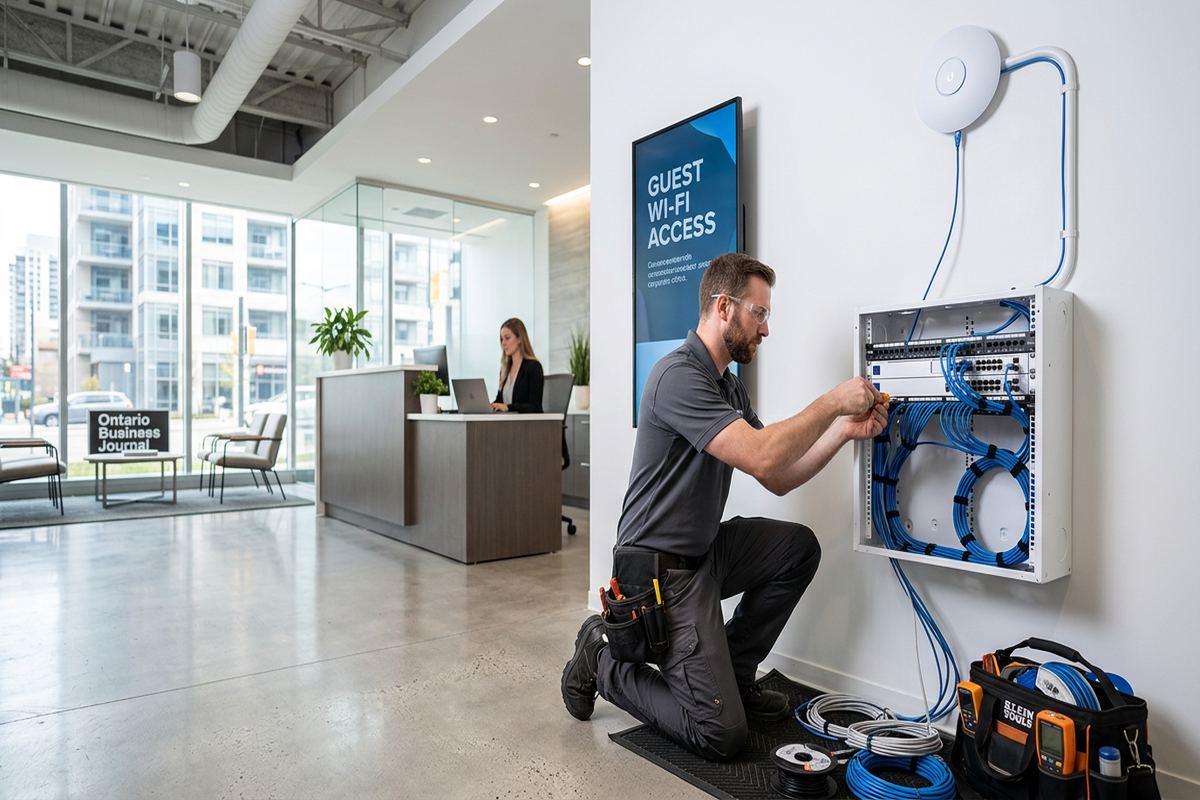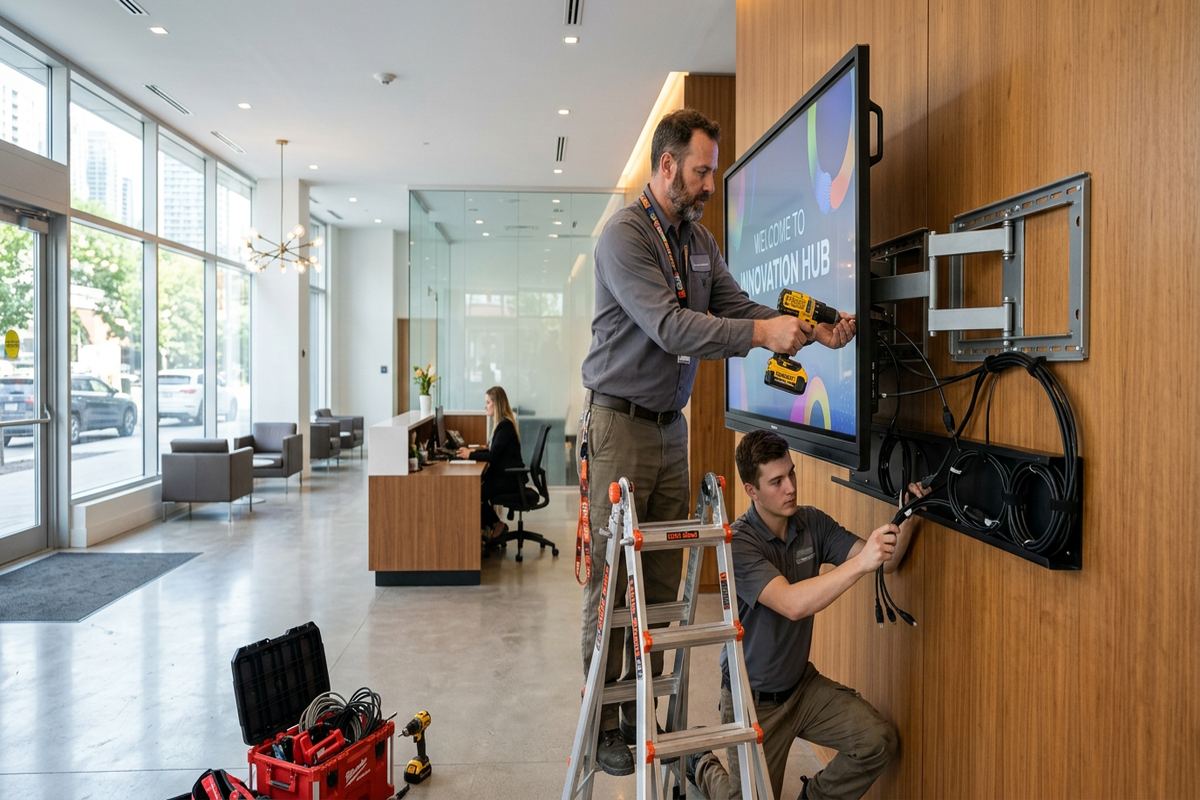
UnifiedLink installs commercial networks for offices, stores, clinics, workshops and mixed-use properties in Cobourg. We plan cable routes, equipment locations, Wi-Fi coverage and network capacity around the building and its operations. Each project starts with a site assessment and proceeds under a written scope, followed by on-site configuration, testing, labelling and documented handover.
Commercial Network Planning for Cobourg Properties
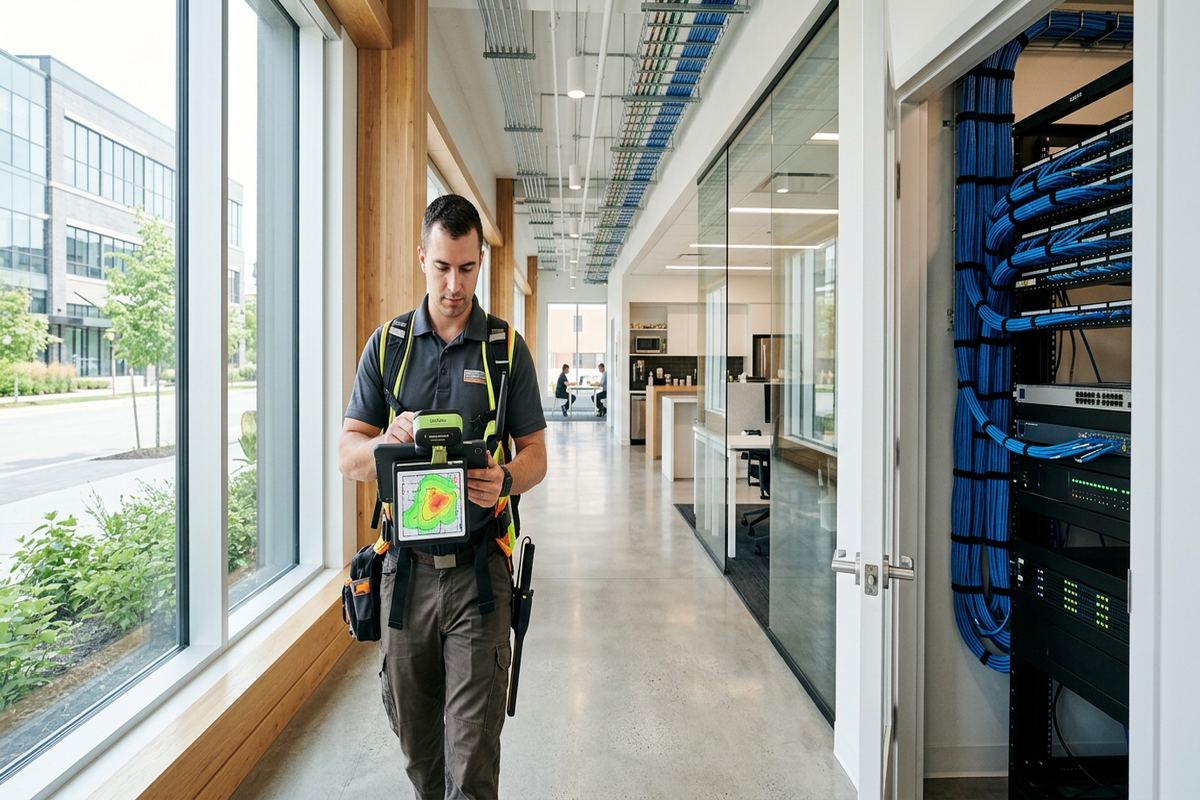
A reliable commercial network begins with understanding how the property is built and how people use it. During a Cobourg site assessment, we review incoming internet service, equipment rooms, workstation locations, wireless coverage needs, building materials and practical cable routes. We also identify systems that may share the network, including payment terminals, phones, cameras, access control, printers and displays. This prevents the installation from being based only on current desk positions while overlooking future devices, bandwidth demands, power requirements or operational areas that are difficult to reach after construction is complete.
Cobourg properties can present very different installation conditions within a short distance. A small Downtown Cobourg business may occupy an older masonry unit with finished ceilings, party walls and limited utility space. An office in New Amherst may have modern frame construction and straightforward pathways, while an industrial unit may need protected routes across open ceilings or warehouse areas. The proposed design accounts for these differences rather than applying one standard layout. Cable type, support method, cabinet placement and wireless access-point locations are selected according to the building, expected network load and access available for maintenance.
Before pricing, UnifiedLink completes a site assessment appropriate to the service and travel distance. The resulting written scope identifies equipment, cable routes, device placement, exclusions, equipment ownership and warranty terms. This gives landlords, tenants, property managers and business owners a clear basis for approval. It also separates included network work from related electrical, internet-provider or construction tasks. Where access above ceilings, wall openings or exterior pathways require permission, those conditions are documented before installation. A defined scope reduces assumptions and helps keep the completed network consistent with the approved plan.
- Assessment of internet entry points and existing infrastructure
- Network design based on users, devices and applications
- Defined cable routes, outlet positions and equipment locations
- Written exclusions, ownership details and warranty terms
- Planning for future ports and wireless capacity
Structured Cabling Installation in Cobourg
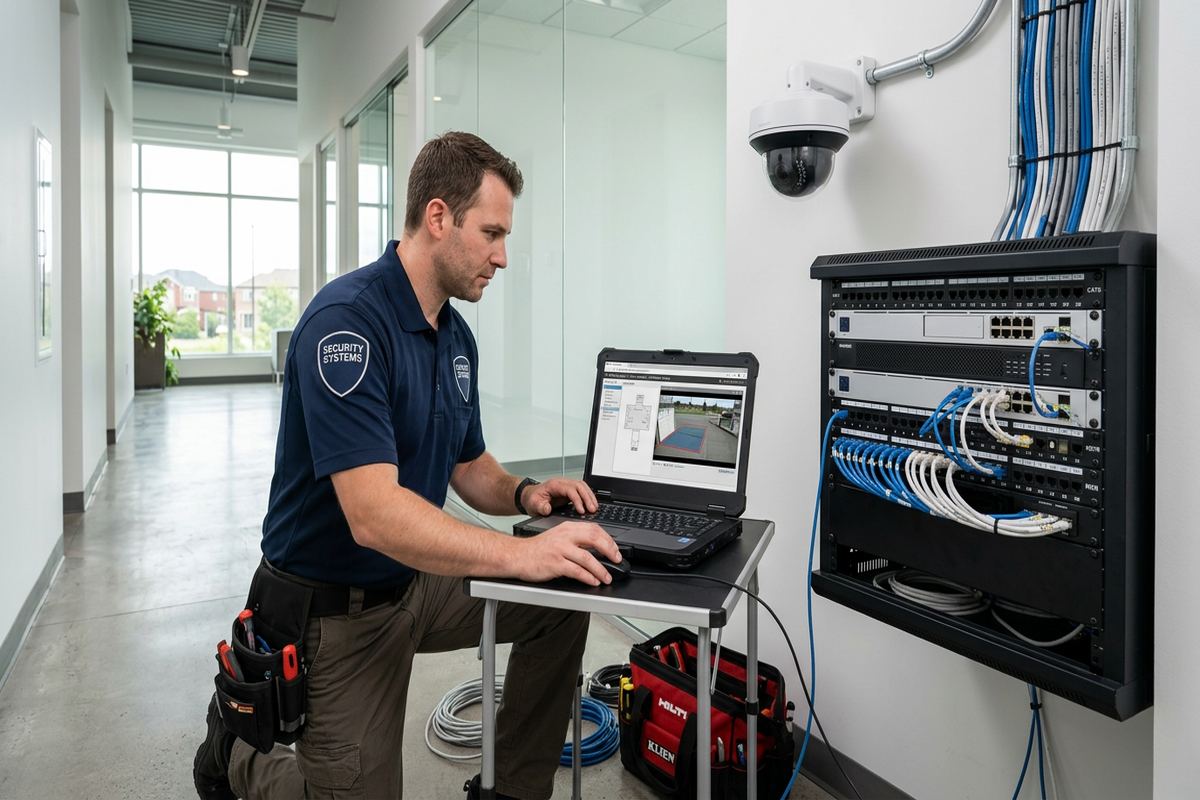
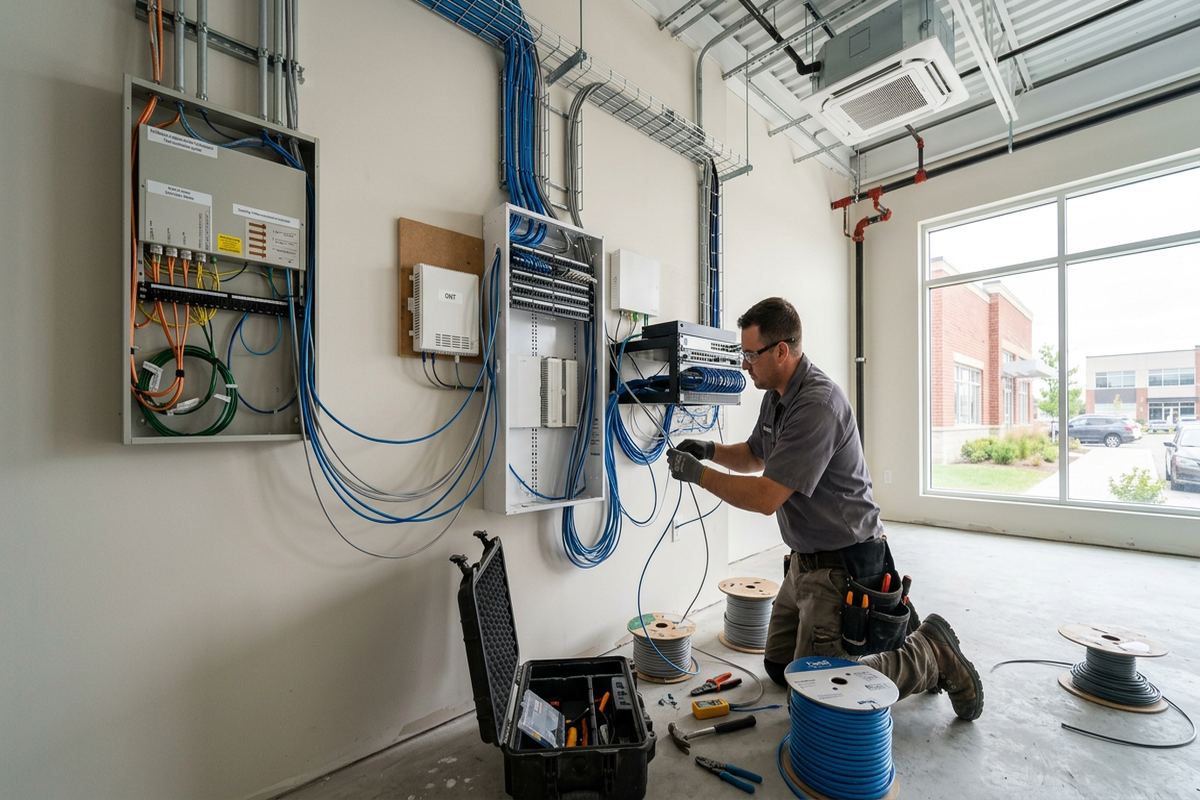
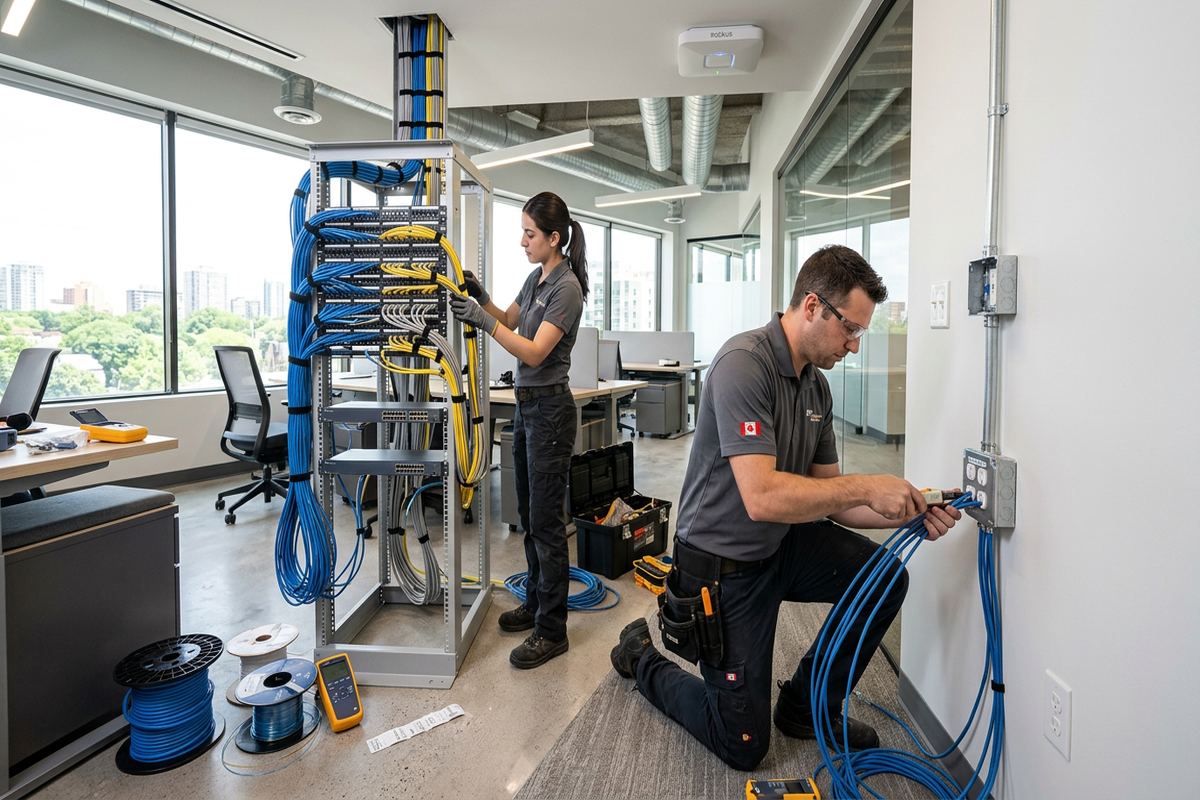
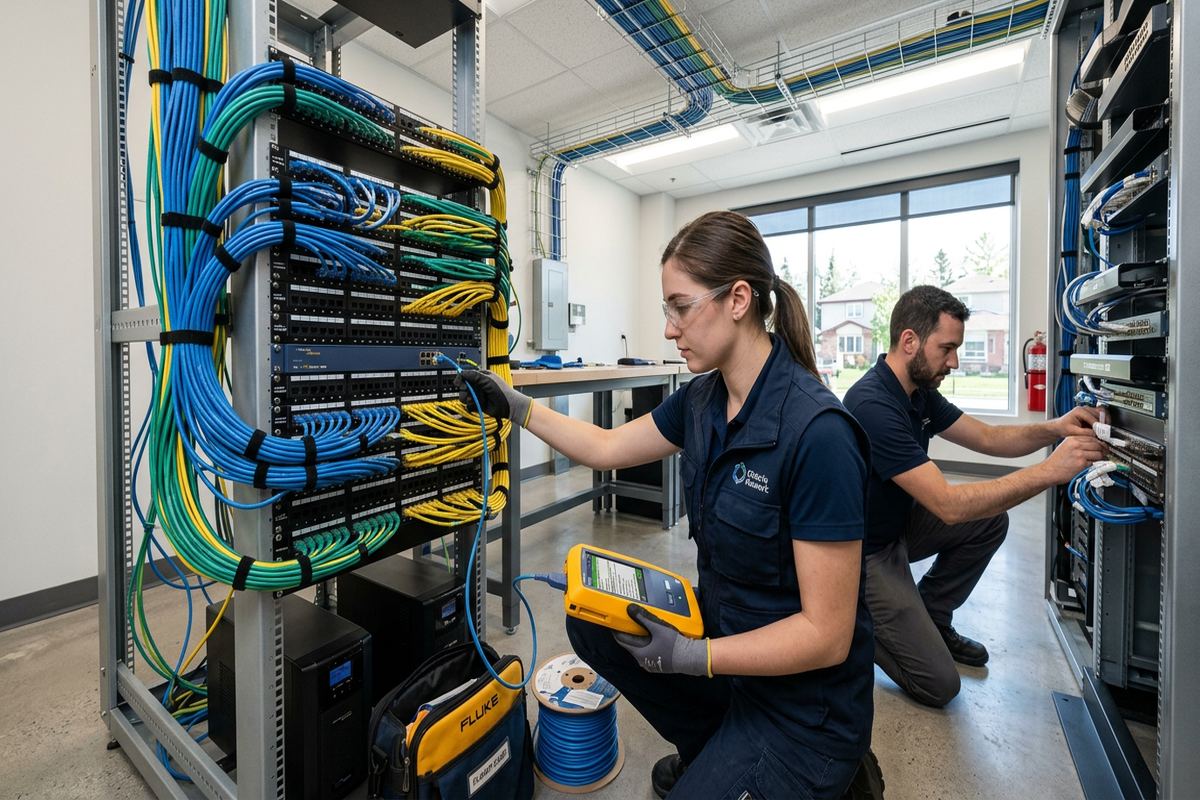
Structured cabling provides the fixed foundation connecting desks, access points, phones, printers, cameras and other network devices. We install continuous labelled cable runs from the communications area to each approved outlet or device location, avoiding hidden joins that complicate testing and repair. Routes are supported and separated from electrical wiring where required, with suitable pathways through ceilings, walls, surface raceway or conduit. At the rack or cabinet, cables are terminated in an orderly patching system. At user locations, clearly identified jacks make changes easier for staff, service providers and future contractors.
Older Cobourg buildings often require more care than open, recently constructed commercial space. Masonry walls may not provide usable cavities, while decorative trim, plaster finishes or heritage features can make conventional concealed routing inappropriate. Near Cobourg Beach and in established downtown properties, reversible surface raceway or carefully selected service routes may preserve finished surfaces while still producing a maintainable installation. Frame construction may permit concealed runs, but insulation, fire blocking and previous renovations still need consideration. We discuss visible components before work begins rather than making unapproved openings or assuming every wall can be fished safely.
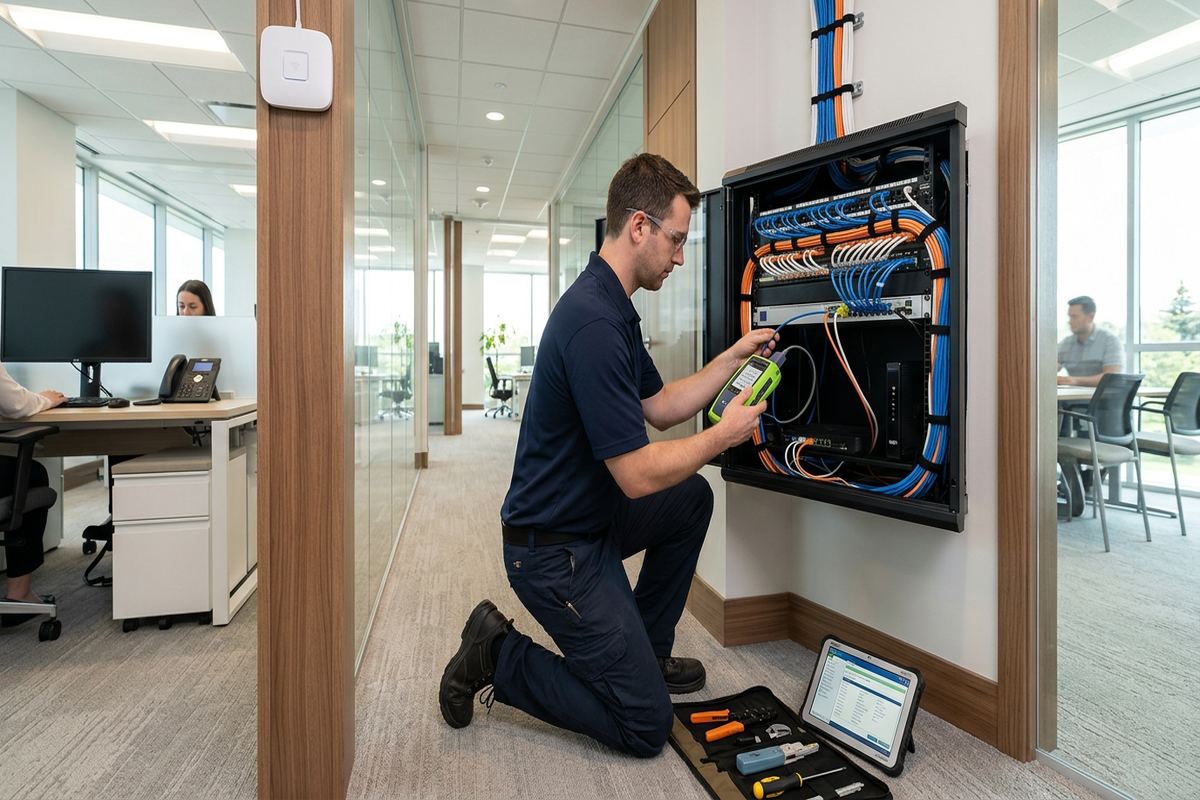
Every installed run is labelled at both ends and tested for continuity and wiring performance appropriate to the installed cabling. Patch panels, outlets and device cables use matching identifiers so a disconnected workstation or access point can be traced without guessing. Where an existing network is being expanded, we inspect accessible terminations and distinguish retained cabling from new work in the records. Cabling that is damaged, poorly routed or unsuitable for the intended application is identified during assessment. Replacement recommendations are based on observed conditions and project requirements, not an automatic assumption that all existing cable must be removed.
- Continuous cable runs without concealed intermediate joins
- Matching labels at outlets, panels and device locations
- Organized patch panels, racks and communications cabinets
- Testing of newly installed data runs
- Surface raceway options for sensitive finished areas
Wi-Fi Design for Cobourg Workplaces
Commercial Wi-Fi should be designed around usable coverage, device density and building materials rather than the advertised range of a single access point. In Cobourg offices and retail spaces, we review where staff, customers, scanners, tablets and wireless equipment actually operate. Access points are positioned to reduce dead areas and excessive overlap while keeping mounting and future servicing practical. Masonry partitions, metal shelving, utility rooms, concrete floors and neighbouring wireless networks can all affect performance. The design may separate staff, guest and operational devices where the selected equipment and business requirements support that arrangement.
A long commercial unit on a downtown strip rarely behaves like an open square office. Thick dividing walls can weaken signals between the storefront, rear office, storage area and upper floor. Industrial units create different challenges because high racking, machinery and wide spaces influence access-point placement. We plan wired connections to access points so coverage is not dependent on repeating a weak wireless signal. When a business occupies only part of a building, equipment locations also consider landlord-controlled areas, shared utility spaces and the approvals needed before mounting devices or routing cable beyond the leased premises.
On-site configuration includes the agreed wireless names, security settings, network separation and access-point adoption into the selected management platform. Administrator access is handed over using the customer’s own credentials rather than retained under an installer-only account. We verify operation in the intended areas and document access-point locations for future reference. Wi-Fi performance still depends on the internet service, client devices, interference and changing occupancy, so those dependencies are explained at handover. If later adjustments are likely because furniture, shelving or tenancy layouts are changing, the design can include practical options for expansion.
- Access-point placement based on building layout
- Wired backhaul for stable commercial Wi-Fi
- Separate staff and guest networks where supported
- Customer-controlled wireless administration credentials
- Coverage checks in occupied work areas
Cobourg, Ontario
Commercial network installation in Cobourg, scoped in writing first
Book a site assessment and get equipment, routes, exclusions, and warranty on paper before anything is installed.
Network Racks, Switching and Power in Cobourg
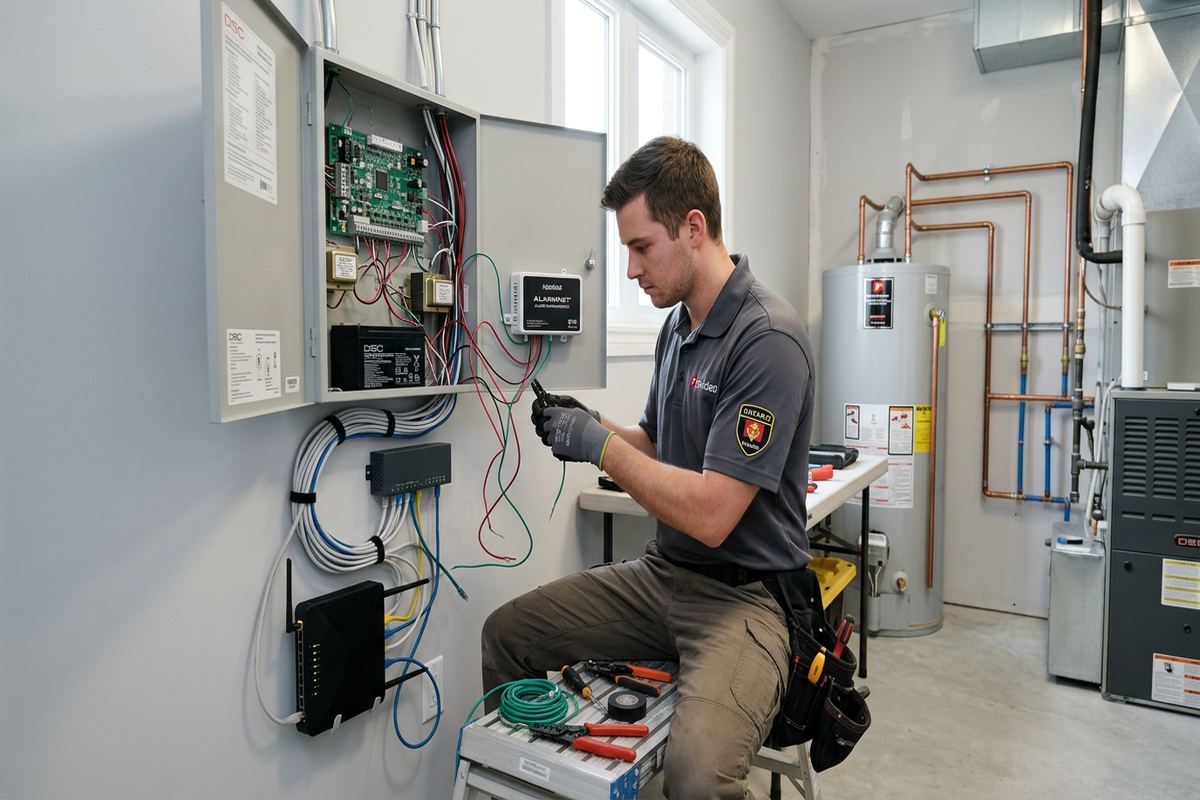
Network equipment needs a location that is secure, ventilated and accessible without interfering with daily work. We assess wall space, cabinet depth, cable entry, available electrical service and clearance for maintenance before selecting a rack or enclosure. Placing equipment above a sink, beside heating equipment or inside an overcrowded storage area can shorten service life and make troubleshooting difficult. For Cobourg businesses with limited back-room space, a compact wall cabinet may be appropriate; larger offices or industrial units may require a floor rack with room for switching, patching and future additions.
Switch selection is based on the required port count, expected traffic and devices needing Power over Ethernet. Wireless access points, phones, security cameras and access-control components may all draw power from network switches, but their combined requirements must remain within the available power budget. We document which ports serve key devices and organize patch leads so changes do not disturb unrelated connections. Where managed features are included, configuration can cover network segmentation, port settings and agreed management access. The final arrangement is intended to be understandable to the customer and maintainable by another qualified technician if needed.
Network continuity can also depend on power quality and shutdown planning. A suitable uninterruptible power supply may support the router, switch and other critical network components during brief interruptions, but its capacity and runtime must match the connected load. Cobourg winters can bring conditions that affect utility service, so equipment placement should avoid damp basements, unconditioned spaces and locations exposed to temperature swings. We identify power dependencies during assessment and coordinate any required receptacle work with the appropriate electrical trade. Low-voltage installation does not replace electrical work where a new supply or circuit is required.
- Rack and cabinet layouts planned before installation
- Switch sizing based on ports and power demand
- Orderly patching with identifiable device connections
- UPS planning for selected network equipment
- Coordination of electrical requirements where necessary
Exterior and Multi-Building Network Links
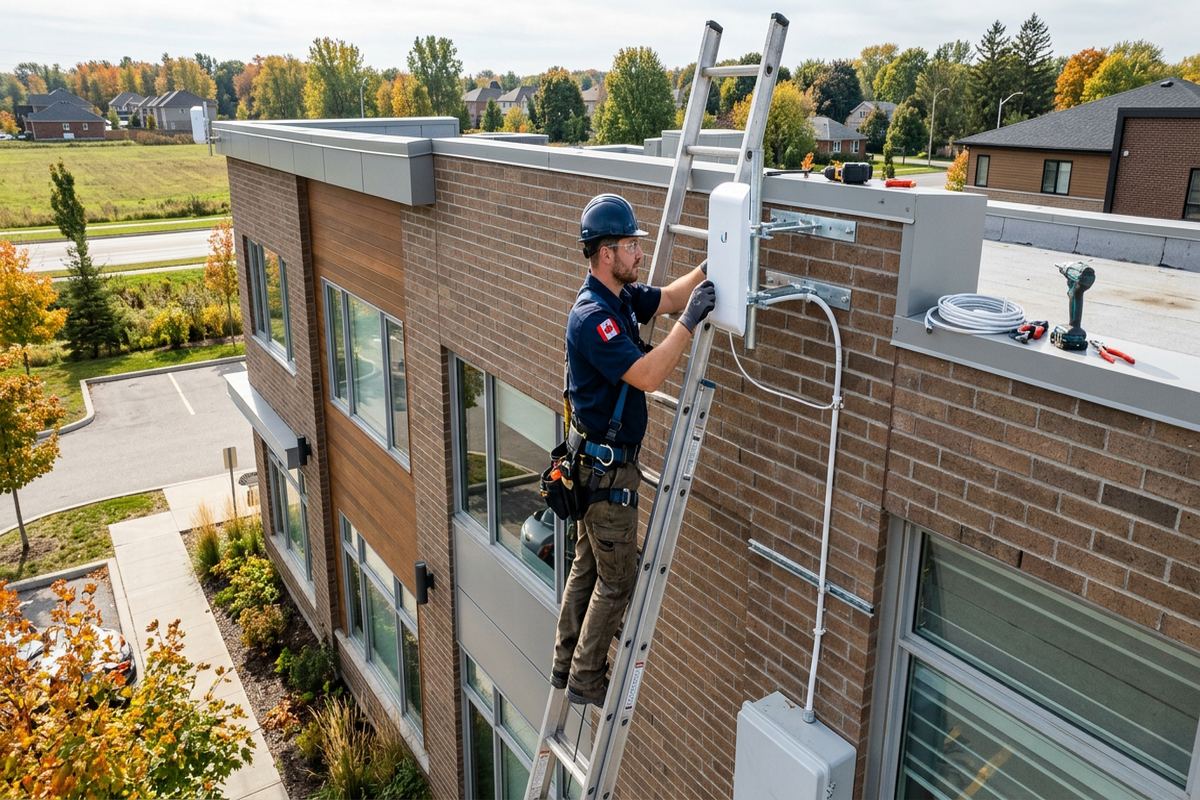
Some Cobourg properties require connectivity to a detached office, workshop, gate, storage building or exterior device. These links need more planning than running indoor cable through an outside wall. We review distance, available pathways, grounding considerations, electrical separation and whether fibre, protected copper or a point-to-point wireless bridge is appropriate. Outdoor cable and enclosures must be rated for the environment, and penetrations need proper sealing. The route should avoid locations where snow clearing, vehicles, landscaping work or building maintenance could damage exposed cable after the installation has been completed.
Freeze-thaw cycles can open poorly sealed penetrations and allow moisture into walls, conduits or equipment boxes. Exterior mounting in Cobourg therefore requires compatible sealants, drip control and entry points that do not direct water toward the building interior. Cable should be supported without relying on temporary clips or loose spans, and service loops must not become water traps. Near the lake, exposed locations can also experience wind-driven precipitation. We select mounting methods according to the wall surface, whether brick, block, siding or frame construction, and discuss visible exterior hardware before drilling begins.
A wireless building-to-building link requires a clear and stable path between properly mounted radios. Trees, vehicles, seasonal foliage and future construction can affect that path, so convenience alone should not determine mounting height. Fibre may be preferable where electrical isolation, distance or interference is a concern, provided a suitable protected route is available. For leased commercial sites, exterior work may require written landlord or condominium approval before equipment is attached. The project scope records who is responsible for permissions, pathways and any related restoration, preventing exterior assumptions from delaying the installation after equipment has been ordered.
- Outdoor-rated cable, enclosures and mounting hardware
- Sealed penetrations designed for freeze-thaw conditions
- Fibre and wireless bridge options between buildings
- Routes protected from vehicles and snow clearing
- Approval planning for leased or condominium properties
Network Upgrades and Office Changes in Cobourg
A network upgrade does not always require replacing everything already installed. We begin by identifying the internet handoff, router, switches, wireless access points, patch panels and accessible cabling, then compare them with current operational needs. Common issues include unmanaged switch chains, unidentified outlets, consumer wireless equipment, exhausted port capacity and devices connected through temporary cords. In a Cobourg office renovation or tenant change, retained equipment can be documented and integrated where it remains suitable. Components that create a clear limitation or maintenance problem are listed separately so the customer can make an informed decision.
Business moves require coordination between the old location, new premises, internet provider and internal technology systems. We can prepare cabling, racks and access points before desks and equipment arrive, subject to site access and construction progress. Downtown Cobourg units may have restricted delivery or work areas, while spaces in West Park or East Village may involve shared buildings, landlord rules or finished residential-style construction. The network plan should account for these conditions early. Internet-provider activation dates remain separate from the internal installation, so responsibilities and dependencies are recorded in the scope rather than treated as one combined task.
Renovations also create an opportunity to add pathways before walls and ceilings are closed. We coordinate outlet locations with furniture plans, reception counters, meeting-room displays, ceiling-mounted access points and equipment that may later connect to the network. If work occurs in stages, temporary connections are kept distinct from the finished cabling plan. Abandoned cable is addressed according to the approved scope and accessible site conditions. At completion, labels and records reflect the final arrangement rather than an earlier drawing that changed during construction. This keeps future troubleshooting tied to what was actually installed in the Cobourg property.
- Assessment of reusable cabling and network equipment
- Replacement of unmanaged or improvised network layouts
- Coordination for moves, renovations and tenant changes
- Pre-wire planning before finishes are installed
- Final records updated to match site changes
Network Security and Business System Segmentation
Commercial networks often carry more than ordinary computer traffic. Payment terminals, voice systems, cameras, access control, building controls and guest devices may all use the same physical switching infrastructure. Keeping every device on one unrestricted network can make management and troubleshooting harder. Where supported by the selected router, firewall and switches, we configure separate logical networks based on the approved design. This can limit unnecessary communication between device groups while preserving required access. Segmentation requirements should be confirmed with the customer’s IT provider, payment processor or application vendor before settings are finalized.
UnifiedLink does not assume control of customer accounts or keep undisclosed administrator access. Routers, switches, wireless platforms and other managed components are configured on site using agreed settings, then handed over with the customer’s own credentials. If an external IT company manages computers, servers, cloud services or cybersecurity policies, we coordinate demarcation points and required network details with that provider. The written scope clarifies which party supplies addressing, firewall rules, remote access or application-specific settings. Clear responsibility is particularly important for small Cobourg businesses that use several vendors for internet, phones, payments and business software.
Physical organization supports network security as well. A locked cabinet can limit casual access to patching and reset buttons, while clear labels reduce the chance that critical equipment is disconnected during unrelated work. Management interfaces should not be exposed unnecessarily, and default credentials should be replaced where the equipment permits. Firmware and ongoing security maintenance remain subject to the equipment, support arrangement and customer responsibilities stated in the scope. At handover, we explain the installed layout and identify systems that require continuing administration. Network installation provides infrastructure, but it does not replace broader cybersecurity planning, endpoint protection or staff policies.
- Logical separation for agreed device groups
- Customer-owned administrator accounts and credentials
- Coordination with IT and application vendors
- Secure placement of managed network equipment
- Documented responsibility for ongoing administration
Testing and Handover for Cobourg Installations
Installation is completed with checks covering the work included in the scope. New data runs are tested and matched to their labels, network equipment is powered and configured, and connected devices are verified where access and vendor requirements permit. Wireless service is checked in the intended operating areas rather than only beside the access point. Any limitations involving the internet provider, customer hardware or third-party applications are identified separately. For a Cobourg shop, office or industrial unit, this process provides a practical record of what was installed, what was observed and what remains outside the network contractor’s responsibility.
The handover includes the customer’s own administrator credentials and an as-built record showing the completed network arrangement. Depending on the project, the record may identify outlet numbers, patch-panel positions, access-point locations, switch connections, equipment models and relevant network names. Changes made during installation are reflected in the final information rather than left only in field notes. We also review basic restart and support boundaries with the designated customer contact. Equipment ownership and warranty terms follow the written scope, reducing uncertainty when a landlord, tenant, internet provider or IT company later needs access to the installation.
Using one accountable contractor for assessment, cabling, equipment mounting, configuration and handover reduces gaps between separate low-voltage trades. It does not eliminate the need for internet-provider, electrical, construction or IT work where those services are required, but it keeps the network installation under one defined scope. Requests sent during business hours are answered the same day, while after-hours requests are answered the next business day. Site assessment timing depends on the service and travel distance. Cobourg customers receive the proposed next step after the request and initial project details have been reviewed.
- Testing tied to the approved installation scope
- As-built record of outlets and network equipment
- Customer credentials supplied at handover
- Equipment ownership and warranty terms documented
- One contractor accountable for the network installation
Cobourg neighbourhoods we cover
- Downtown Cobourg
- Cobourg Beach
- New Amherst
- West Park
- East Village
Commercial network installation in Cobourg — common questions
Can you install a network in an older Downtown Cobourg building?
Yes. Older masonry, plaster, decorative woodwork and limited ceiling access require route planning before drilling. We assess concealed and surface-mounted options, including reversible raceway where preserving finishes matters. The written scope identifies proposed routes, visible components and exclusions. Any landlord, heritage-related or building approvals remain subject to the property and planned work, and should be obtained before installation begins.
Do I need landlord or condominium approval?
Approval is often required when work affects common areas, exterior walls, shared communications rooms or parts of a building outside the leased unit. This can apply to Cobourg retail premises, offices, mixed-use buildings and condominium properties. We can provide the planned routes and mounting details for review. The scope will identify who is responsible for obtaining permission before cable installation, drilling or exterior equipment mounting proceeds.
Can you improve Wi-Fi without replacing all cabling?
Possibly. We first inspect the usable cabling, equipment locations and wireless coverage conditions. Existing cable may be retained when it is suitable, accessible and properly terminated. In some Cobourg properties, adding wired access points or relocating existing units solves coverage problems without a complete replacement. The assessment separates reusable infrastructure from components that limit capacity, power delivery, management or reliable operation.
How do Cobourg winters affect exterior network cabling?
Exterior routes must account for moisture, snow, wind and repeated freeze-thaw cycles. We use environment-appropriate cable, enclosures, supports and sealing methods, with penetrations positioned to reduce water entry. Exposed routes are kept away from likely snow-clearing or vehicle contact where practical. Brick, block and siding require different fasteners and sealing details, so the mounting method is selected after reviewing the actual surface.
Will we receive passwords and network documentation?
Yes. Managed equipment included in the project is handed over with the customer’s own credentials rather than an installer-only account. UnifiedLink also provides an as-built record appropriate to the Cobourg installation, identifying completed cable runs, outlets, equipment locations and relevant configuration details. The written scope confirms equipment ownership, warranty terms and any ongoing administration that remains with the customer, IT provider or another vendor.
How quickly will UnifiedLink respond to my request?
Requests sent during business hours are answered the same day. Requests sent after hours are answered the next business day. The timing of a Cobourg site assessment depends on the service required and travel distance. After reviewing basic details such as the property type, number of users, current concerns and desired completion window, we will outline the appropriate next step for assessment and scoping.
Coverage in Cobourg is confirmed against the address before we quote. See everything we install in Cobourg or the province-wide commercial network installation page.