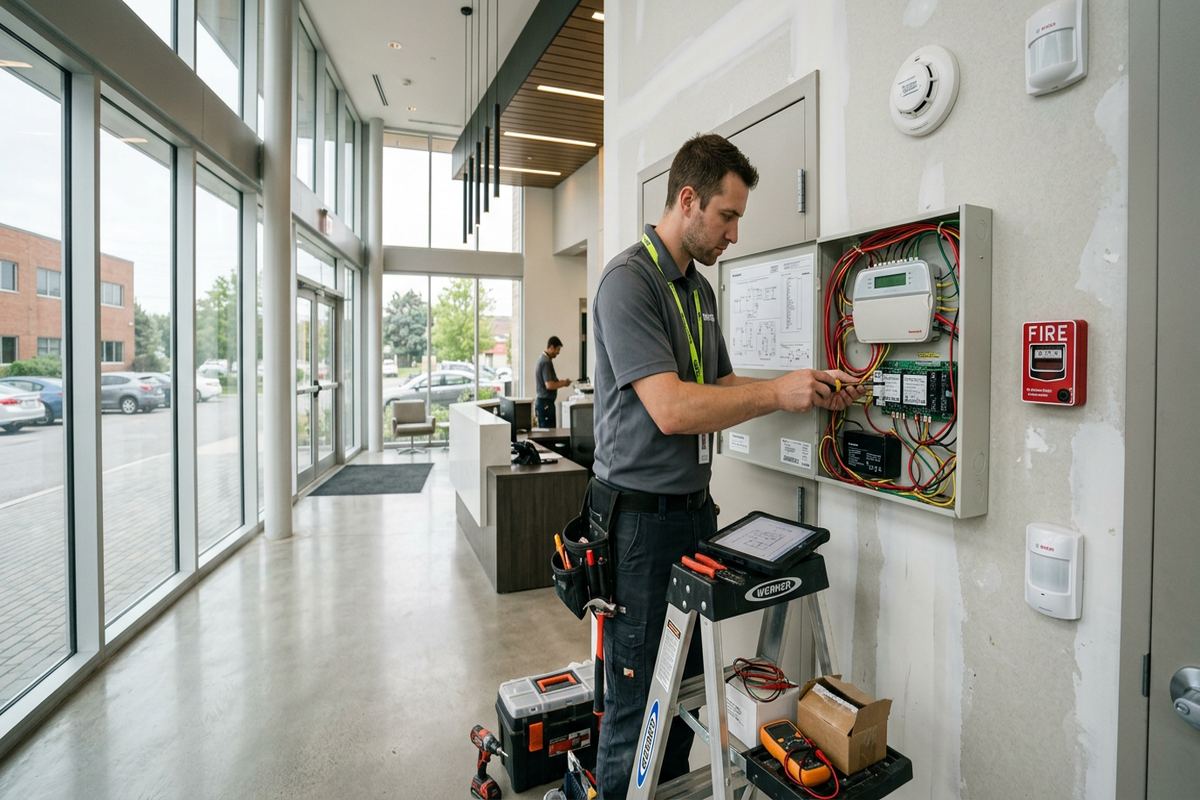
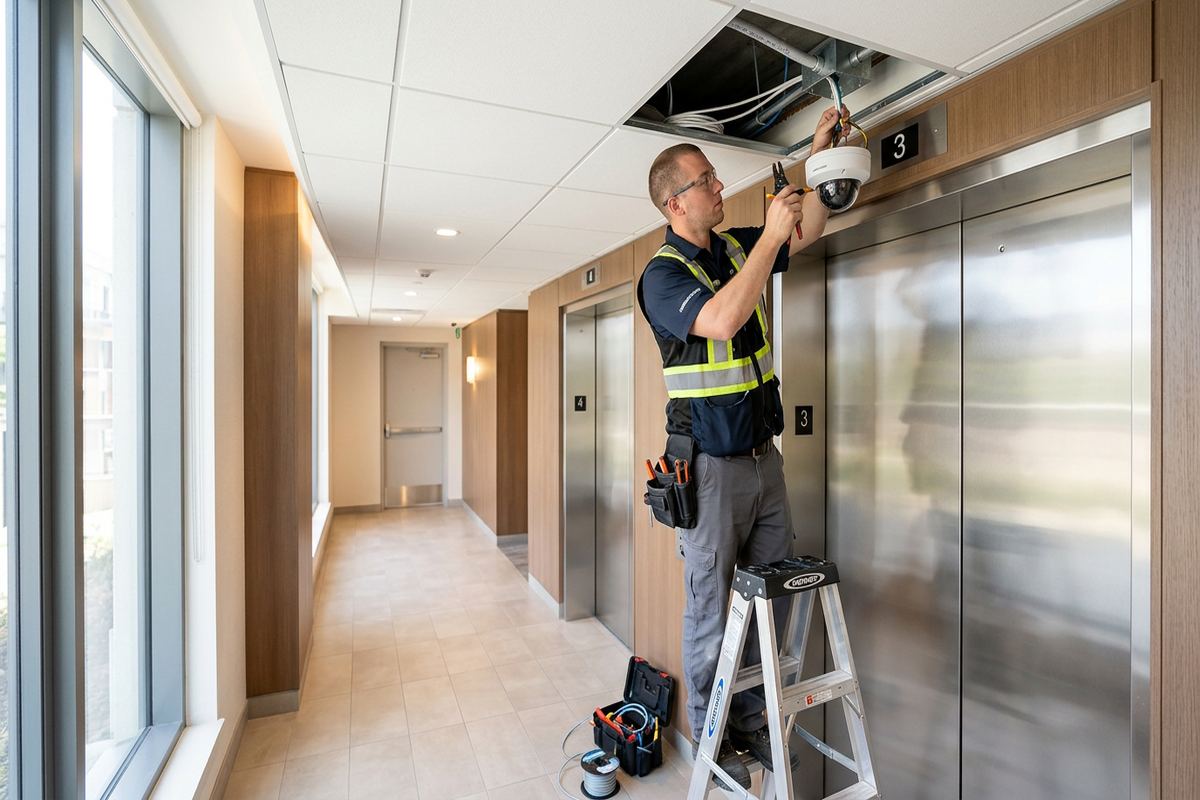
UnifiedLink installs commercial security camera systems for properties across Cambridge and Waterloo Region. We assess the site, plan useful camera coverage, install continuous labelled cable runs, configure recording and remote access, and document the completed system. Designs account for local masonry, industrial units, exterior exposure, network capacity and the approvals required for leased or shared properties.
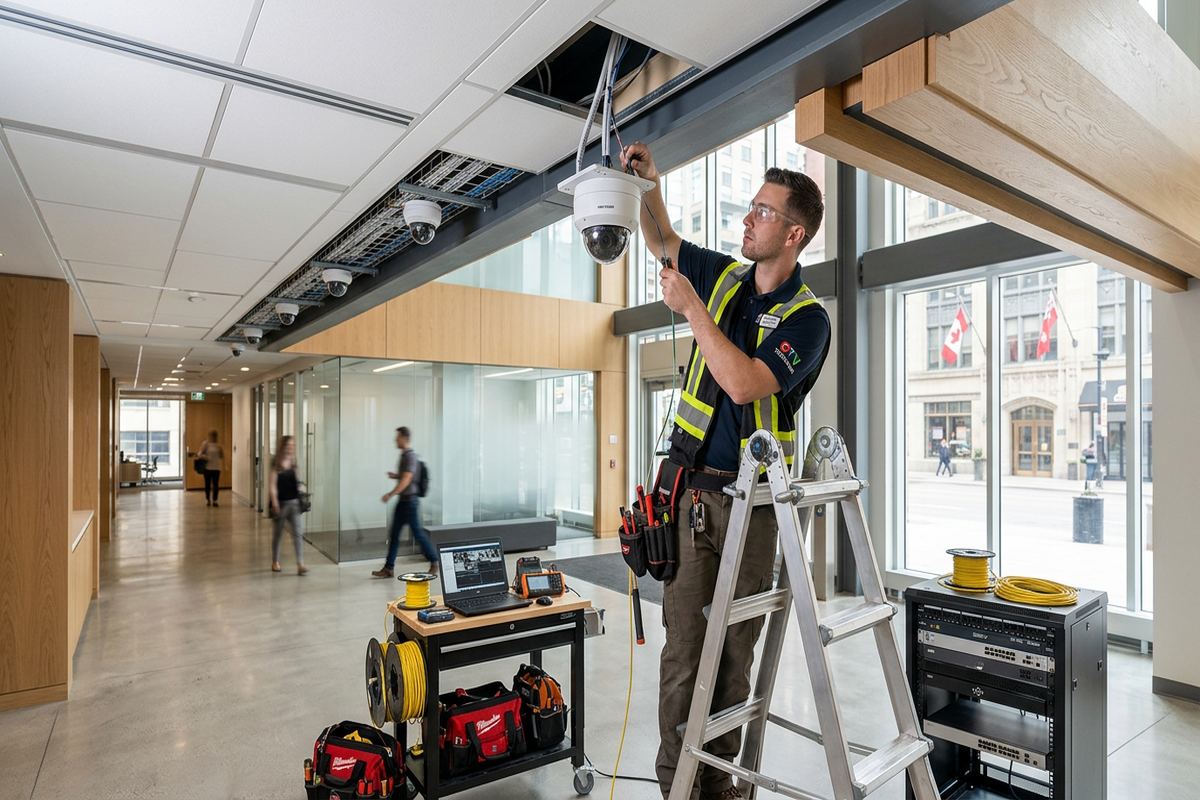
Commercial Camera Planning in Cambridge
Useful camera coverage starts with the site rather than a camera count. During an assessment, UnifiedLink reviews entrances, exits, loading areas, cash points, public approaches, restricted rooms and exterior boundaries. We identify what each view must accomplish, such as recognizing a person, confirming an event or monitoring general activity. Lighting, mounting height, obstructions and likely movement paths are considered before device locations are proposed. This process helps Cambridge businesses avoid overlapping views in one area while leaving another operationally important area without usable coverage or sufficient recorded detail.
A written scope is prepared before pricing so the customer can review the complete installation rather than an unexplained equipment list. It covers proposed cameras, recording equipment, cable routes, device placement, exclusions, equipment ownership and warranty. Where work affects a landlord-controlled wall, shared corridor, condominium common element or neighbouring unit, required approvals should be obtained before installation. The scope also distinguishes customer network responsibilities from camera-system work. That distinction matters when remote viewing, internet access, managed switches or existing communications cabinets are part of the proposed Cambridge installation.
Camera placement must account for how the property actually operates throughout the day. Delivery doors may need a different field of view from a public entrance, while a parking area may require several coordinated angles rather than one wide image. Staff-only spaces, customer areas and neighbouring properties also create privacy considerations. We discuss viewing priorities with the person responsible for operations, facilities or loss prevention. The resulting plan balances useful evidence, practical mounting locations, cable access and future maintenance without assuming that every corner needs to be watched or that maximum resolution solves poor positioning.
- Entrance, exit and loading-area review
- Lighting and obstruction assessment
- Written equipment and placement scope
- Landlord or condominium approval checks
- Operational coverage priorities
Cambridge Buildings Need Different Installation Methods
Stone heritage buildings, riverside neighbourhoods and industrial parks each carry their own installation constraints in Cambridge. Older masonry may have irregular wall construction, limited ceiling access or finishes that should not be disturbed without approval. Frame construction can offer easier concealed pathways, but insulation, fire separations and renovated wall cavities may still restrict cable routes. Industrial units often provide exposed structure and longer pathways, although lifts, production schedules or protected work areas can affect access. An assessment identifies these conditions early so mounting hardware, pathway methods and labour planning match the actual building.
In Galt and West Galt, a commercial property may combine older exterior construction with newer interior renovations. A camera route that appears simple on a drawing can encounter thick masonry, finished ceilings or additions built at different times. Surface pathway may be more appropriate than invasive drilling in some areas, provided its appearance and attachment method are accepted. Penetrations through stone, brick, siding or interior partitions require suitable placement and sealing. UnifiedLink documents proposed routes so owners can evaluate visual impact, maintenance access and any restrictions connected with the property before work begins.
Commercial strips and industrial units around Cambridge present another set of decisions. Shared façades, rear service lanes, high ceilings and open warehouse areas can change the required lens, mounting height and cable distance. A tenant may control the interior but not the exterior wall, roofline or common electrical room. In those cases, the landlord’s written approval can prevent disputed penetrations or device placement. Installation scheduling may also need to avoid shipping periods, customer traffic or active work zones. These details are addressed in the scope instead of being left for the installation day.
- Masonry and frame-route evaluation
- Low-impact options for finished areas
- Industrial ceiling and pathway planning
- Shared-property approval requirements
- Access planning around operations
Choosing Cameras for Cambridge Commercial Sites
Camera selection follows the intended view and available light. A fixed camera can provide consistent coverage of a doorway or counter, while a varifocal model allows the field of view to be adjusted during commissioning. Turret, dome and bullet formats each have practical mounting and maintenance differences. Resolution is only one part of image quality; lens choice, subject distance, motion, lighting contrast and recording settings also matter. For Cambridge properties, we specify devices according to the scene rather than using one camera model everywhere for the sake of a simple equipment list.
Entrances with bright windows or exterior daylight may require stronger handling of backlighting than an evenly lit stockroom. After dark, available lighting and reflected infrared can significantly affect recorded detail. Light-coloured walls, close soffits, glass and nearby objects can cause glare or overexposure when an infrared camera is poorly positioned. We review daytime and low-light conditions, then aim cameras away from avoidable reflections. Where identifying clothing, faces, vehicles or actions is important, the field of view is kept narrow enough to preserve detail at the relevant distance.
Wide exterior areas often tempt owners to request a single camera that sees everything. Although a broad overview can show activity, it may not provide enough detail to determine who entered a doorway or what happened near a loading bay. A more practical design may combine an overview with a dedicated identification view at a controlled approach. In Hespeler, Preston or Clemens Mill, the same principle applies whether the site is a storefront, office, small warehouse or mixed commercial property. Each camera receives a stated purpose that can be checked during commissioning.
- Fixed and varifocal lens selection
- Day and low-light scene review
- Backlight and infrared reflection checks
- Overview and identification views
- Purpose defined for every camera
Cambridge, Ontario
Commercial security camera installation in Cambridge, scoped in writing first
Book a site assessment and get equipment, routes, exclusions, and warranty on paper before anything is installed.
Cabling and Network Design in Cambridge
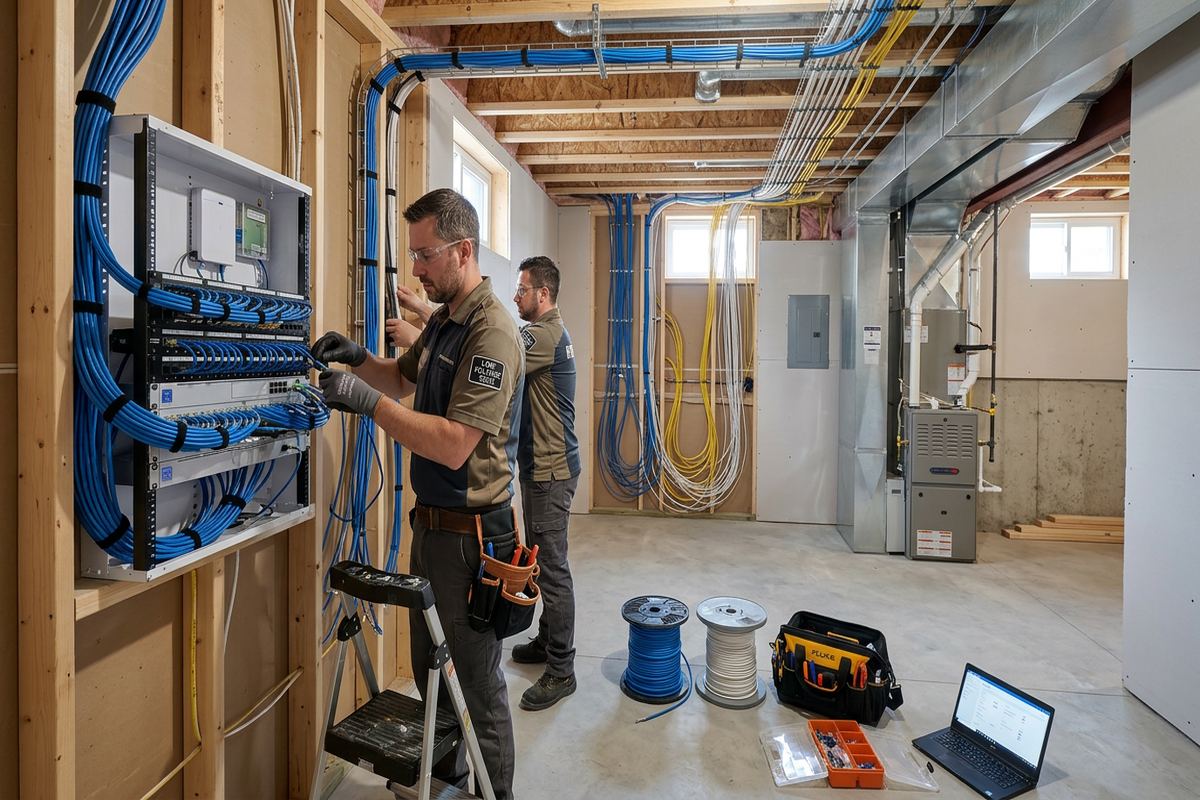
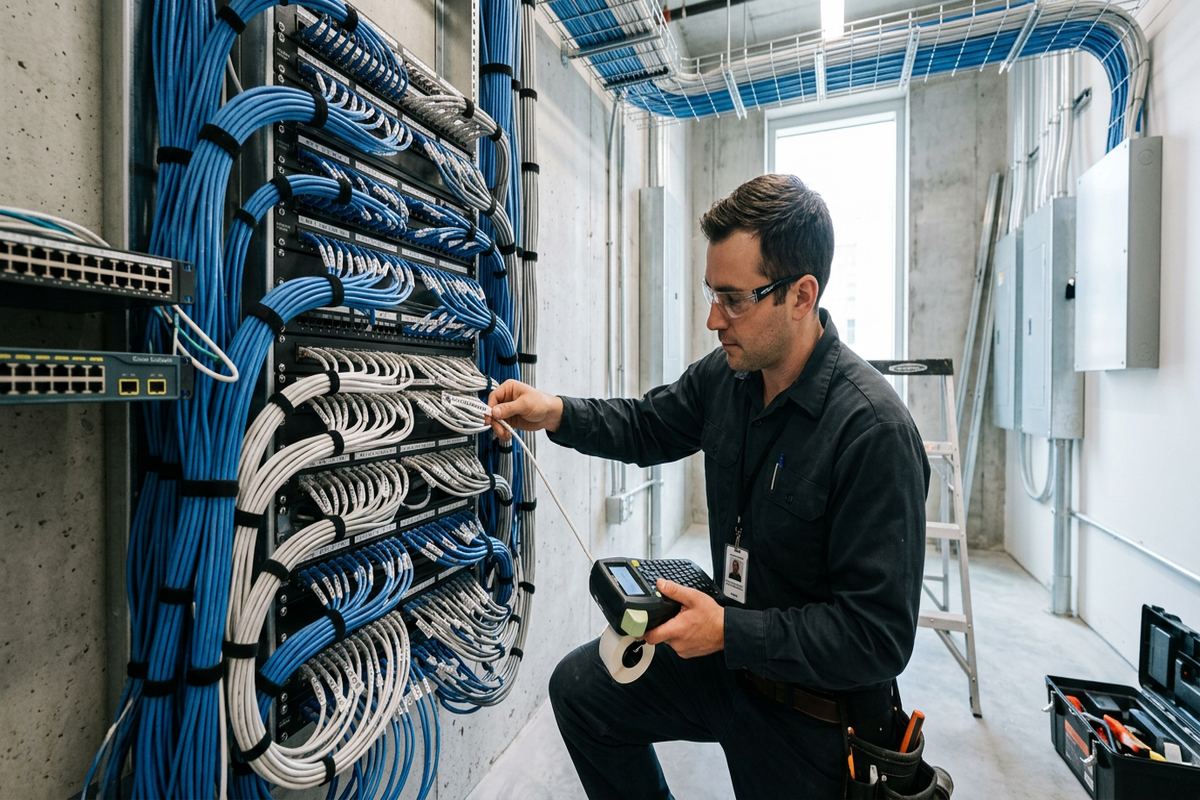
Reliable video depends on the pathways behind the cameras. UnifiedLink installs continuous labelled cable runs from each device to the designated communications or recording location, avoiding hidden couplers and unnecessary intermediate joints. Routes are planned around ceiling access, structural barriers, occupied spaces and separation from electrical hazards. Cable support and pathway choices depend on the building and installation environment. At both ends, labels correspond with the camera schedule and as-built record. This makes future troubleshooting, device replacement or network changes clearer for the customer and any technician who later works on the Cambridge property.
Most modern commercial camera systems use network cabling and Power over Ethernet, but they should not be added to an existing network without reviewing capacity and responsibility. Switch port availability, power budget, uplink limits, addressing and remote-access requirements all influence system operation. A dedicated camera network or logical separation may be appropriate depending on the site and customer’s IT policies. We coordinate demarcation points with internal or third-party IT contacts when needed. The written scope identifies which network components are included and which existing services, internet connections or customer-managed devices remain outside our work.
Recording location also affects reliability and serviceability. The recorder, switches and related power equipment need suitable space, ventilation, physical protection and access for authorized staff. Placing equipment above a loose ceiling tile or in an exposed public area can complicate maintenance and increase the chance of accidental disconnection. Industrial dust, heat and restricted electrical availability may rule out an otherwise convenient corner. During the Cambridge site assessment, we review candidate locations and cable distances before finalizing the design. Any dependency on an existing rack, cabinet or backup-power system is recorded in the scope.
- Continuous labelled cable runs
- PoE capacity and switch review
- Network responsibility documented
- Recorder-location assessment
- As-built cable and camera schedule
Exterior Cameras and Cambridge Winters
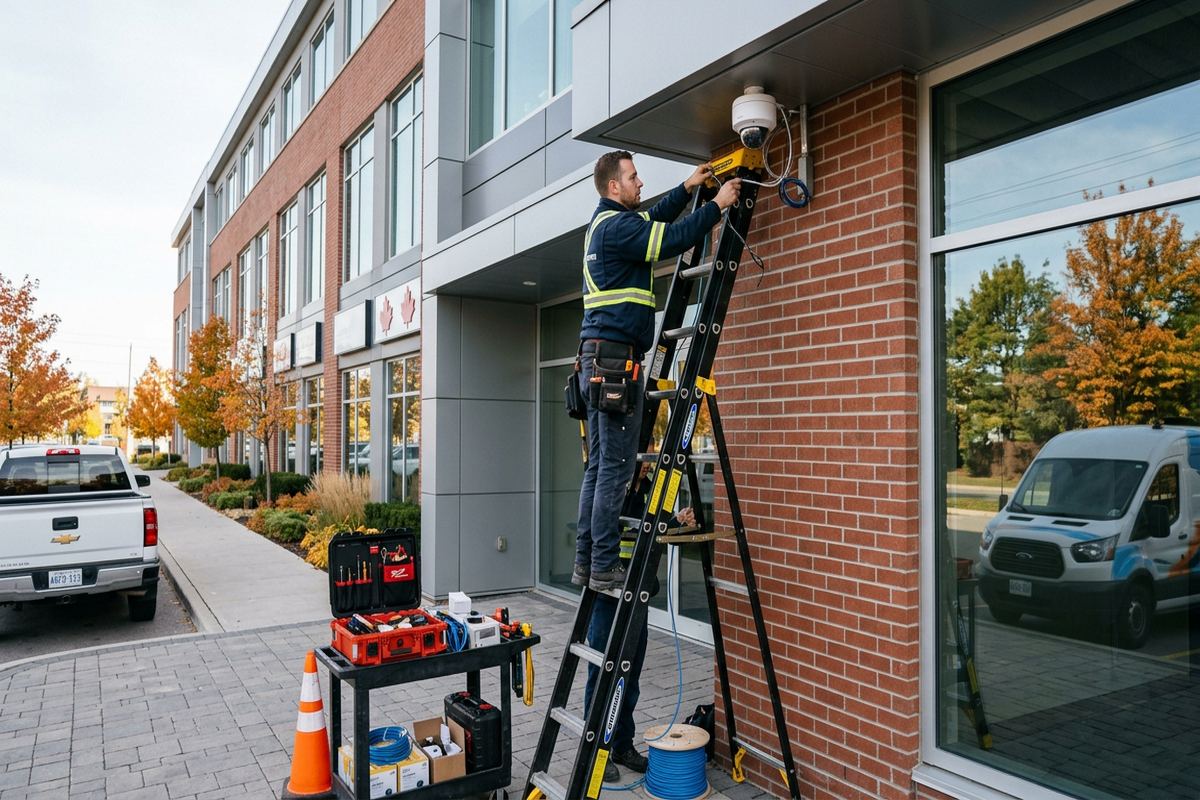
Exterior installation in Cambridge must account for winter temperatures, precipitation and repeated freeze-thaw cycles. Water can follow a cable, enter an unsealed penetration or collect behind unsuitable mounting hardware. We use appropriate exterior-rated components where the design exposes equipment or cabling to weather, form drip loops where needed and seal building penetrations according to the surface and route. Connections are kept protected rather than left loose behind a camera. Mounting locations are also chosen with snow accumulation, runoff, roof edges and practical access for future cleaning or service in mind.
Masonry and framed exteriors require different fastening and sealing approaches. Brick or stone surfaces need careful anchor selection and sensible penetration points, while siding or other cladding may require a secure structural attachment behind the finish. A camera should not rely on thin trim that can move, crack or deform with seasonal conditions. Junction boxes can provide protected cable termination and a stable mounting surface when correctly selected and installed. Before drilling, the route and visible hardware are reviewed so the owner understands how the completed work will appear on the Cambridge building.
Riverside neighbourhoods can expose exterior equipment to moisture and changing weather, but local conditions still vary by elevation, shelter and mounting face. A north-facing wall, open parking lot and protected doorway do not experience the same exposure. Camera housings must suit their installed environment, and placement should reduce avoidable water entry or lens obstruction. Image checks are completed after mounting because a sound physical installation can still produce a poor view if eaves, lighting or reflective surfaces interfere. Exterior work therefore combines weather protection, secure attachment and verified recorded images.
- Weather-suitable exterior components
- Sealed wall penetrations
- Drip loops and protected connections
- Masonry or cladding-specific fastening
- Snow, runoff and service access review
Recording, Retention and Secure Access
Recording design begins with how the customer expects to use footage. Continuous recording, motion-based recording or a schedule can affect storage needs and the ease of reviewing an incident. Camera quantity, resolution, frame rate, compression, scene activity and desired retention all influence capacity. Rather than promising a retention period without calculation, UnifiedLink configures the system around agreed assumptions and documents them. Actual results can vary when settings or activity levels change. Customers should also decide who may view live video, export recordings, change settings and administer user accounts at the Cambridge site.
Remote viewing requires deliberate security choices. Port forwarding or shared generic passwords should not be treated as convenient defaults. Available access methods depend on the selected platform, customer network and IT policy. We configure supported access on site, create or transfer administrator control using the customer’s own credentials, and avoid retaining account ownership that belongs to the customer. Individual users should receive only the permissions needed for their roles. Multi-factor authentication should be enabled where supported, and departing staff accounts should be removed promptly through the organization’s established access process.
Commercial camera use also requires attention to privacy and workplace policy. Cameras should be directed toward legitimate security and operational areas, not placed where people reasonably expect privacy. Views that unnecessarily capture neighbouring doors, residential windows or unrelated public areas can often be narrowed or masked, depending on the equipment. Audio recording introduces separate legal and policy concerns and is not assumed to be appropriate merely because a camera supports it. Cambridge owners and managers remain responsible for signage, internal policies, access authorization, retention decisions and any legal guidance required for their particular operation.
- Retention based on documented assumptions
- Role-based viewing permissions
- Customer-owned administrator credentials
- Secure remote-access configuration
- Privacy masking where appropriate
Installation and Commissioning in Cambridge
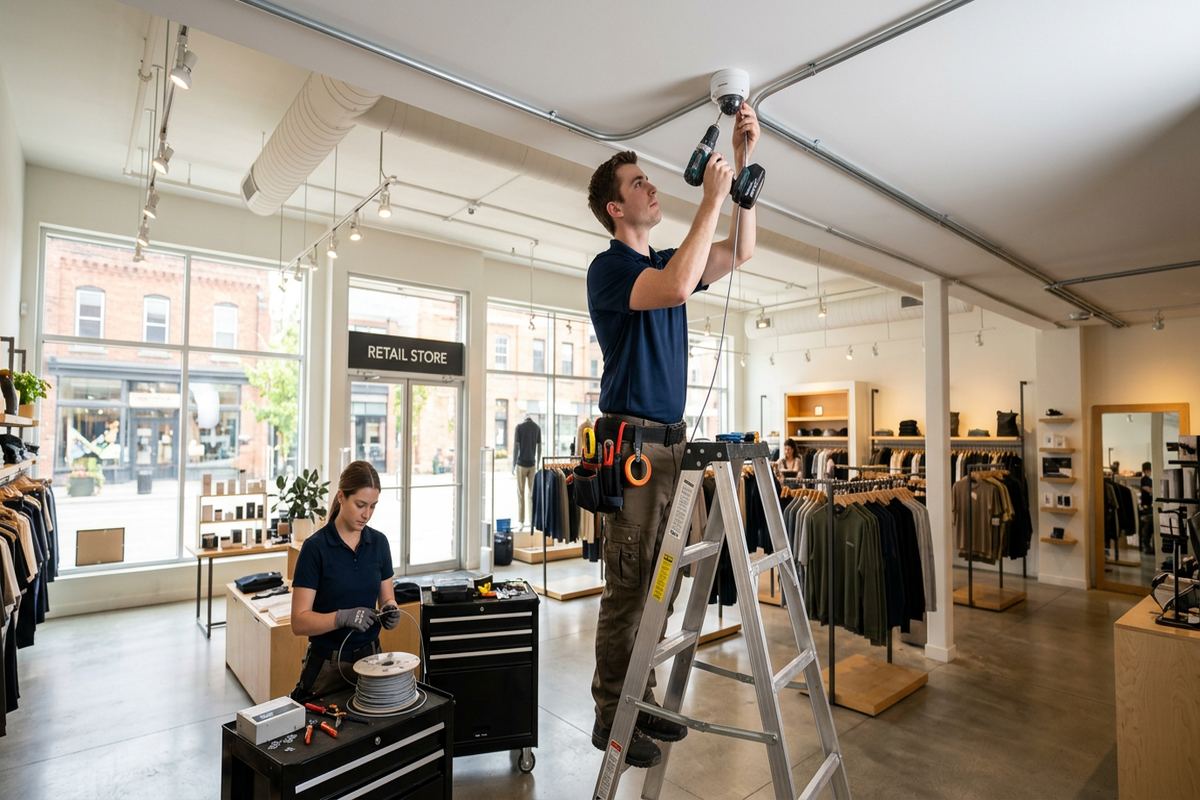
Once the scope and access arrangements are approved, installation proceeds according to the documented routes and device locations. Work areas are coordinated with the customer so drilling, ladder use and temporary access restrictions can be managed around normal operations. Cameras are mounted, continuous cables are installed and labelled, and network or recording equipment is connected as specified. If concealed conditions differ materially from the assessment, the issue is discussed before changing the agreed approach. This keeps the Cambridge customer informed when an inaccessible cavity, unexpected construction layer or landlord restriction affects the planned work.
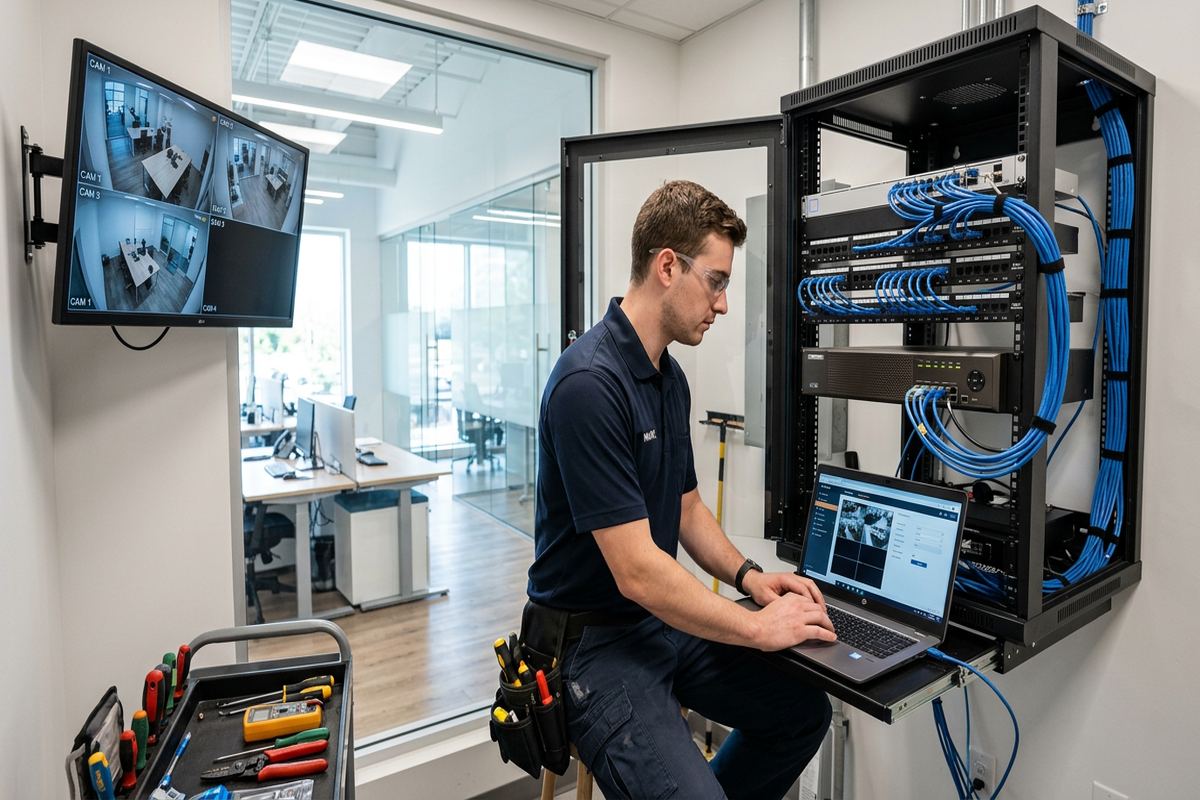
Physical completion is followed by configuration and image verification. Each camera is named by a useful location, assigned to the recording system and adjusted for its intended scene. We check focus, field of view, orientation, time settings, recording behaviour and available low-light performance. Remote access is configured when included and when the required customer internet or network access is ready. Views are reviewed with the customer’s priorities in mind, including whether entrance subjects occupy enough of the image and whether exterior lighting, glare, obstructions or privacy-sensitive areas require adjustment.
Commissioning also tests whether the system can be operated by the people responsible for it. We demonstrate live viewing, recorded playback, basic searching and video export on the included platform. Authorized users are confirmed, and administrator control is handed over through customer-owned credentials. The completed information includes an as-built record showing camera names, device locations and relevant cable or equipment details. This handover gives the Cambridge organization a practical reference rather than leaving knowledge only with the installer. One accountable contractor remains responsible for the agreed camera, cabling and configuration scope.
- Installation coordinated around site operations
- Camera naming and image adjustment
- Recording and playback verification
- On-site remote-access configuration
- Documented customer handover
Commercial Camera Upgrades Across Cambridge
Not every project starts with an empty building. Existing Cambridge systems may have usable pathways, cabinets or network equipment, while other components may be obsolete, damaged or poorly documented. An assessment determines what can reasonably remain and what should be replaced. Compatibility is checked rather than assumed because cameras, recorders, applications and power methods can use different standards or vendor limitations. Existing cable may require visual review and testing where accessible. The written scope identifies reused customer equipment, new equipment and exclusions, reducing confusion about ownership, support responsibility and warranty after the upgrade.
Recurring problems such as missing footage, intermittent cameras or unreliable remote viewing require diagnosis before replacement decisions are made. The cause could involve a damaged cable, insufficient PoE power, storage condition, incorrect recording schedule, unstable network path, failed connection or changed account setting. Swapping a camera without checking the full signal and power path can leave the original fault unresolved. UnifiedLink reviews the affected devices, recorder events, physical connections and relevant network conditions. Findings are used to define a repair or upgrade scope appropriate for the commercial property rather than automatically proposing a complete new system.
Cambridge service coverage includes Galt, Preston, Hespeler, Blair, West Galt and Clemens Mill, with site assessment timing depending on the service and travel distance. Requests sent during business hours are answered the same day, while after-hours requests are answered the next business day. Before pricing, we confirm the property type, approximate camera needs, known network conditions and required approvals, then arrange the appropriate assessment. Whether the work involves a commercial strip, industrial unit, office or shared property, the goal is a clearly scoped system with maintainable cabling, controlled access and documented handover.
- Existing-system condition review
- Compatibility checked before reuse
- Cable, power and storage diagnosis
- Repair and upgrade scopes
- Cambridge neighbourhood service coverage
Cambridge neighbourhoods we cover
- Galt
- Preston
- Hespeler
- Blair
- West Galt
- Clemens Mill
Commercial security camera installation in Cambridge — common questions
How many cameras does my Cambridge business need?
The number depends on the views you need, not simply the building’s floor area. An assessment considers entrances, exits, loading points, customer areas, restricted rooms, parking and likely movement paths. UnifiedLink then proposes camera purposes and locations in a written scope. A combination of overview and identification views is often more useful than trying to cover a large Cambridge property with one very wide image.
Can cameras be installed on an older stone building?
Yes, subject to the building’s condition, access and any owner or heritage-related approvals that apply. Older stone and masonry buildings in Cambridge may require careful route planning, suitable anchors, controlled penetrations and visible surface pathway instead of invasive concealed work. We assess the substrate and proposed mounting points before pricing, then document cable routes and visible hardware so the owner can review the impact.
Do I need landlord or condo approval?
Approval may be required when cameras, cables or fasteners affect an exterior wall, common corridor, shared ceiling, condominium common element or landlord-controlled communications room. Cambridge tenants and condo owners should obtain written permission before installation where their agreement or property rules require it. UnifiedLink can provide the proposed device locations, cable routes and mounting details needed for review, but the customer remains responsible for securing authorization.
Will outdoor cameras work through Cambridge winters?
Outdoor cameras can operate reliably when their environmental rating, mounting and connections suit the location. Cambridge freeze-thaw conditions make exterior sealing, protected terminations, secure attachment and drip management important. We also consider snow, roof runoff and safe maintenance access. Performance still depends on keeping the lens clear and ensuring lighting supports the required image, so exterior views are checked during commissioning rather than assumed from specifications alone.
Can I view my commercial cameras remotely?
Remote viewing can be configured when the selected platform, internet service, network and customer IT policy support it. At the Cambridge site, UnifiedLink configures included access and hands administrator control over using the customer’s own credentials. User permissions should be assigned by role, with multi-factor authentication enabled where supported. Remote access is not treated as a reason to use shared passwords or leave unnecessary network services exposed.
What do I receive after installation?
Handover includes on-site guidance for live viewing, playback, searching and video export on the included system. Cameras are named by location, customer-owned credentials are confirmed, and an as-built record documents device locations and relevant cable or equipment details. The written scope also records equipment ownership, exclusions and warranty. This gives the Cambridge owner or manager a practical reference for daily use, future service and staff access changes.
Coverage in Cambridge is confirmed against the address before we quote. See everything we install in Cambridge or the province-wide commercial security camera installation page.