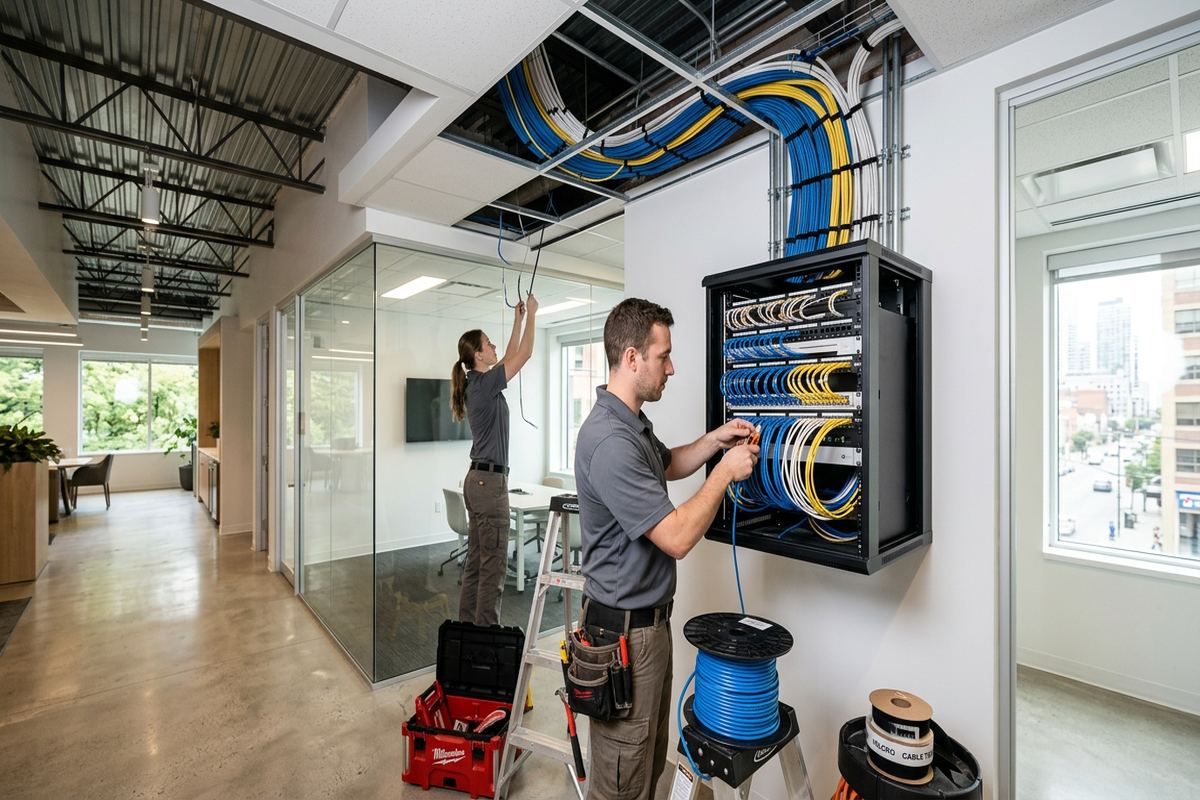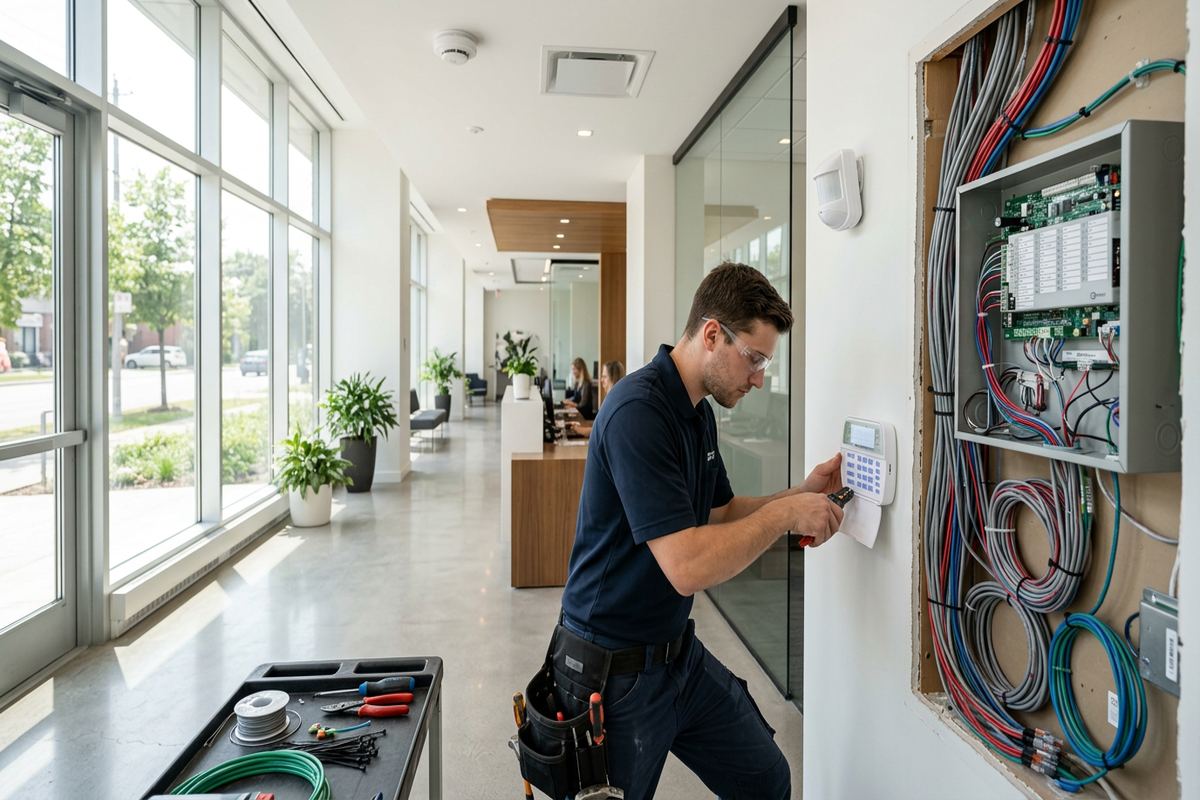
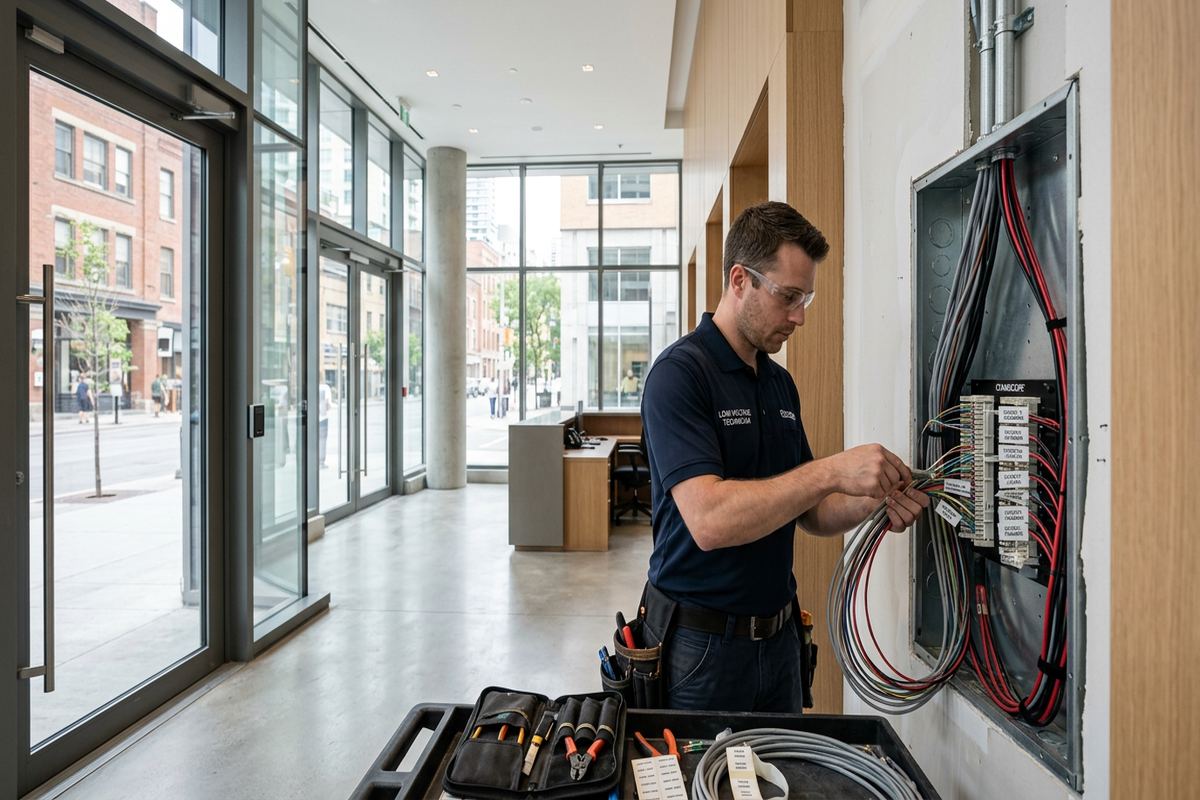
UnifiedLink installs commercial access control systems for offices, shops, industrial units, multi-tenant properties and other facilities in Cambridge. We assess each opening, plan the door hardware and cabling, configure permissions on site, and provide a written scope before work begins. The completed system is handed over using your organization’s own credentials.
Commercial Access Control Planning in Cambridge
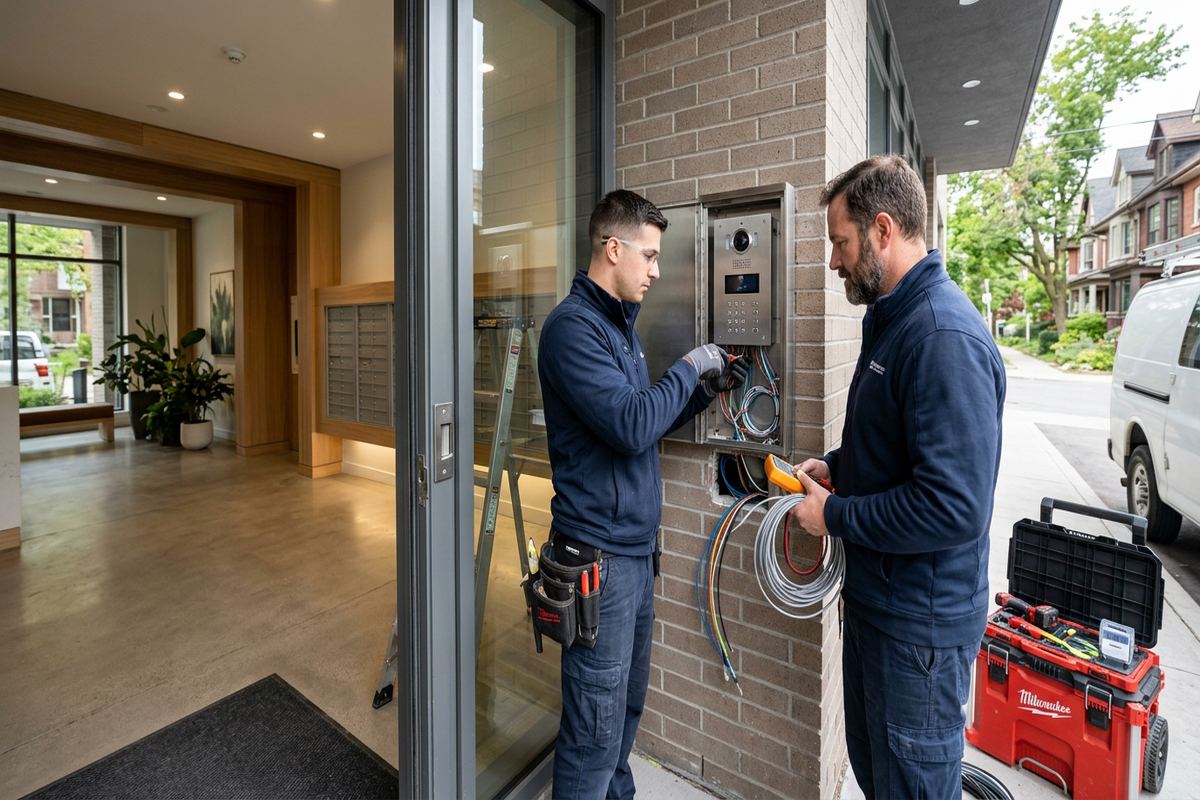
An effective access control installation starts with the door, not the software. During a Cambridge site assessment, we examine the opening, frame, existing lock, hinges, door closer, available ceiling space and route back to the communications or electrical room. We also discuss who needs access, when permissions should apply and how staff will enter if power or network service is interrupted. This groundwork identifies whether an electric strike, magnetic lock, electrified hardware or another arrangement suits each opening before equipment is selected or cable routes are committed.
Cambridge properties vary considerably between stone heritage buildings, riverside neighbourhoods, commercial strips and industrial parks. Thick masonry may prevent a direct cable path, while newer frame construction can offer concealed routes that need careful coordination with insulation and fire separations. Industrial units may have high ceilings, exposed structure, overhead doors and long distances between controlled openings. We document these conditions during the assessment so the proposal reflects realistic labour, mounting and pathway requirements rather than relying on assumptions based only on floor plans or photographs.
The written scope identifies the proposed readers, controllers, credentials, locking interfaces, request-to-exit devices, door contacts and power supplies. It also covers device placement, cable routes, exclusions, equipment ownership and warranty. Where existing door hardware, network equipment, electrical work or fire alarm integration affects the project, responsibilities are stated clearly. This gives building owners, managers and tenants a practical basis for approvals and scheduling. UnifiedLink remains one accountable low-voltage contractor for the specified access control cabling, installation, configuration, testing, documentation and system handover.
- Assessment of every proposed controlled opening
- Review of locks, frames, closers and hinges
- Defined reader, controller and power locations
- Written responsibilities, exclusions and warranty terms
- Planning for network and electrical dependencies
Selecting Hardware for Cambridge Buildings
Hardware selection must account for how a door is built and used throughout the day. A busy staff entrance has different demands than an interior records room or occasional loading-area door. We consider latch geometry, frame material, traffic patterns, accessibility hardware, emergency egress and the condition of the existing closer. Readers are positioned for practical credential use without interfering with door trim or glazing. Controllers and power supplies are placed in serviceable locations, rather than hidden where future inspection, battery replacement or troubleshooting would require disruptive access.
Older properties in Galt and Blair can include stone or masonry walls, deep openings and finishes that owners want to preserve. Surface raceway may be more appropriate than cutting historic material, but its path and colour should be agreed upon before installation. Frame construction found elsewhere can permit concealed wiring, although wall cavities may contain blocking, insulation or previous renovations. We review drilling and fastening methods with the property’s construction in mind, then record visible pathway choices in the scope so the finished result is predictable for the owner or tenant.
Exterior readers, gate devices and door contacts face Cambridge winters, moisture and repeated freeze-thaw cycles. Equipment must be suited to its location, while penetrations require appropriate sealing and drip management. Reader placement should limit exposure where practical without making the device difficult to use. Metal frames and exterior cladding can also influence mounting and wireless performance. The assessment distinguishes indoor-rated locations from exposed or damp areas, allowing enclosures, fasteners, glands and cable transitions to be specified according to actual conditions rather than treating every side door as an identical installation.
- Electric strikes and compatible locking hardware
- Card, fob or mobile-capable reader options
- Door contacts and request-to-exit devices
- Serviceable controller and power-supply placement
- Exterior-rated mounting where conditions require it
Door, Life-Safety and Egress Coordination
Access control manages entry, but it must not prevent required exit. Each controlled opening is reviewed for its normal egress method, mechanical release and behaviour during a power loss. Some locking arrangements may require coordination with door hardware, electrical or fire alarm contractors, depending on the building and intended operation. UnifiedLink does not conceal these dependencies inside a general installation allowance. They are identified in the scope, assigned to the appropriate party and confirmed before commissioning, helping avoid a system that operates electronically but conflicts with the door’s required mechanical function.
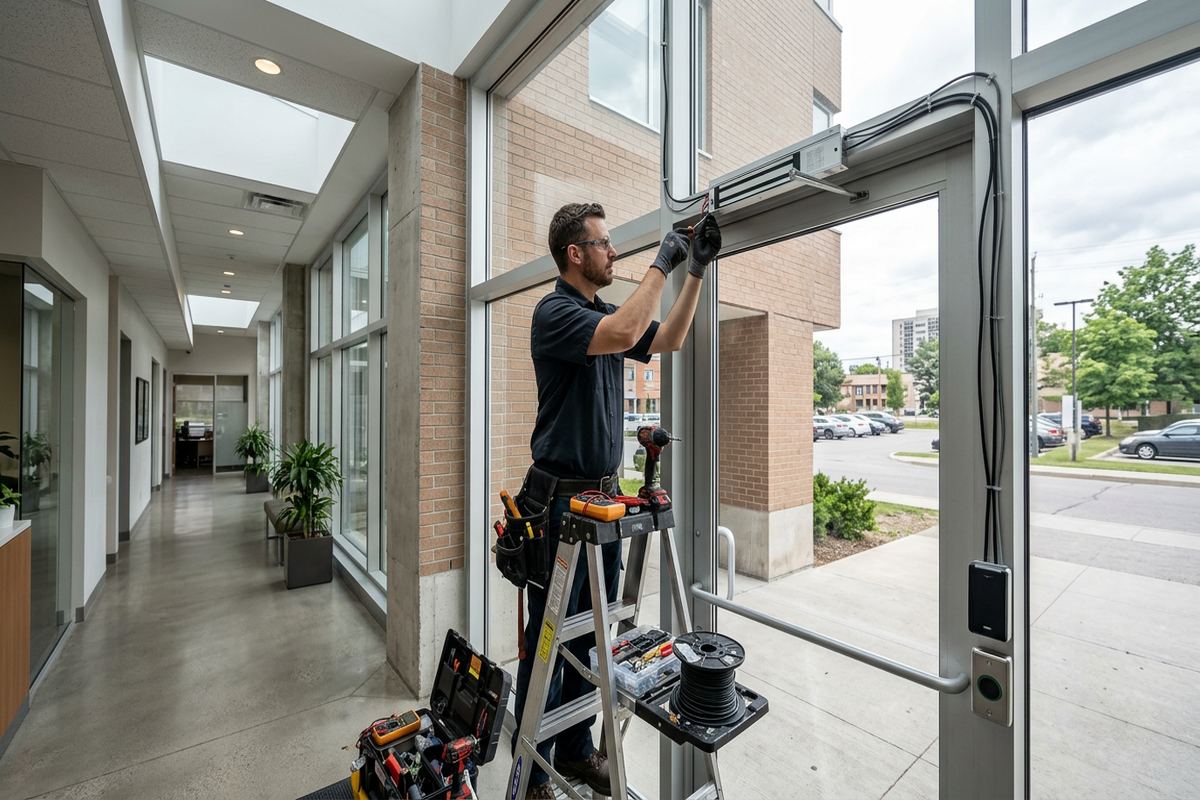
A magnetic lock, electric strike and electrified panic device do not behave the same way. Selection depends on the opening, listed hardware, desired fail-safe or fail-secure response and applicable approval requirements. Existing hardware may be reusable when it is compatible and in suitable condition, but it should not be assumed to work merely because it is already installed. We test the complete door cycle, including credential entry, free egress, closer operation, latch engagement, door-held events and power response, then document any deficiency outside the agreed low-voltage scope.
Multi-tenant buildings and condominium properties in Cambridge may require landlord, condominium board or property-management approval before cables are routed through common areas or exterior devices are mounted. Base-building rules can also govern riser access, fire stopping, working hours and connection to shared systems. Tenants should confirm their authority over the doors in question before installation is scheduled. We can provide equipment locations and proposed routes for review, while the customer remains responsible for obtaining required property approvals unless the written scope expressly assigns a different coordination process.
- Review of free-egress operation
- Defined power-loss door behaviour
- Coordination points for fire alarm interfaces
- Testing of latch and closer operation
- Support documents for property approvals
Cambridge, Ontario
Commercial access control installation in Cambridge, scoped in writing first
Book a site assessment and get equipment, routes, exclusions, and warranty on paper before anything is installed.
Access Control Cabling Across Cambridge Sites
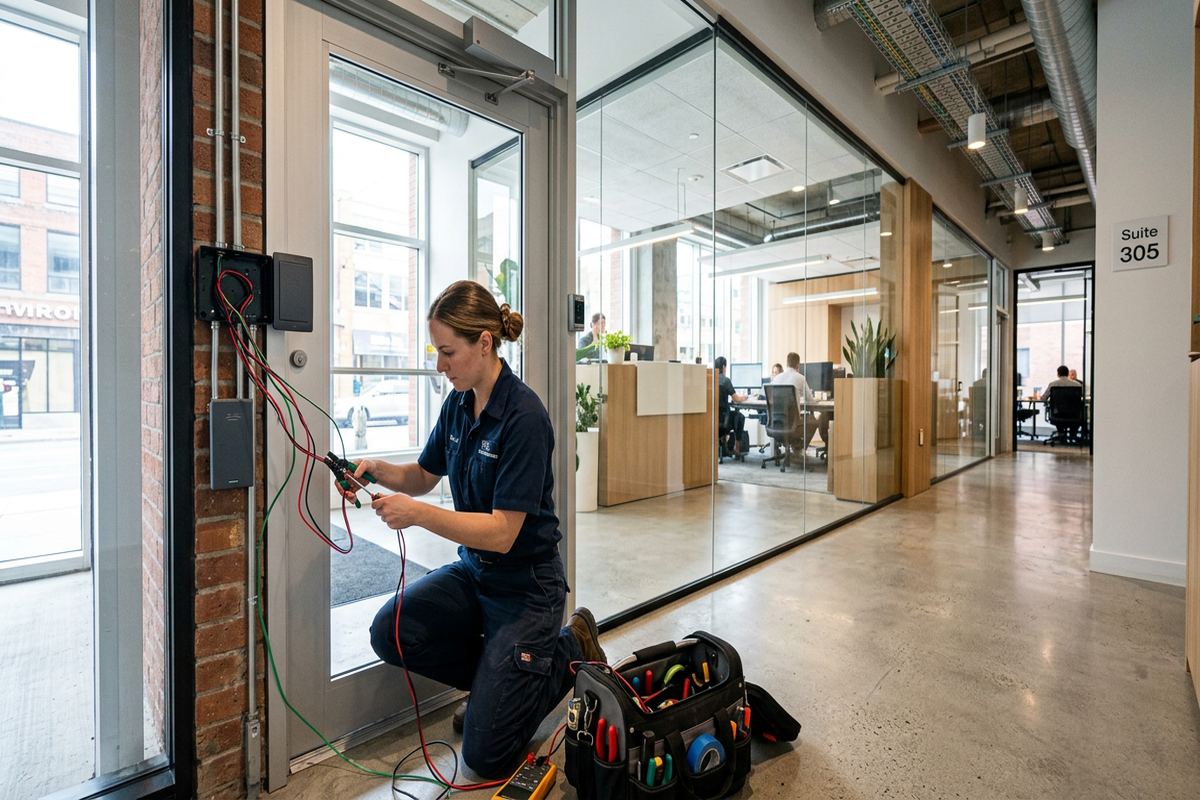
Reliable access control depends on cable pathways that are planned for the building rather than improvised at each door. UnifiedLink installs continuous labelled cable runs between field devices and their designated termination points, subject to the approved scope. Routes are chosen with attention to distance, accessibility, physical protection and separation from electrical conductors. Where pathways pass through finished offices, open industrial ceilings or shared corridors, we agree on concealed routing, surface raceway or supported exposed cable before work starts. Labels correspond with controller ports and the final as-built record.
Commercial strips in Preston and Hespeler often combine finished customer areas with service corridors, basements or rear utility spaces. A cable route that looks direct from the storefront may cross another tenancy or an inaccessible ceiling. Industrial units can present the opposite issue: routes are visible, but long spans, high structure and production equipment complicate access. We inspect these conditions before pricing, identify lift or after-hours dependencies where applicable, and avoid promising a pathway until both ends and the intervening route have been reviewed on site.
Penetrations through exterior walls need more than a bead of sealant applied after drilling. Hole direction, sleeve or gland selection, cable support and the transition into the device all affect water management. Cambridge freeze-thaw conditions can open poorly prepared gaps and place stress on surface-mounted components. Masonry anchors must suit the substrate, while frame walls require attachment to appropriate backing rather than cladding alone. Indoor penetrations through rated assemblies may need approved fire-stopping by the responsible trade, with that responsibility documented before the affected pathway is used.
- Continuous cable runs without hidden joins
- Labels at device and controller ends
- Supported routes through open ceilings
- Agreed surface raceway in finished spaces
- Documented penetration and fire-stopping responsibilities
Credentials, Permissions and On-Site Configuration
Once the hardware is installed, configuration turns individual devices into an operational security system. We set up doors, schedules, access groups, credential formats and event reporting according to information provided by the customer. Permissions can separate general staff, managers, cleaners, contractors and other defined users without giving every credential access everywhere. Decisions should reflect actual operating needs, including early arrivals, weekend activity and temporary access. A named customer administrator reviews these rules during commissioning so the final configuration is understood rather than being left as an unexplained installer default.
Credentials may include cards, fobs or supported mobile methods, depending on the selected platform and reader technology. The organization should decide who issues them, how identity is verified and when lost credentials are disabled. In Cambridge facilities with several entrances or separate tenant areas, a consistent naming convention makes daily administration easier. We can establish the initial structure and demonstrate common tasks, but ongoing user management remains under the customer’s control. Administrator access is handed over using the customer’s own credentials, not an installer-owned account that creates avoidable dependence.
Network-connected access control may require customer-provided addressing, internet access, firewall changes or coordination with a managed IT provider. These requirements are identified before commissioning wherever the selected platform makes them relevant. Controllers should not simply be connected to an unknown network port and assumed to be secure. We confirm the agreed connection, configure supported system settings on site and test communication from authorized management devices. Cloud subscriptions, licences or manufacturer accounts, if required by the selected equipment, are identified in the written scope along with ownership and renewal responsibility.
- Configured doors, schedules and access groups
- Customer-controlled administrator credentials
- Practical card or fob enrolment workflow
- Coordination with the customer’s IT provider
- Defined licence and account ownership
Cambridge Retrofit and Expansion Projects
Many access control projects extend an existing system rather than starting with an empty building. Before adding doors, we identify the current platform, controller capacity, credential technology, available power, software access and condition of the installed cabling. A reader that looks compatible may use a different format or communication method, and an enclosure with spare space may not have sufficient power capacity. The assessment determines what can reasonably be retained, what needs replacement and whether the existing system can support the requested expansion without creating separate, difficult-to-manage islands.
Renovated buildings in West Galt or older parts of Galt can contain several generations of door wiring, abandoned alarm cable and undocumented power supplies. We trace accessible circuits instead of relying on cable colour or handwritten labels. Where reuse is proposed, testing and limitations are stated in the scope. Concealed existing cable cannot always be fully inspected, so the customer is told where performance depends on infrastructure that remains in place. New runs are labelled continuously at their endpoints and added to the as-built record to improve future serviceability.
Industrial tenants may need access control added while production, shipping or office operations continue. Work sequencing then matters as much as equipment selection. Doors can be completed in stages, with shutdowns or hardware changes arranged around agreed operating windows. If another trade is replacing doors or frames, rough-in locations and cable protection should be coordinated before finishes are closed. We define dependencies early and test each completed opening, reducing the risk that cabling, locksmith work, electrical supply and software configuration are finished at different times without clear accountability.
- Existing controller and licence review
- Credential technology compatibility checks
- Trace and test of reusable cabling
- Staged work for occupied facilities
- Coordination with renovations and door replacement
Testing and Handover in Cambridge
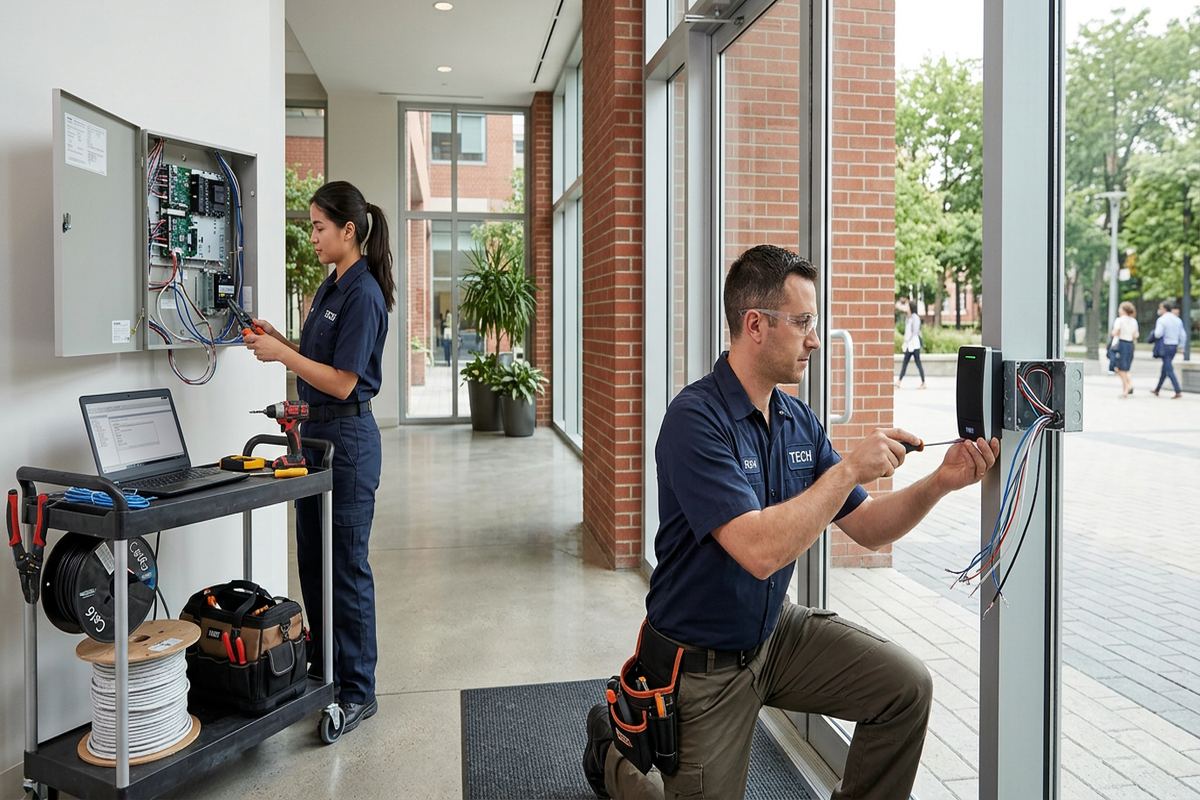
Commissioning covers the complete opening, not only whether a reader beeps. We present an authorized credential, verify the intended unlock period, confirm the door closes and latches, and check that the contact reports the correct state. Request-to-exit operation, forced-door events, held-open timing and configured schedules are tested where included. Power interruption behaviour is also reviewed according to the selected locking arrangement. Any mechanical issue affecting reliable operation is recorded and assigned, rather than hidden by increasing unlock times or disabling a useful event.
At handover, the Cambridge customer receives administrator access through the organization’s own credentials and an as-built record for the installed work. Documentation identifies controlled doors, device names, controller locations and cable information within the agreed scope. We also review basic user administration, credential enrolment, event viewing and the process for disabling a lost credential. Equipment ownership and applicable warranty information follow the written scope. The objective is a system the customer can operate and explain, without depending on undocumented passwords, unnamed doors or installer-controlled accounts.
A final review also captures items that could affect later operation. These may include a worn closer, misaligned latch, planned network change or exterior seal requiring inspection after other construction is completed. For sites with several phases, the record distinguishes completed openings from future provisions. Labels, names and access groups are checked for consistency before the project is closed. This disciplined handover is particularly useful for multi-unit and industrial properties, where building managers, tenants and IT providers may each need accurate information without receiving broader system authority than their role requires.
- Credential and schedule testing at each door
- Verification of contacts and exit devices
- Power-response checks within the agreed scope
- Customer-owned administrator account
- As-built record and operating review
Arranging Commercial Access Control in Cambridge
The first step is a discussion about the property, number of doors, current hardware and intended users. Floor plans and photographs can provide context, but pricing follows a site assessment because construction and pathway conditions materially affect the work. In Cambridge, assessment timing depends on the service requirements and travel distance. Requests sent during business hours are answered the same day, while after-hours requests are answered the next business day. This response wording concerns the initial request; it is not a guarantee that assessment or installation will occur on that timeline.
Before the visit, gather any available door schedules, landlord rules, condominium requirements, network standards and details for existing access systems. Identify which openings are essential, which may be future phases and who can approve hardware changes. For leased premises, confirm whether exterior walls, common corridors or base-building rooms require written permission. Having the property manager, IT contact or door-hardware representative available can resolve dependencies quickly. The site assessment then focuses on verified conditions instead of trying to reconstruct ownership and approval boundaries after equipment has already been proposed.
Following assessment, UnifiedLink prepares a written scope covering equipment, cable routes, device placement, exclusions, equipment ownership and warranty. Once approved, installation is coordinated around site access and any dependent trades. We install the specified low-voltage components and continuous labelled cable runs, configure the system on site, test each included opening and complete the customer handover. One accountable contractor manages the defined access control work, while clearly identified locksmith, electrical, fire alarm, IT or property-management tasks remain with the parties assigned in the scope.
- Same-day reply during business hours
- Next-business-day reply after hours
- Assessment before project pricing
- Written scope before installation
- Coordinated installation, testing and handover
Cambridge neighbourhoods we cover
- Galt
- Preston
- Hespeler
- Blair
- West Galt
- Clemens Mill
Commercial access control installation in Cambridge — common questions
What type of access control suits my Cambridge property?
The answer depends on the door construction, existing lock, traffic level, egress requirements and how you want to manage credentials. A Cambridge site assessment may identify electric strikes for some openings and different electrified hardware for others. We review each door before specifying readers, controllers, contacts, request-to-exit devices and power arrangements.
Can access control be installed in an older stone building?
Yes, but stone heritage buildings in Cambridge often require careful pathway and mounting decisions. Thick masonry, deep openings and protected finishes may make surface raceway preferable to concealed drilling. We review acceptable routes with the owner and document visible components, fastening methods and exterior sealing before installation. Required heritage, landlord or property approvals remain part of project planning.
Will the system work during a power outage?
Power-loss behaviour depends on the selected locking hardware, power supply, battery arrangement and required egress operation. Some doors are designed to unlock when power is removed, while others remain mechanically secure but still permit exit. For a Cambridge installation, the intended response is established during design and tested during commissioning within the agreed scope.
Can you add doors to our existing system?
Often, provided the existing platform has suitable controller capacity, power, licensing and compatible credential technology. We first identify the equipment and test accessible infrastructure. In older Cambridge properties, undocumented wiring or obsolete readers can limit practical reuse. The written scope states which components will remain, what will be replaced and any limitations associated with retained equipment.
Do I need landlord or condominium approval?
Approval may be required when installation affects common areas, exterior walls, shared risers, base-building systems or doors that are not solely under your control. This is common in leased and condominium properties in Cambridge. We can provide proposed device locations and cable routes for review, but the customer must secure required approvals unless the written scope assigns that responsibility differently.
What do we receive when installation is complete?
Handover includes on-site testing, administrator access through your organization’s own credentials and an as-built record for the installed work. We review door names, user administration, credential enrolment and common event functions. The written scope also identifies equipment ownership and warranty. Any unresolved mechanical, network or third-party issue is documented rather than left as an unexplained system fault.
Coverage in Cambridge is confirmed against the address before we quote. See everything we install in Cambridge or the province-wide commercial access control installation page.