UnifiedLink installs home security camera systems across Caledon, including rural acreages, suburban houses, gates, long driveways and outbuildings. We assess the property before pricing, plan practical camera positions and cable routes, configure recording and remote access on site, and provide a written scope and as-built record for a system the owner can operate directly.
Planning Home Security Cameras for Caledon Properties
A useful camera system starts with the areas you need to identify, not with a camera count. During a Caledon site assessment, we review entrances, vehicle approaches, side yards, decks, attached garages and routes toward detached structures. The plan distinguishes broad observation views from identification points where faces, clothing or licence plates may be clearer under suitable conditions. We also consider night lighting, sun direction, seasonal foliage and places where snowbanks or parked vehicles could block the image. These details determine lens choice, mounting height, recording settings and whether another camera angle is justified.
Rural acreages and long driveways create different coverage problems from closely spaced houses in Bolton or Mayfield West. A camera mounted high on the house may show that a vehicle arrived without capturing useful detail at the gate. In those cases, the assessment may consider a separate entrance view, an overview camera, lighting and a reliable network path between buildings. Outbuildings also require attention to available power, cable distance, grounding context and connectivity. The written scope identifies proposed device locations and cable routes so that the intended coverage is understood before installation begins.
Camera placement must balance useful evidence with privacy and practical maintenance. Views should concentrate on the customer’s entrances, driveway and property rather than a neighbour’s windows or private yard. Trees, eavestroughs, downspouts and future landscaping can limit an otherwise suitable position. We also check whether ladders can safely reach each device for cleaning or adjustment. Before pricing, UnifiedLink documents equipment, placement, cable routes, exclusions, equipment ownership and warranty terms. This process gives Caledon property owners a defined installation plan instead of relying on assumptions made after work has started.
- Entrance, driveway and perimeter coverage review
- Day and night scene assessment
- Camera purpose defined for each location
- Proposed cable routes documented before work
- Privacy and maintenance access considered
Wired Camera Installation and Structured Cabling
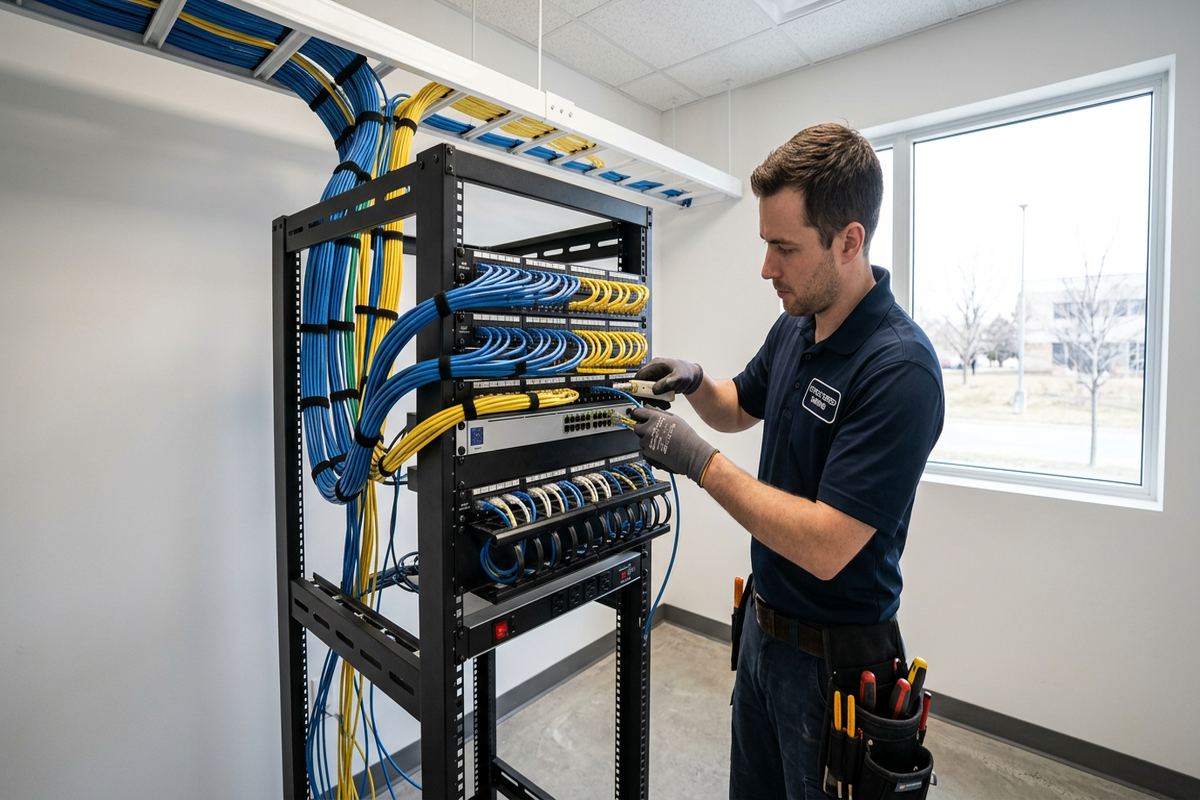
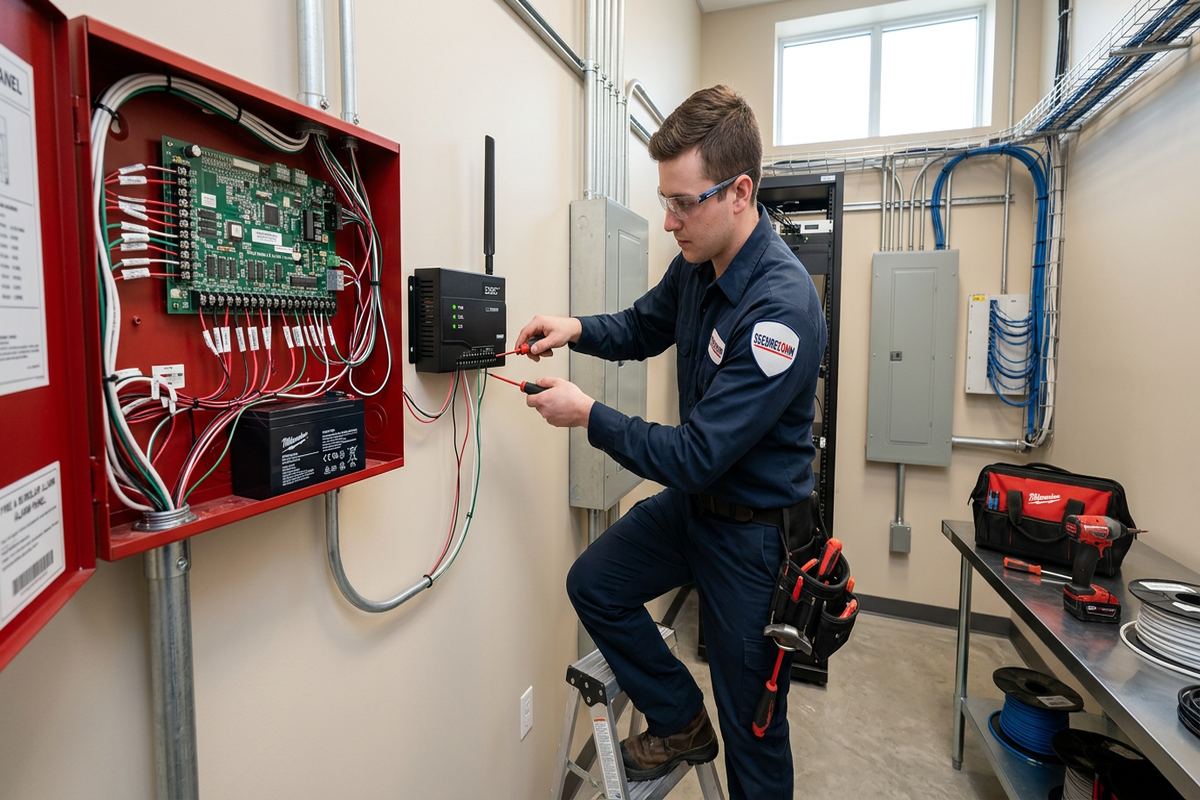
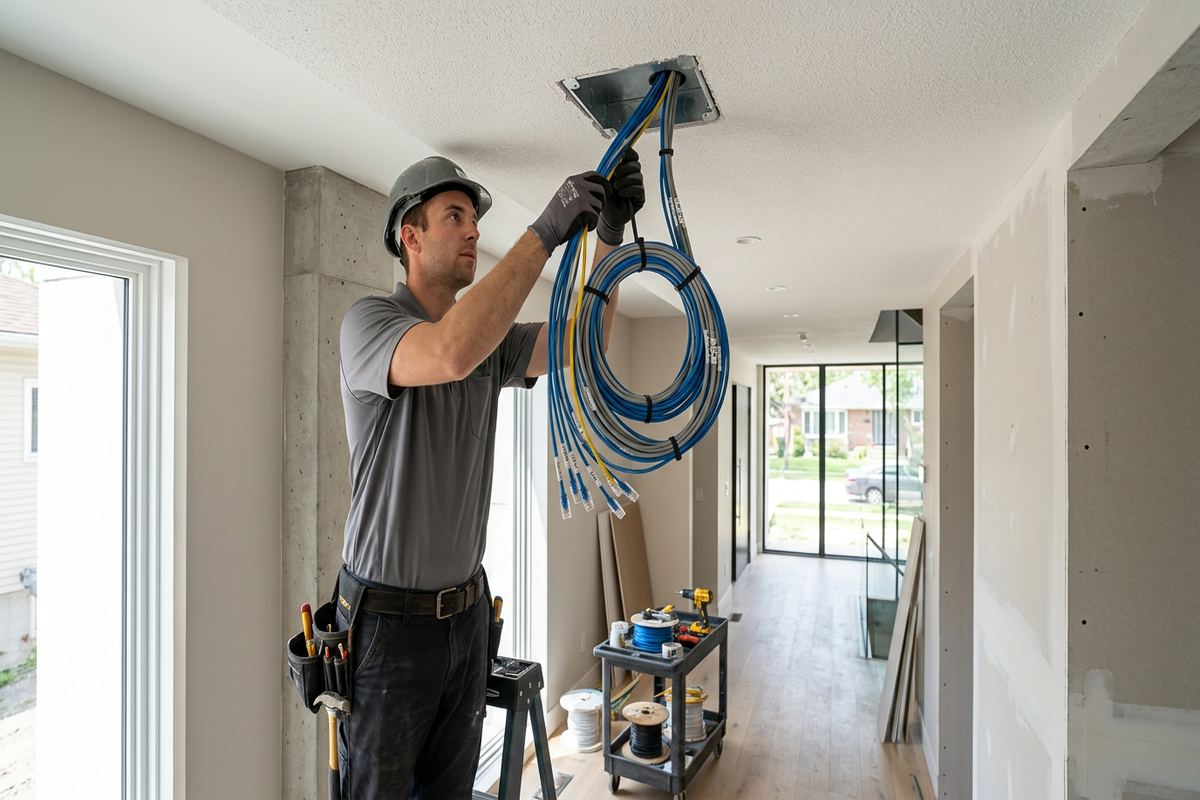
Wired Power over Ethernet cameras are often appropriate when stable recording and predictable connectivity matter. A continuous data cable runs from each camera to the network or recording location, carrying both power and data where compatible equipment is used. UnifiedLink avoids unnecessary hidden joins and labels both ends of every installed run. Cable routes may pass through unfinished basements, utility spaces, attics or carefully selected exterior pathways, depending on construction. The assessment confirms accessible routes and identifies areas where finished ceilings, insulation, fire separations or limited attic access affect the work.
Caledon housing includes newer frame construction, renovated homes and older buildings where wall cavities may not follow current layouts. Frame walls can provide concealed routes, but vapour barriers, blocking and spray foam may restrict access. Masonry walls require different anchors and drilling methods, and penetrations must avoid unnecessary damage to brick or stone. Where concealed routing is impractical, a neat surface route or exterior-rated pathway may be proposed. The written scope explains visible cabling and required openings, allowing the owner to approve the approach before cameras or cable supports are installed.
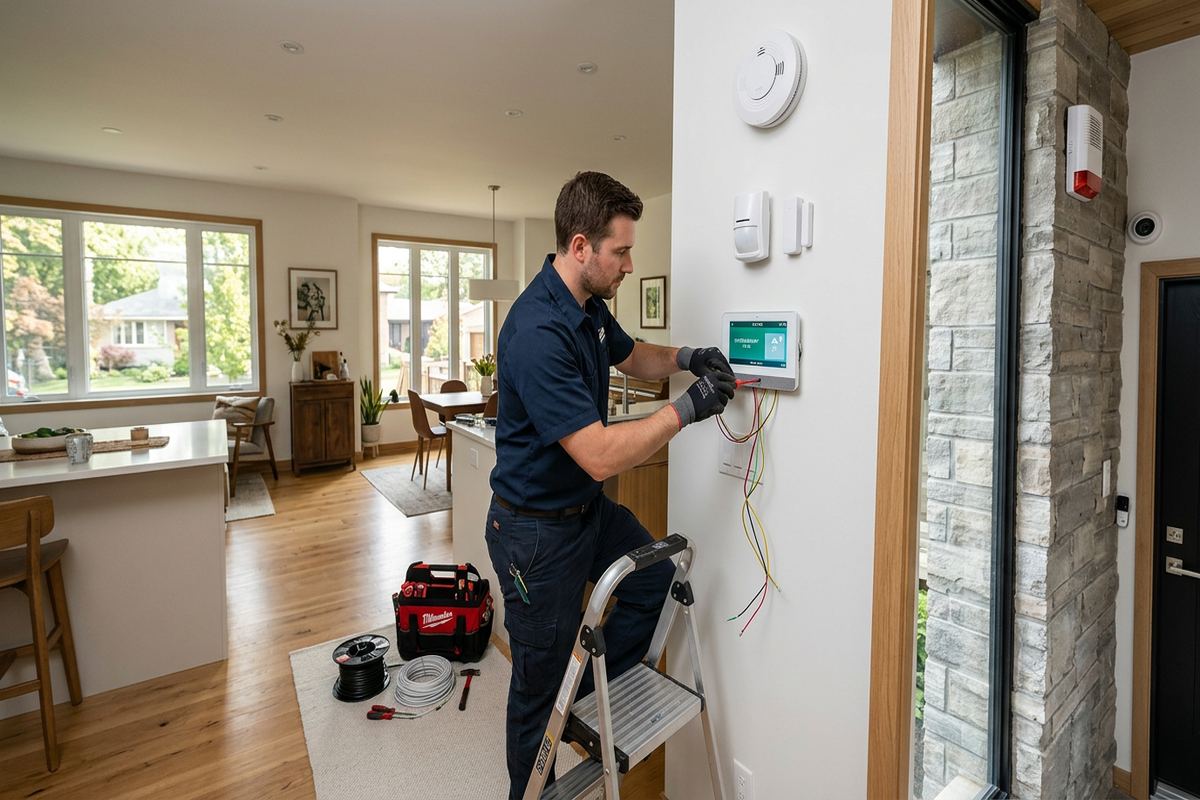
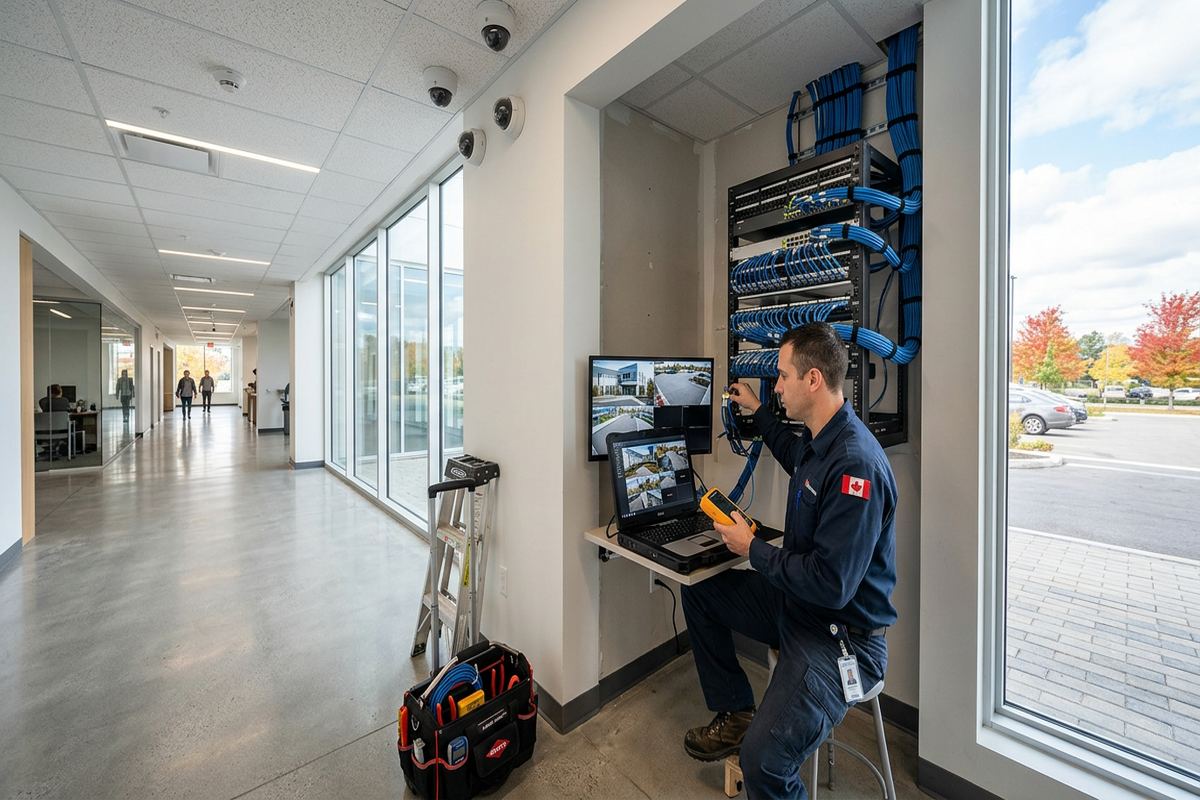
The recording location needs ventilation, electrical power and reasonable protection from casual access. Depending on the selected system, cameras may record to a local network video recorder, compatible server or other approved storage platform. We connect and configure devices on site, assign descriptive names and confirm live viewing and playback. Network changes are limited to what the agreed installation requires. At handover, the customer receives control through their own credentials rather than an installer-owned account. An as-built record identifies camera names, installed cable runs and relevant equipment locations for future maintenance.
- Continuous labelled cable runs
- Routes suited to frame or masonry construction
- Recorder location and ventilation review
- On-site camera and network configuration
- As-built cabling and device record
Outdoor Camera Mounting for Caledon Winters
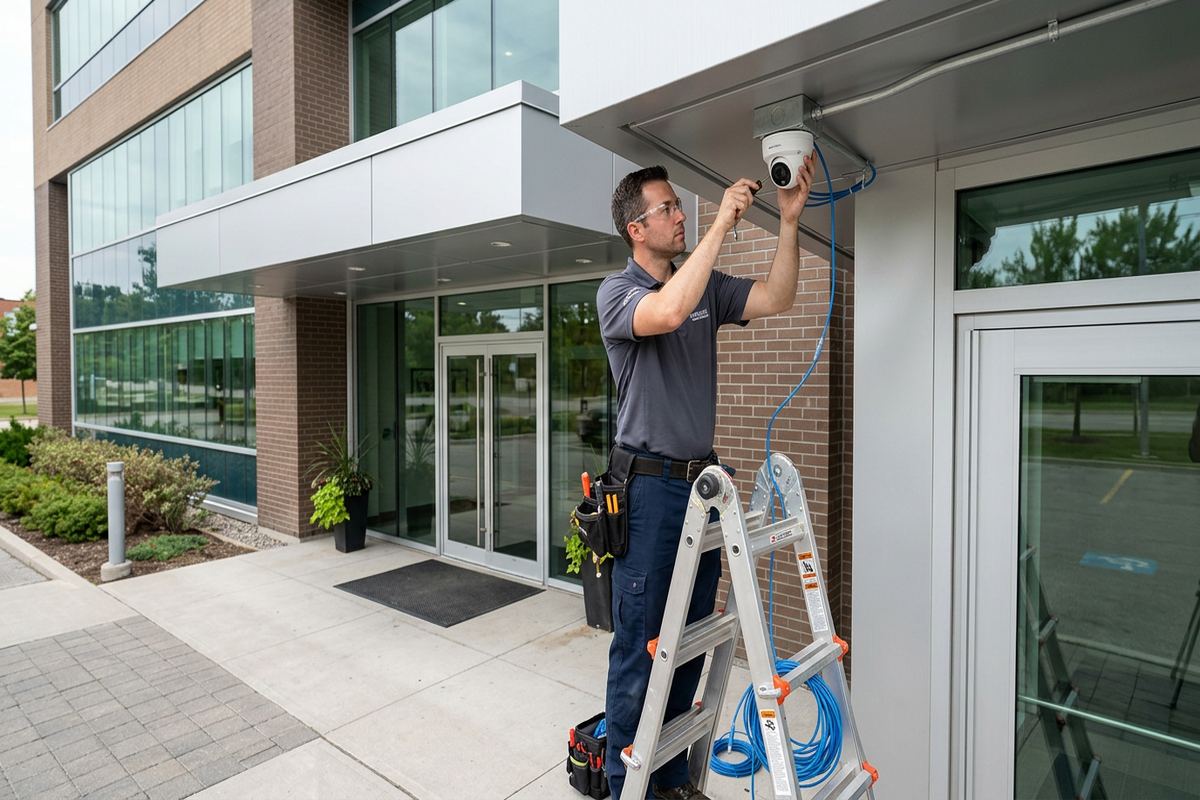
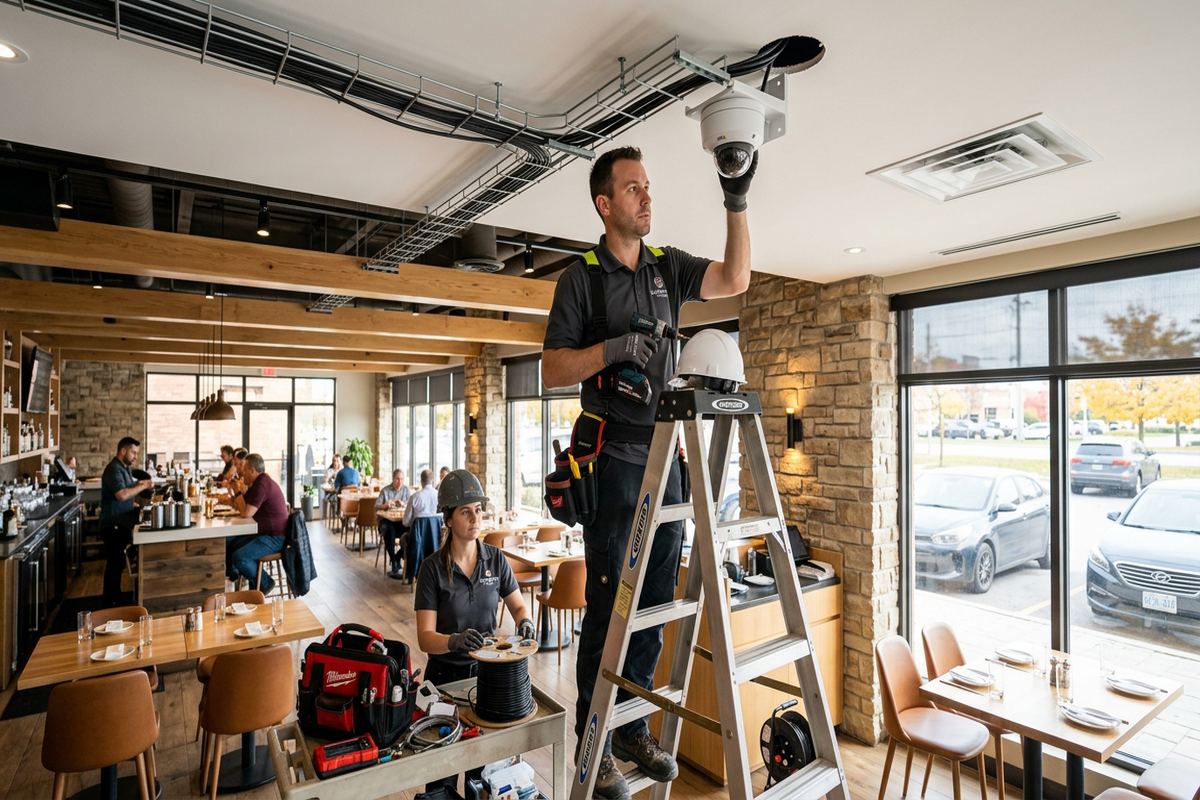
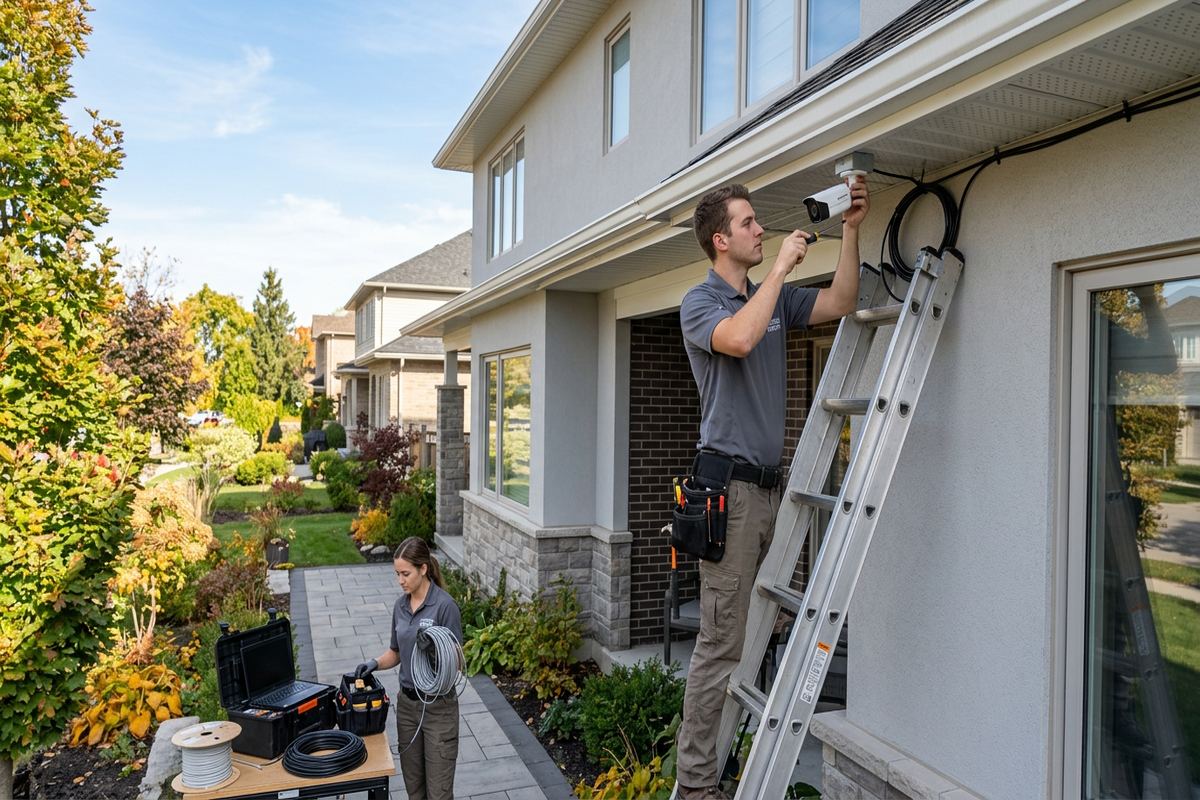
Exterior camera work in Caledon must account for repeated freezing, thawing, wind-driven rain and summer heat. A weather-rated camera is only one part of the installation; the mounting surface, junction protection, cable entry and drip management also matter. We select anchors for the underlying material and avoid fastening only to thin cladding where a secure substrate is available. Exterior penetrations are positioned and sealed to reduce water entry, while cable loops and fittings are arranged so moisture is not directed toward the building opening or camera connection.
Brick, poured concrete, siding, soffit and wood trim each require a different mounting approach. On masonry, the installer must consider mortar joints, brick condition and the route behind the penetration. On sided frame construction, the mount needs stable backing and should not crush or distort the finished surface. Soffit locations can be useful, but loose panels and very high mounting positions may produce poor identification views. In Caledon East, Inglewood and Alton, building additions or renovations can also leave mixed materials that need to be checked before drilling.
Winter conditions change the recorded scene as well as the hardware environment. Infrared light can reflect from snow, nearby walls, soffits, spider webs or moisture on a lens cover, reducing night detail. Low winter sun may create glare at entrances facing east or west, while summer leaves can later cover a clear spring view. We test the live image during configuration and set practical exposure, motion zones and lighting behaviour. Seasonal changes cannot be eliminated, but suitable angles and accessible mounting positions make cleaning, adjustment and ongoing review more manageable.
- Anchors selected for each mounting surface
- Sealed and protected exterior cable entries
- Drip paths kept away from penetrations
- Night glare and infrared reflection checked
- Mounting height balanced with identification needs
Caledon, Ontario
Home security camera installation in Caledon, scoped in writing first
Book a site assessment and get equipment, routes, exclusions, and warranty on paper before anything is installed.
Gate, Driveway and Outbuilding Coverage in Caledon
A gate camera can show activity at the property entrance, but useful identification depends on distance, angle, speed and lighting. For long Caledon driveways, one wide camera at the house rarely performs every task. A planned system may use an entrance view for arriving vehicles, another perspective near the home and separate coverage around a garage or workshop. We discuss whether the goal is general awareness, recognition of familiar vehicles or more detailed evidence. No camera can guarantee a readable plate in every weather, speed and lighting condition.
Connecting an outbuilding requires more than attaching a camera to whatever Wi-Fi signal happens to reach it. The assessment checks separation distance, available conduit, electrical service, line of sight and the construction of both buildings. Depending on site conditions, a buried pathway, fibre link, point-to-point wireless bridge or local recording arrangement may be considered. Each option has different limitations and must be included in the scope. Where existing underground conduit is available, its route and condition still need confirmation before it is treated as a usable cable path.
Gate access systems and cameras can be planned together without treating them as the same function. A camera provides a view and recording; it does not by itself control a gate, provide safe vehicle detection or replace required gate safety devices. Palgrave and other rural parts of Caledon may also have entrance pillars, fences, vegetation and roadside setbacks that constrain placement. UnifiedLink defines the camera, network and cabling work clearly, including exclusions involving gate operators, trenching, electrical service or third-party equipment when those items are outside the agreed project.
- Separate entrance and property overview views
- Outbuilding network path assessment
- Conduit and line-of-sight checks
- Gate camera limitations explained
- Related access-control work clearly separated
Recording, Remote Viewing and Camera Notifications
Recording settings should reflect the reason each camera was installed. Continuous recording may suit primary entrances or busy approaches, while event-based recording can help users review less active areas. Available retention depends on camera count, resolution, frame rate, recording mode and installed storage capacity. Rather than promising a fixed number of days without calculation, UnifiedLink configures the agreed equipment and explains the factors that affect stored history. During handover, the customer is shown how to find a camera, search the timeline, export available footage and confirm that recording is operating.
Remote viewing normally depends on the property’s internet service, local network and the selected camera platform. Caledon acreages can have variable internet arrangements, so an assessment may need to distinguish local recording reliability from remote application performance. Cameras on a wired local network may continue recording during an internet outage if the recorder, cameras and required power remain available, but remote access will generally be interrupted. We configure approved mobile or desktop access on site and use the customer’s own account credentials. Passwords should be unique, retained securely and protected with supported multifactor authentication.
Motion notifications require adjustment because outdoor scenes contain unavoidable movement. Headlights, tree branches, insects, precipitation, shadows and animals can all generate events, particularly on rural properties. Person or vehicle classification may reduce unwanted alerts on compatible equipment, but it should not be treated as perfect detection. We establish practical zones and schedules based on the agreed coverage, then explain how the owner can refine them after observing normal activity. A quiet driveway in Inglewood may need different settings from a Bolton home near regular pedestrian or road traffic.
- Recording mode configured by camera purpose
- Retention factors explained during handover
- Customer-owned remote access credentials
- Practical motion zones and schedules
- Playback and footage export demonstrated
Camera Upgrades for Caledon Homes and Rentals
An existing system may be reusable in part, but compatibility must be verified rather than assumed. Older analogue cabling, network cable, power supplies, recorders and camera mounts can each affect an upgrade. We inspect accessible wiring, identify equipment where possible and test relevant connections before proposing reuse. Some older coaxial systems can support replacement technology with suitable equipment, while damaged or poorly routed cables may be better replaced. The written scope states which customer-owned components remain, which new components are supplied and any limitations created by retaining existing infrastructure in the Caledon property.
Renovations are a practical time to install camera cabling before insulation and drywall close the routes. For finished homes, careful planning can reduce disruption, although concealed cable access is never identical across buildings. Older houses may contain plaster, masonry partitions or additions with uncertain transitions; newer construction may include dense insulation and finished basements. We discuss expected access openings, visible pathways and areas that are excluded from repair or painting. One accountable contractor coordinates the approved low-voltage camera work, reducing ambiguity about who installed, labelled and configured each part of the system.
Tenants, landlords and condominium owners should obtain the required permission before exterior drilling, cabling or mounting begins. Condo corporations may control common walls, soffits, hallways, parking areas and exterior appearance, even when a camera is intended to serve one unit. A landlord may also set conditions for penetrations and removal at the end of a tenancy. UnifiedLink can provide a proposed device and cable plan for approval, but the customer is responsible for securing required authorization. Views should remain focused on the permitted area and avoid unnecessary coverage of shared private spaces.
- Existing cameras and cabling assessed
- Reusable equipment identified in writing
- Renovation-stage pre-wiring available
- Access openings and finishes discussed
- Condo or landlord approval required
Home Cameras Near Commercial and Industrial Areas
Some Caledon properties sit near commercial strips, employment areas or mixed residential activity, particularly around Bolton and Mayfield West. Passing vehicles, deliveries, pedestrians and adjacent lighting can make notification settings more complex than on a secluded acreage. Camera views should prioritize the home’s own doors, parking area and access routes instead of continuously monitoring public or neighbouring spaces without a defined purpose. During planning, we use framing and supported privacy masking where appropriate, then configure motion areas to reduce events caused solely by distant road traffic or activity outside the relevant zone.
Homes with workshops, home occupations or detached storage buildings may need coverage that resembles a small commercial layout. The design should still separate observation, identification and operational needs. A wide view can document activity around loading doors, while a closer camera may be needed at a personnel entrance. If employees, contractors or customers attend the property, the owner should consider applicable privacy, workplace and notice obligations. UnifiedLink installs the agreed technical system but does not replace legal advice. Audio recording is discussed separately because legal and privacy considerations differ from ordinary video coverage.
Industrial units and commercial premises require additional review if a homeowner also operates or owns a nearby business. Ceiling height, loading bays, warehouse lighting, network separation and landlord restrictions can materially change the design. A residential package should not simply be copied into an industrial space. For any Caledon business location, we confirm the intended monitoring areas, existing network responsibility and approval for drilling or cable pathways. The scope also distinguishes customer equipment from supplied equipment, which is important when a tenant may later relocate while cameras, cabling or mounts remain part of the premises.
- Traffic-related motion zones refined
- Home workshop coverage planned by purpose
- Privacy masking used where supported
- Audio requirements reviewed separately
- Commercial and landlord constraints documented
Site Assessment, Installation and Handover in Caledon
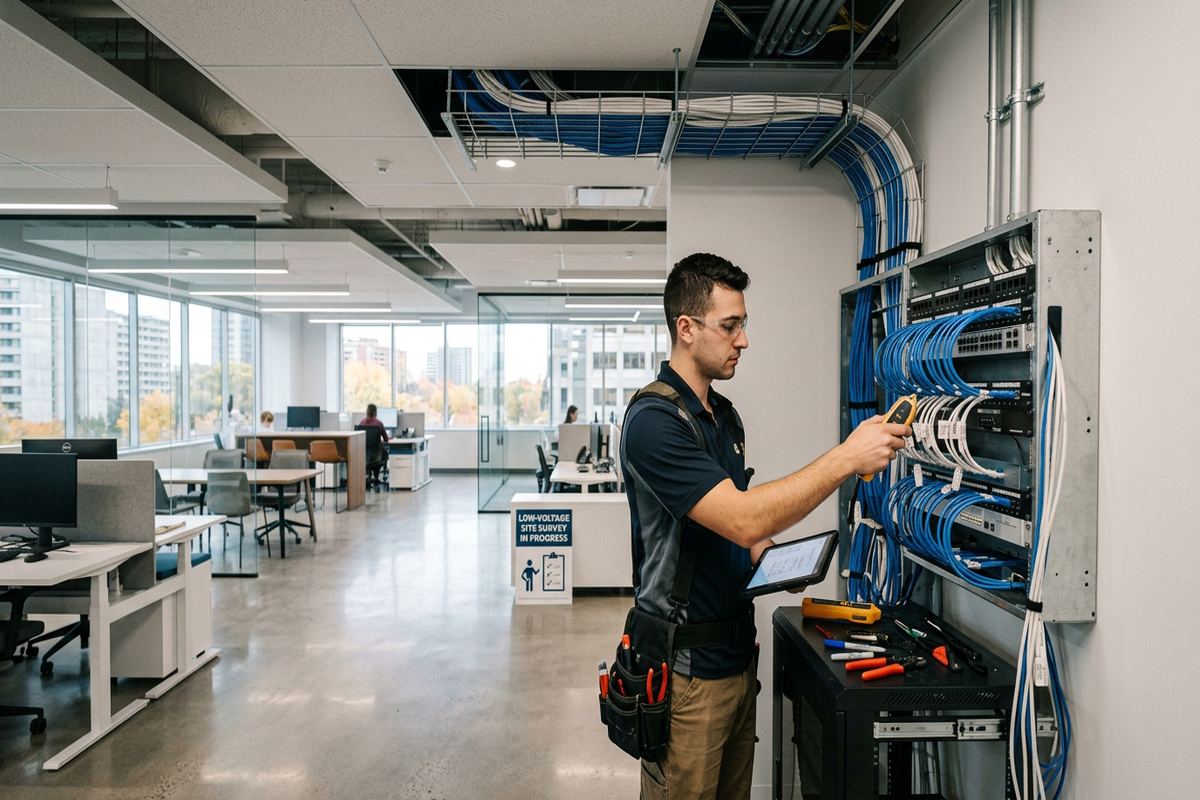
Every project begins with enough information to understand the property and requested outcome. Photos and an initial discussion can help identify likely requirements, but final pricing follows a site assessment. Timing depends on the service and travel distance. Requests sent during business hours are answered the same day, while after-hours requests are answered the next business day. At the Caledon property, we verify construction, camera positions, cable pathways, recorder location, network access and any gate or outbuilding connections. Uncertain conditions are recorded rather than hidden inside a broad assumption.
The resulting written scope covers equipment, cable routes, device placement, exclusions, equipment ownership and warranty. Once approved, installation follows that scope, with changes documented if site conditions reveal an inaccessible route or unsuitable mounting surface. Cable runs are continuous and labelled, devices are mounted with appropriate supports, and exterior entries are sealed for the surface and exposure. Configuration takes place on site so camera names, recording, time settings, image orientation and approved remote access can be checked against the installed system rather than prepared without seeing the final views.
Handover is intended to leave the owner able to operate the system without depending on an installer-controlled login. We provide access using the customer’s own credentials and review live view, playback, footage export and basic notification controls. The as-built record lists relevant camera names, equipment locations and installed cable information. Owners should periodically confirm recording, clean accessible lenses and review notifications after seasonal changes or network replacements. From Bolton to Palgrave, this consistent process gives Caledon customers one accountable contractor for the assessed camera, cabling, configuration and documented handover work.
- Site assessment completed before pricing
- Detailed written scope provided
- Installation checked against final camera views
- Owner credentials used at handover
- As-built record supplied after completion
Caledon neighbourhoods we cover
- Bolton
- Caledon East
- Inglewood
- Alton
- Mayfield West
- Palgrave
Home security camera installation in Caledon — common questions
How many cameras does my Caledon home need?
The number depends on the views and evidence required, not simply the property size. A typical assessment considers entrances, driveway approaches, side access, attached garages and detached buildings. Long Caledon driveways may need separate entrance and house views because one camera cannot provide both broad coverage and close identification at every distance. We determine proposed positions during the site assessment before pricing.
Can cameras reach a gate or detached outbuilding?
Often, but the connection method depends on distance, conduit, power, line of sight and the buildings involved. Caledon acreages may use underground cabling, fibre, a point-to-point wireless bridge or another planned arrangement. Ordinary home Wi-Fi should not be assumed to provide reliable coverage. The assessment identifies the practical option and states related trenching, electrical or third-party exclusions in the written scope.
Will outdoor cameras work through a Caledon winter?
Equipment intended for exterior use can operate in winter when selected and installed for the location, but mounting and sealing are also important. We use suitable anchors, protect cable entries and consider freeze-thaw exposure, snow reflection and moisture. Owners should keep accessible lenses clear and periodically inspect views because snowbanks, ice, salt residue and seasonal sun angles can affect the image without indicating equipment failure.
Can you reuse my existing camera wiring?
Possibly. UnifiedLink first checks the cable type, route, condition, terminations and compatibility with the proposed equipment. Some network or coaxial runs may be reusable, while damaged, joined or poorly placed wiring may limit performance. For a Caledon upgrade, the written scope identifies what remains customer-owned, what will be reused and what should be replaced, rather than assuming all existing infrastructure is serviceable.
Do I need approval for a condo or rental installation?
Yes, obtain any required condominium, landlord or property-management approval before drilling, exterior mounting or running cable through controlled areas. Common walls, soffits, corridors and parking areas may not be under the occupant’s authority. We can document proposed camera positions and cable routes for review. Caledon customers remain responsible for securing permission and ensuring views do not unnecessarily capture neighbouring or shared private spaces.
How soon will UnifiedLink respond and attend?
Requests sent during business hours are answered the same day, and after-hours requests are answered the next business day. Site assessment timing depends on the service and travel distance within or around Caledon. An assessment is completed before pricing so equipment, mounting surfaces, cable routes, network requirements and exclusions can be reflected in a written scope. We do not provide a fixed attendance guarantee before reviewing those details.
Coverage in Caledon is confirmed against the address before we quote. See everything we install in Caledon or the province-wide home security camera installation page.