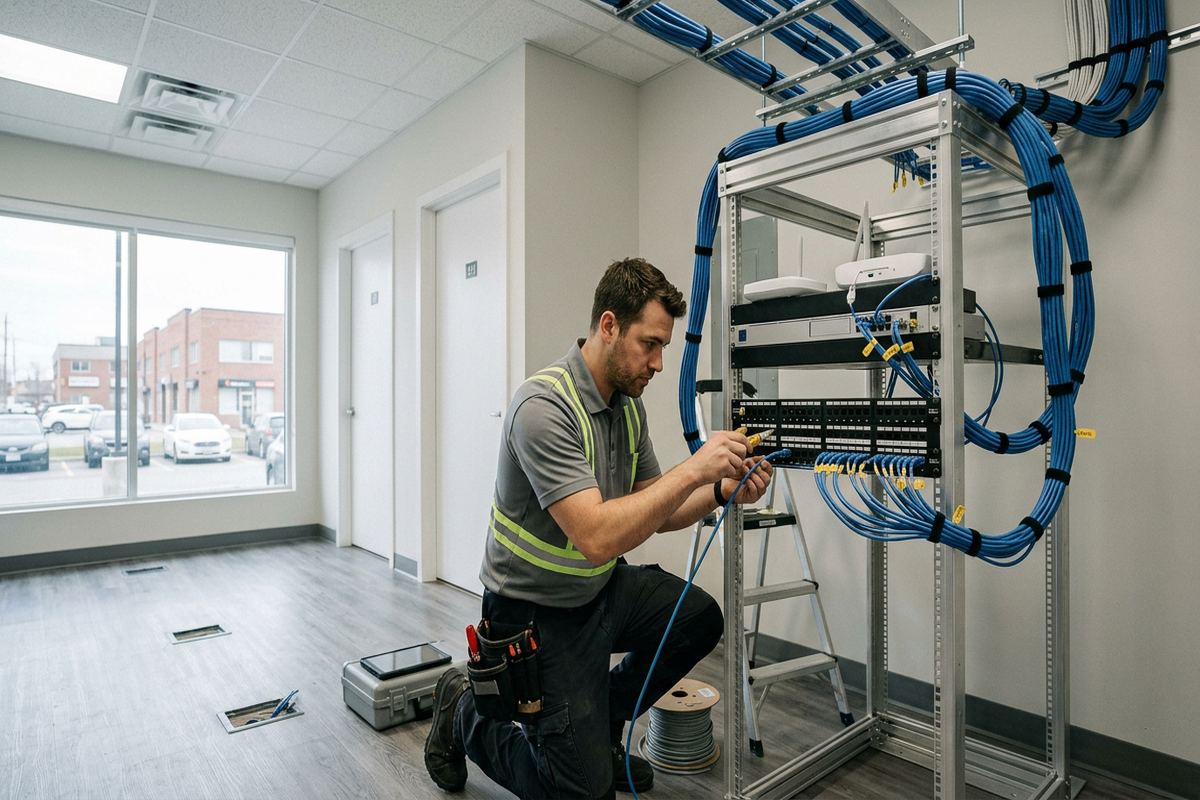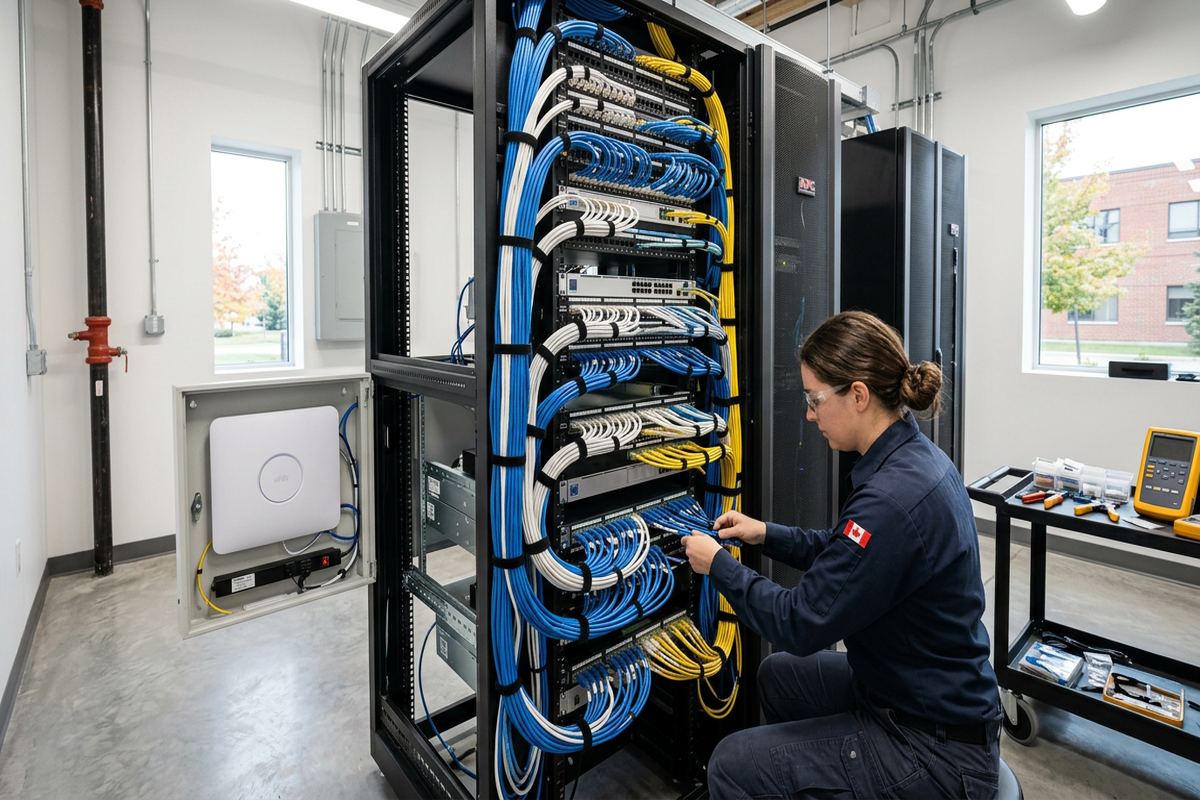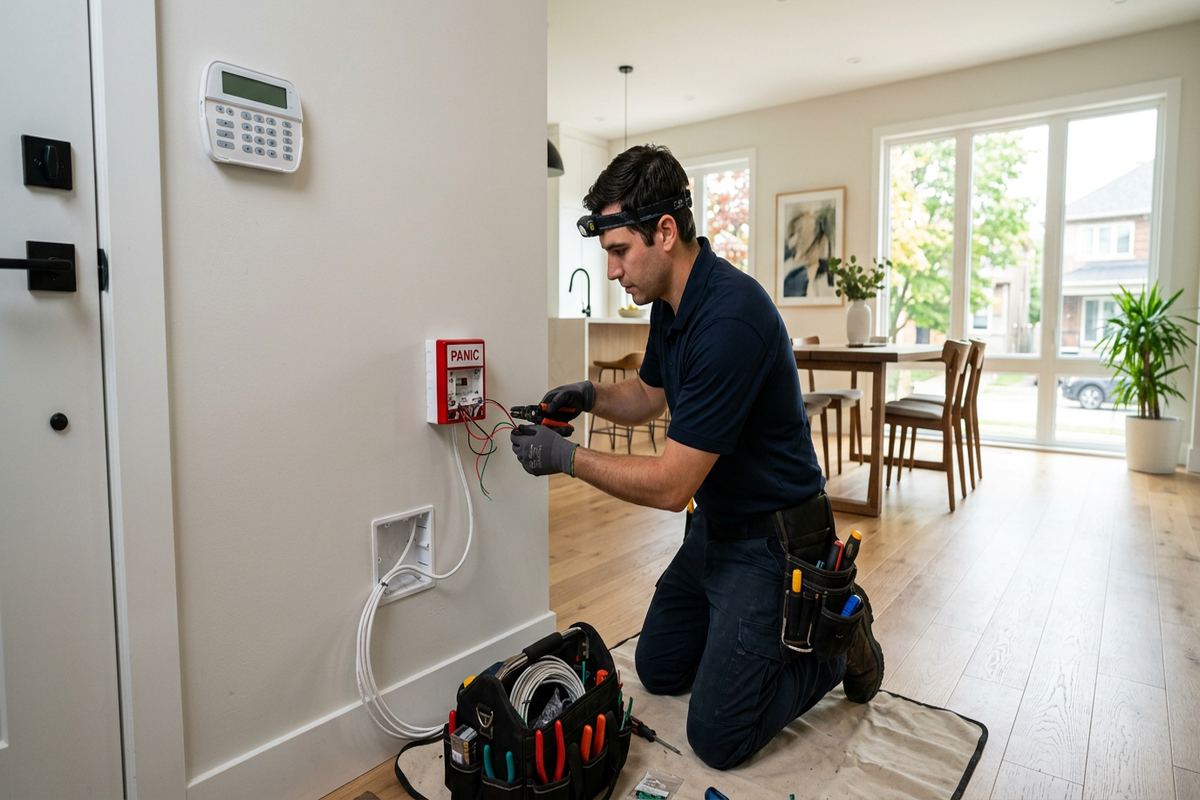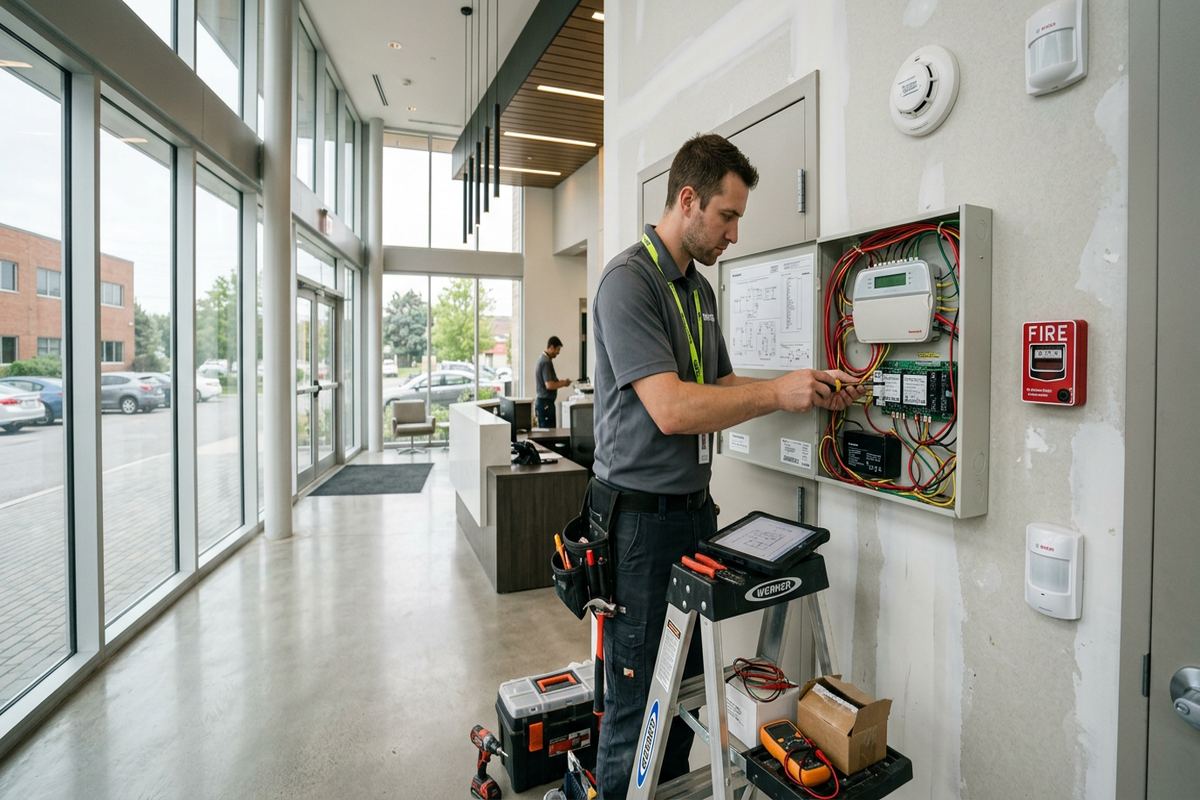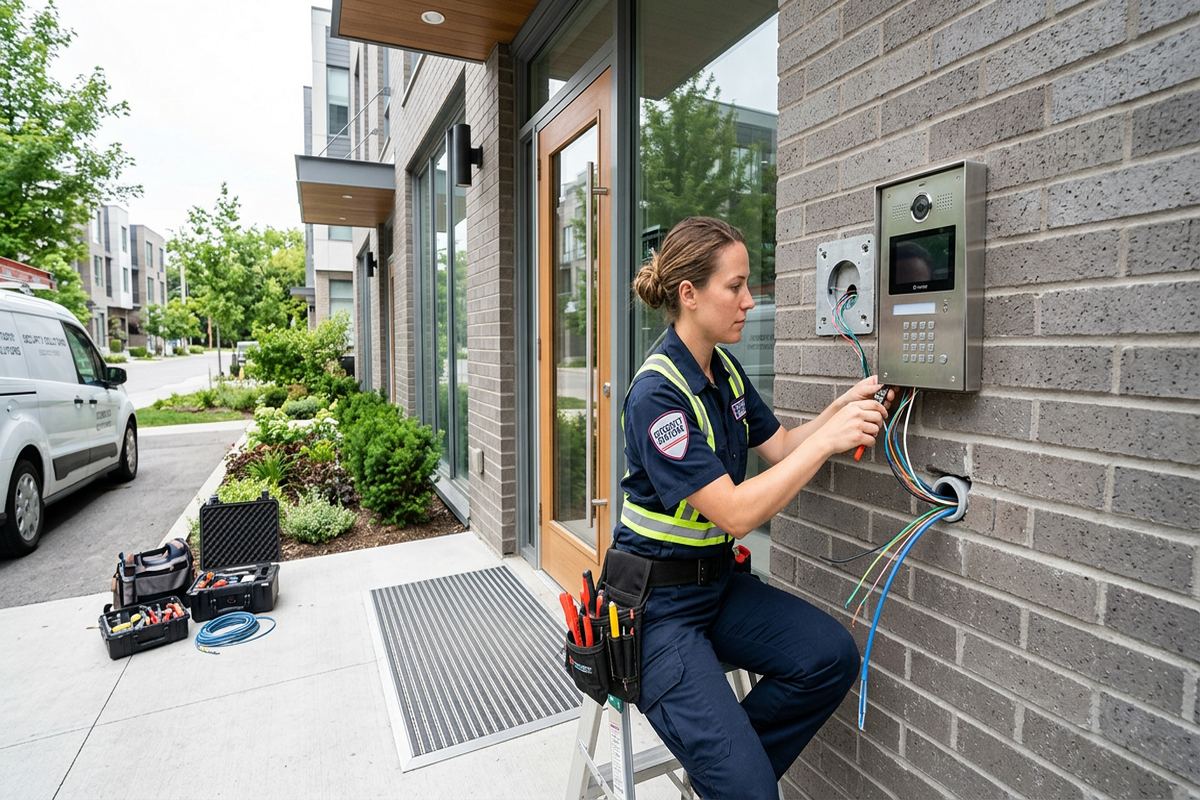
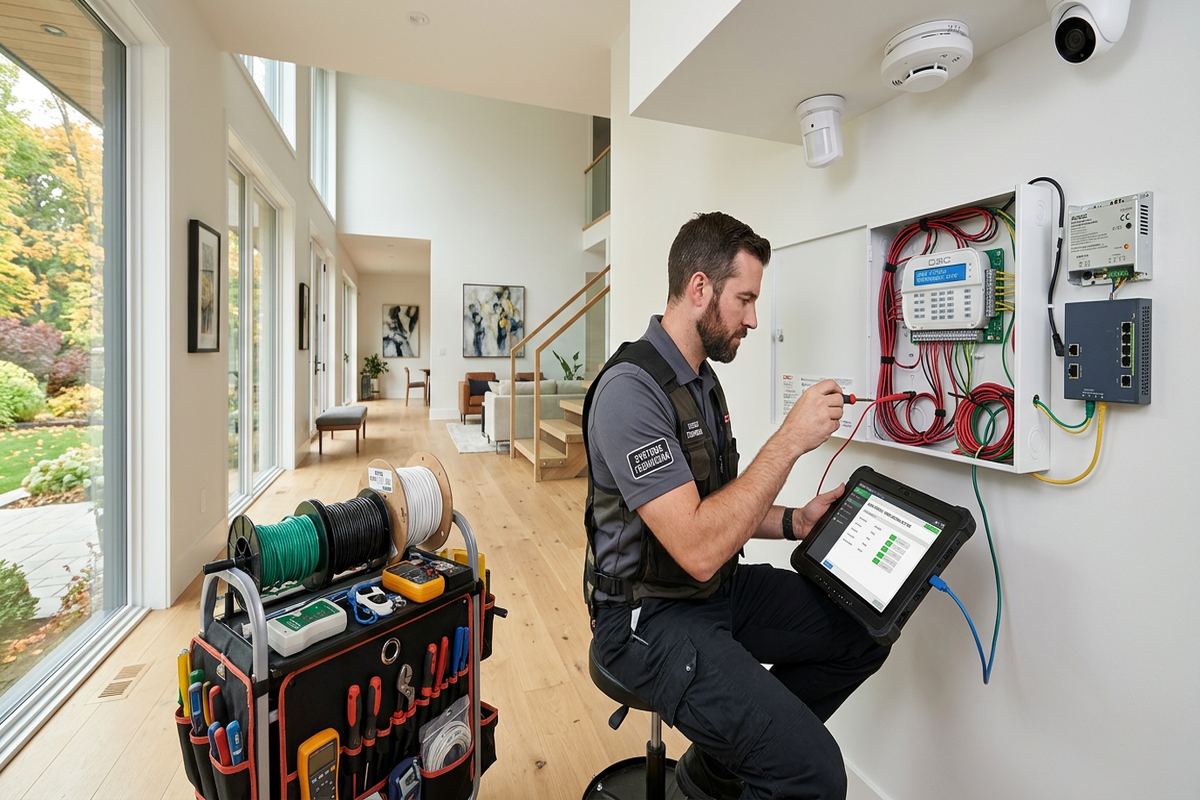
UnifiedLink installs commercial alarm systems for offices, shops, industrial units, rural businesses, and mixed-use properties across Caledon. We assess the site before pricing, document the proposed equipment and cable routes, configure the system on site, and provide a practical handover using the customer’s own credentials. Wired, wireless, and hybrid designs are available according to the building and operating requirements.
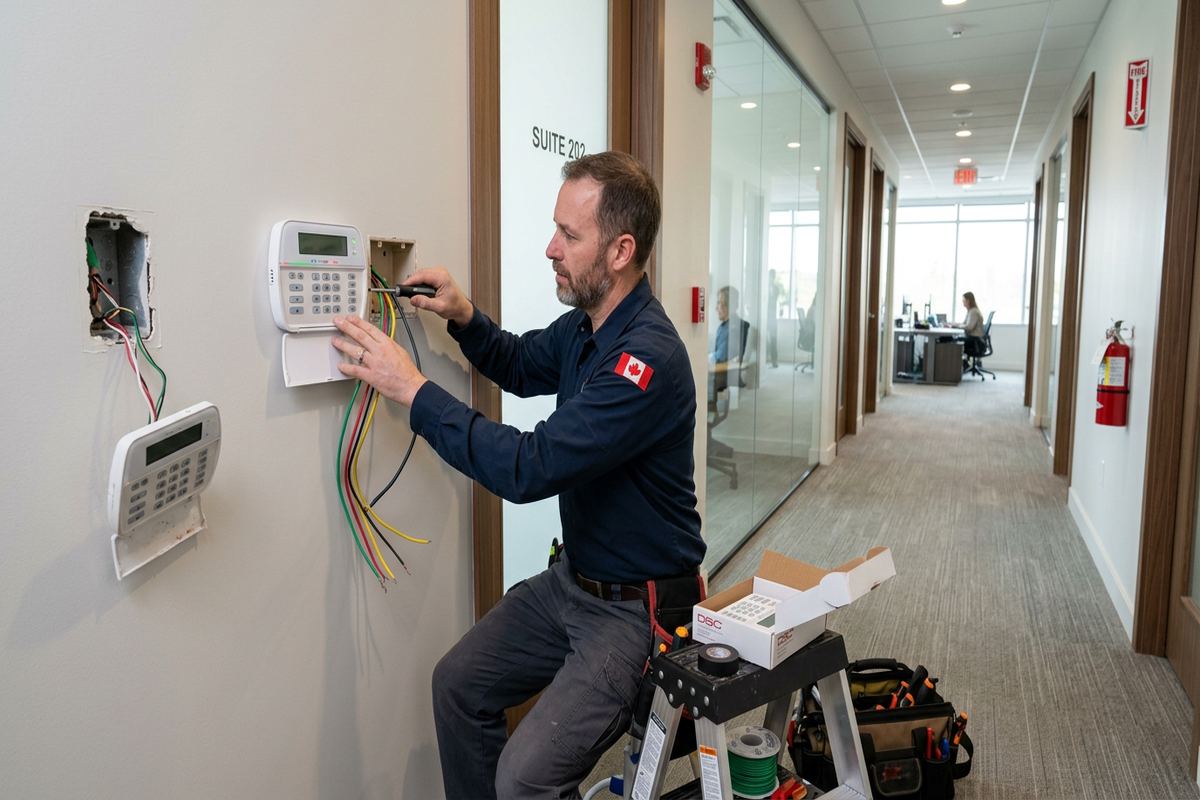
Commercial Alarm Installation for Caledon Properties
Commercial alarm design starts with how the Caledon property is actually used. A street-facing shop in Bolton has different entry points, schedules, and public areas than a contractor’s yard near Palgrave or an office operating from a rural acreage. We review exterior doors, loading areas, internal circulation, valuable rooms, staff access, and after-hours activity. This assessment helps determine where door contacts, motion detectors, glass-break sensors, keypads, sirens, and other devices belong without covering spaces unnecessarily or leaving predictable gaps in the planned detection layout.
Building layout affects both detection and installation. Older commercial buildings may contain renovated sections, mixed wall assemblies, inaccessible ceiling spaces, or legacy wiring with uncertain labels. Newer units in Mayfield West may offer clearer pathways but can still have finished ceilings, fire separations, landlord requirements, and shared service areas. We inspect likely cable routes before proposing equipment. Where practical, continuous labelled cable runs are used between devices and control equipment, reducing concealed joints and making future testing, troubleshooting, or system changes easier for the property owner and service contractor.
Alarm equipment must also fit daily operations. Staff need straightforward arming procedures, managers may require separate permissions, and cleaners or delivery personnel may need limited access at defined times. We discuss partitions, user codes, opening schedules, notification paths, and areas that remain occupied after the public leaves. If access control, cameras, gates, or intercoms are present, their relationship to the alarm is reviewed carefully. Integration is included only where compatible, useful, and clearly documented rather than assumed from product branding or an existing device’s network connection.
- Door, window, motion, and glass-break detection
- Keypads placed around actual opening routines
- Separate partitions for offices or outbuildings
- Documented review of compatible system integrations
- Audible and notification device planning
Alarm Planning for Rural Caledon Sites
Rural acreages, long driveways, and detached outbuildings are common considerations around Caledon. A single control panel inside the main building may not address a workshop, storage barn, gate, or utility structure effectively. Distance, available pathways, power, network coverage, and environmental exposure all affect the design. We identify which structures need independent detection, shared arming, or separate partitions. Gate access and outdoor camera coverage also come up often, so alarm planning should account for how vehicles, staff, visitors, and deliveries move between the road and each secured building.
Long cable distances require more than selecting a convenient route on a drawing. Voltage drop, conductor type, surge exposure, underground pathways, and future service access must be considered before devices are assigned. Existing conduits are inspected where accessible, but they are not assumed to be usable or correctly sized. Wireless links may solve specific routing problems, although distance, terrain, construction materials, battery maintenance, and radio interference can limit reliability. The written scope identifies the proposed method so owners can see which connections are wired, wireless, network-based, or dependent on another building’s services.
Outbuildings also experience different conditions from occupied offices. Temperature swings, dust, moisture, pests, large doors, and machinery can affect detector choice and placement. A motion detector suited to a conditioned room may perform poorly in an unheated structure with moving equipment or changing sunlight. Door contacts and cable entries need appropriate mechanical protection. For properties near Caledon East, Inglewood, or Palgrave, we assess each building as its own environment rather than extending the main-building design by default. This produces a clearer plan for operation, maintenance, and eventual expansion.
- Separate protection for detached buildings
- Long-distance cable and conduit assessment
- Gate and driveway activity considered
- Environmental device selection for unheated areas
- Wired, wireless, or hybrid options documented
Choosing Detection Devices
Device selection should follow the risk and room conditions, not a standard package. Door contacts identify openings, motion detectors cover movement within selected areas, and glass-break sensors may support rooms with accessible glazing. Panic or duress devices can be considered where staff handle sensitive interactions, while temperature or water sensors may address specific operational risks. Each device has limitations, so overlapping technologies are used only when they provide a clear purpose. The scope identifies proposed equipment, placement, and exclusions before installation begins, allowing the owner to review what the system will and will not detect.
Commercial spaces often change during the day. A warehouse may have active loading doors while the office remains armed, or a retail unit may need stockroom protection after front-of-house staff arrive. Partitioning can divide the alarm into practical areas, provided users understand the controls. We map zones to recognizable names instead of relying on unexplained numbers. In multi-tenant buildings, system boundaries, shared entrances, and responsibility for common spaces must be confirmed. Landlord or condominium approval may also be required before cabling, drilling, exterior devices, or connections to shared infrastructure proceed.
False alarms are often linked to unsuitable placement, incomplete user procedures, unsecured doors, moving stock, or environmental conditions. Installation details therefore matter as much as the control panel. Detectors are positioned with sightlines, heat sources, ceiling fans, overhead doors, and normal staff movement in mind. Contacts are aligned and protected from routine impact where practical. During configuration, zone types, entry delays, schedules, and user permissions are reviewed against operations. Testing confirms device signals and annunciation, but ongoing housekeeping and staff training remain important parts of dependable alarm use.
- Contacts for selected doors and windows
- Motion coverage based on room conditions
- Glass-break detection where appropriate
- Clearly named zones and partitions
- Optional environmental or duress inputs
Caledon, Ontario
Commercial alarm system installation in Caledon, scoped in writing first
Book a site assessment and get equipment, routes, exclusions, and warranty on paper before anything is installed.
Wired and Hybrid Alarm Systems in Caledon
A wired alarm remains practical where cable pathways are accessible and long-term serviceability matters. Continuous labelled runs provide a traceable connection between field devices and the control location, while properly planned power and enclosure space support orderly maintenance. Finished buildings can make new cabling disruptive, however, especially where ceilings are inaccessible or walls contain fire separations. During the Caledon site assessment, we compare available routes with device requirements and visible-finish expectations. The written scope records proposed routes and identifies areas where access panels, surface raceway, or localized wall repair may be required.
Wireless devices can reduce disturbance in completed interiors, but they still require deliberate planning. Batteries need periodic replacement, radio paths can change as shelving or equipment is added, and masonry, metal cladding, refrigerators, or dense storage can reduce signal performance. We test likely locations rather than assuming advertised range will apply inside a specific building. A hybrid system can combine wired devices in accessible areas with wireless equipment where routing is impractical. This approach is useful only when ownership understands the maintenance differences and the control equipment supports both methods appropriately.
Existing alarm wiring may sometimes be reused after inspection and testing, but reuse is not guaranteed. Cable condition, conductor count, routing, labels, end-of-line components, and compatibility with the proposed panel all matter. Abandoned or undocumented wiring can increase troubleshooting time and conceal faults behind finished surfaces. We identify tested reuse separately from new work in the scope. Equipment ownership is also documented, including any devices supplied by another party. This gives a Caledon business a clear record of which infrastructure remains, what is replaced, and what future service will depend upon.
- Continuous labelled cable runs where practical
- Wireless coverage checked at proposed locations
- Hybrid designs for difficult finished spaces
- Existing wiring tested before approved reuse
- Cable routes and repair exclusions documented
Exterior Installation and Ontario Weather
Exterior alarm components in Caledon must tolerate winter temperatures, precipitation, and repeated freeze-thaw cycles. Cable entries, junction points, conduits, and device housings need to be selected and installed for their exposure. Water can travel along poorly routed cable or enter through an unsealed penetration, causing intermittent faults that are difficult to reproduce indoors. We use suitable exterior pathways, form drip arrangements where required, and seal penetrations according to the wall assembly. Devices are not described as weather-resistant unless their specified rating and installation method support the proposed location.
Mounting methods vary between masonry, concrete, metal cladding, and frame construction. Brick veneer should not be treated like structural concrete, while hollow block may require different anchors and careful routing. Frame walls can offer concealed pathways, but vapour barriers, insulation, and interior finishes limit where openings should be made. Commercial strips in Bolton and industrial units elsewhere in Peel Region may also have fire-rated demising walls or landlord-controlled façades. These conditions are reviewed before drilling, with approvals obtained by the customer where the lease or condominium rules require them.
Outdoor detection demands careful expectations. Animals, vegetation, blowing debris, headlights, snow accumulation, and changing temperatures can affect devices exposed to open areas. For that reason, perimeter alarm detection is not treated as a direct substitute for secured doors, controlled gates, good lighting, or properly positioned cameras. On rural Caledon properties, an alarm event at an outbuilding or gate should be considered alongside the time needed to investigate it. We document environmental limitations and recommend layered measures where a single technology would leave an avoidable operational or verification gap.
- Sealed exterior cable penetrations
- Mounting suited to each wall assembly
- Freeze-thaw and snow exposure considered
- Customer obtains required façade approvals
- Outdoor detector limitations explained
Installation, Configuration, and Testing
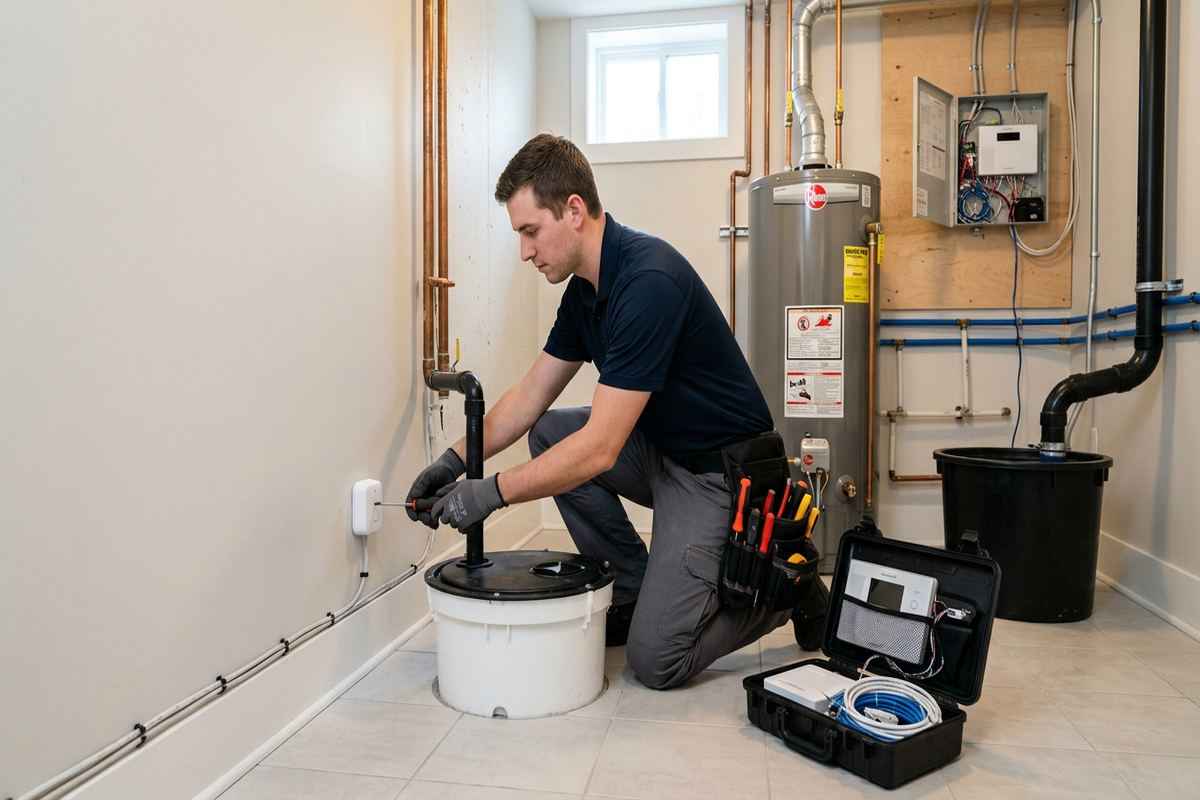
Installation begins from an agreed written scope covering equipment, routes, placement, exclusions, ownership, and warranty. Any site condition that changes the proposed work is discussed before the affected portion proceeds. Cable is routed through approved pathways, supported appropriately, and labelled at service points. Control equipment is mounted where authorized users can reach it without placing it in an obvious public location. Detectors and contacts are installed to suit their surfaces and operating clearances. Work around occupied areas is coordinated with the customer’s representative to reduce conflict with staff, tenants, deliveries, and normal business activities.
On-site configuration turns installed hardware into an operating alarm system. Zones receive useful names, entry and exit delays are set for real travel paths, and partitions follow the customer’s opening and closing routines. User permissions are assigned according to roles rather than sharing one code among everyone. Notification settings depend on the selected equipment, communications services, and any monitoring arrangement. Where third-party monitoring is involved, account activation and dispatch procedures must be confirmed with that provider. UnifiedLink does not assume those services are active merely because the panel can communicate with them.
Testing covers each installed input, audible device, keypad, partition, and configured notification path within the agreed scope. Doors are opened, contacts checked, motion areas walked, and relevant delays observed. Communication features are verified using the available service and account configuration. Staff receive practical instruction on arming, disarming, bypassing a zone, recognizing trouble messages, and handling common user errors. Tests represent conditions at handover; later renovations, furniture changes, damaged doors, network changes, or expired wireless batteries can alter performance and should be addressed through periodic inspection and maintenance.
- Installation follows the approved written scope
- Zones labelled with recognizable names
- Role-based codes and permissions configured
- Devices and notification paths tested
- Staff shown routine system operation
Alarm Handover and System Records
A commercial alarm should not leave the owner dependent on an installer’s private account. At handover, the customer receives access using the customer’s own credentials wherever the selected platform allows it. Administrative roles are reviewed so authorized personnel understand who can add users, change schedules, or adjust notifications. Credentials should then be stored securely and updated when managers or keyholders leave. If a manufacturer portal, communicator, or monitoring account has separate ownership terms, those relationships are identified rather than grouped together under a vague description of cloud access or remote service.
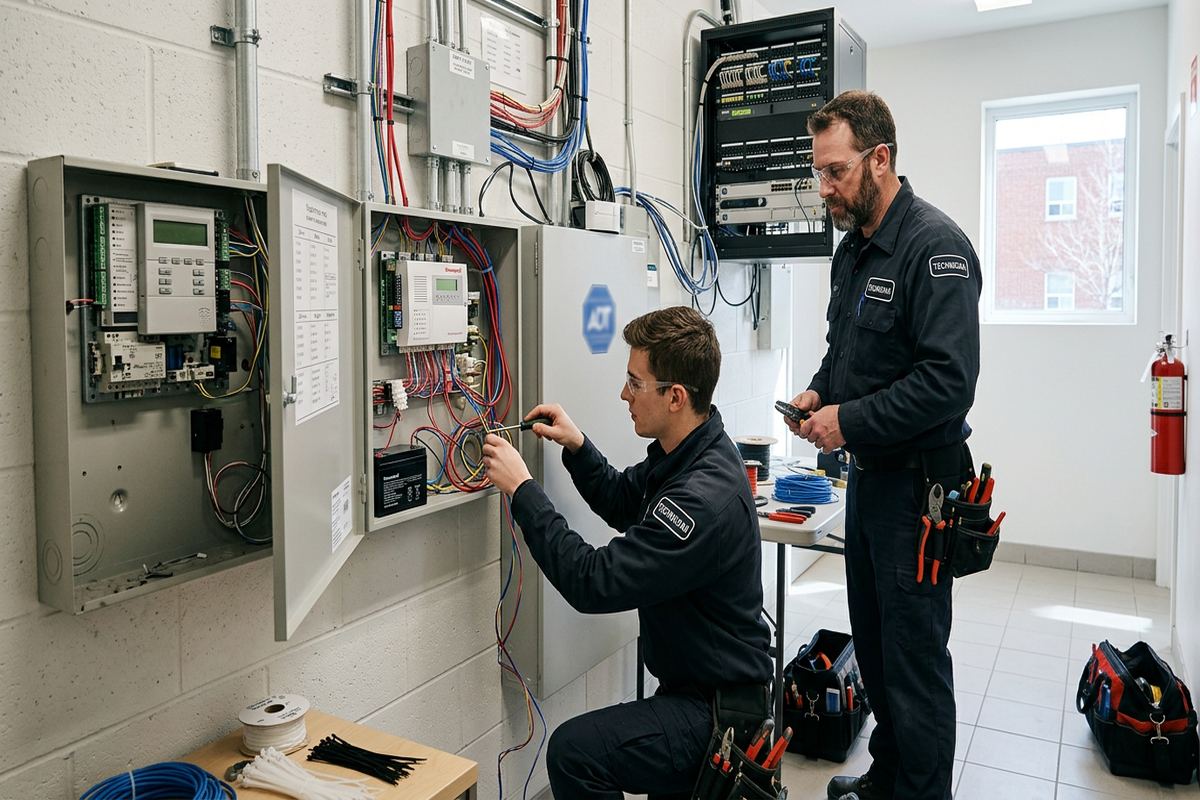
The as-built record reflects the installed system rather than only the original proposal. It can identify device and zone locations, panel and expansion equipment, cable references, partitions, and relevant network dependencies. Exact content depends on the project and security sensitivity, so distribution should be controlled by the owner. Equipment ownership, exclusions, and warranty information are included in the project documentation. For multi-building Caledon sites, records are particularly useful because they distinguish which devices belong to each structure and which links depend on shared power, conduit, wireless communication, or network infrastructure.
Handover also defines outstanding responsibilities. The owner may need to finish monitoring agreements, maintain a cellular or internet service, distribute user procedures, obtain landlord approval for later changes, or arrange repairs to finishes excluded from low-voltage work. Battery replacement, sensor cleaning, door alignment, and testing should be planned according to the equipment and environment. If cameras, access control, Wi-Fi, or gate systems are included, their records should identify any dependencies without implying that every platform is fully integrated. Clear documentation makes future service decisions easier for authorized parties.
- Customer-controlled administrative credentials
- As-built device and zone record
- Equipment ownership stated in writing
- Warranty information included
- Ongoing customer responsibilities identified
Requesting an Alarm Assessment in Caledon
Before pricing, UnifiedLink conducts a site assessment suited to the proposed service and property. The visit reviews entrances, rooms, construction, available cable pathways, communications, power, operating schedules, and any alarm equipment already present. For rural Caledon locations, it may also include gates, long driveways, separate structures, and links between buildings. Access to electrical, network, ceiling, and control areas helps produce a useful scope. Site assessment timing depends on the service and travel distance, so scheduling is confirmed after the initial property and project details are received.
Useful preparation includes floor plans, landlord rules, renovation drawings, existing alarm records, and a list of staff roles or areas requiring separate control. Owners should identify planned construction, changing tenants, new loading procedures, or future outbuildings before device locations are finalized. In Alton, Inglewood, Caledon East, or other communities, access conditions can differ substantially between a village commercial property and a remote acreage. A representative familiar with daily opening, closing, deliveries, and after-hours work should participate so the design reflects operations rather than assumptions based only on an empty walkthrough.
Following assessment, the written scope describes equipment, cable routes, device placement, exclusions, ownership, and warranty. It also separates required work from optional additions and identifies customer-provided services or approvals. This gives the customer a practical basis for reviewing the installation before scheduling. Requests sent during business hours are answered the same day; after-hours requests are answered the next business day. UnifiedLink can coordinate alarm, cabling, access control, camera, Wi-Fi, audio, and display work as one accountable contractor when those systems are part of the agreed project.
- Assessment completed before pricing
- Plans and existing records reviewed where available
- Written equipment and route scope
- Optional and required work separated
- One accountable low-voltage contractor
Caledon neighbourhoods we cover
- Bolton
- Caledon East
- Inglewood
- Alton
- Mayfield West
- Palgrave
Commercial alarm system installation in Caledon — common questions
Can you protect detached buildings on a Caledon property?
Yes, subject to a site assessment. We review the distance between buildings, available conduit, power, network coverage, environmental conditions, and how each structure should be armed. A detached workshop or storage building may use wired, wireless, or hybrid communication. The written scope identifies dependencies and limitations rather than assuming the main building’s alarm can simply be extended.
Can existing alarm wiring be reused?
Existing wiring can sometimes be reused after it is inspected and tested. In Caledon buildings with renovations or undocumented legacy systems, cable routes and labels may be uncertain. We check condition, conductor count, continuity, end-of-line components, and compatibility with the proposed panel. Wiring that cannot be verified is identified separately from approved reuse or new continuous labelled runs.
Do I need landlord or condominium approval?
Approval may be required when work affects a leased unit, condominium property, exterior façade, common area, fire separation, or shared infrastructure. This is relevant in commercial strips and multi-unit buildings around Caledon. The customer is responsible for obtaining required permissions, while our scope can show proposed device locations, penetrations, cable routes, and mounting methods for review by the appropriate party.
Will the alarm work during an internet outage?
That depends on the control panel, communication method, monitoring arrangement, and available backup services. Local detection and sirens may operate independently of internet access, while app notifications or remote functions can require a working network or cellular path. For a Caledon site, we document the proposed communication dependencies and test configured paths during handover without promising coverage from third-party carriers or providers.
How do you handle winter conditions on exterior devices?
Exterior work in Caledon is planned for low temperatures, precipitation, snow, and freeze-thaw exposure. We consider device ratings, mounting surfaces, cable protection, drainage, and sealed penetrations. Masonry, frame walls, and metal cladding require different fastening and entry methods. Outdoor detection also has environmental limitations, so equipment selection accounts for animals, vegetation, headlights, and changing temperatures.
What will we receive when installation is complete?
The system is configured and tested on site, followed by an operational handover. Authorized users receive access with the customer’s own credentials where the platform permits. We provide an as-built record appropriate to the project, along with documented equipment ownership, exclusions, and warranty information. Staff are shown routine arming, disarming, bypass, trouble-message, and user-management procedures.
Coverage in Caledon is confirmed against the address before we quote. See everything we install in Caledon or the province-wide commercial alarm system installation page.