UnifiedLink installs whole-home audio systems for houses, condos and mixed-use properties in Brantford. We plan speaker locations, wiring pathways, equipment placement and control options around the building rather than forcing a standard layout. Each project starts with a site assessment and ends with on-site configuration, customer-owned credentials and an as-built record.
Whole-Home Audio Planning for Brantford Properties
A useful whole-home audio system begins with decisions about where sound is needed, how each area will be used and who should control it. During a Brantford site assessment, we review room dimensions, ceiling construction, listening positions, likely volume levels and access above or below finished spaces. The design can separate quiet bedrooms from active kitchens, patios or recreation rooms. We also identify a practical location for amplifiers, network equipment and source devices, allowing enough ventilation and service access without placing technical equipment in the middle of a living area.
Brantford’s varied building stock makes pathway planning especially important. Older brick homes may have plaster walls, narrow framing cavities, additions from different periods and limited access between floors. Newer houses in West Brant generally offer more predictable frame construction, but finished basements, insulation and fire blocking can still restrict cable routes. Converted industrial buildings may combine masonry, steel, exposed structure and unusually long distances. We assess these conditions before recommending speaker types or preparing pricing, so the written scope reflects an achievable route rather than an assumption based on floor plans alone.
The written scope identifies equipment, cable routes, proposed speaker placement, exclusions, equipment ownership and warranty information. It also clarifies which rooms operate together, which require independent volume control and whether television sound will share any installed speakers. This planning prevents avoidable mismatches between the audio design and daily routines. A family may want simple app control, while a shared property may need fixed keypads or restricted access. By documenting those choices before installation, the finished Brantford system is easier to use, support and modify when rooms or source equipment change.
- Room and listening-area review
- Amplifier and equipment location planning
- Proposed cable routes and access points
- Documented zones and control methods
- Written equipment and ownership details
Speaker Placement and Listening Zones in Brantford
Speaker placement affects clarity, coverage and the volume required to fill a room. We consider ceiling height, furniture layout, hard reflective surfaces and the position of people using each space. A pair of speakers may suit a focused sitting room, while evenly distributed ceiling speakers can provide lower-volume coverage through a kitchen or open-plan main floor. In Brantford homes with connected additions or changed floor plans, boundaries between rooms are not always obvious. Zone design should follow how occupants move and listen, not simply the walls shown on an old drawing.
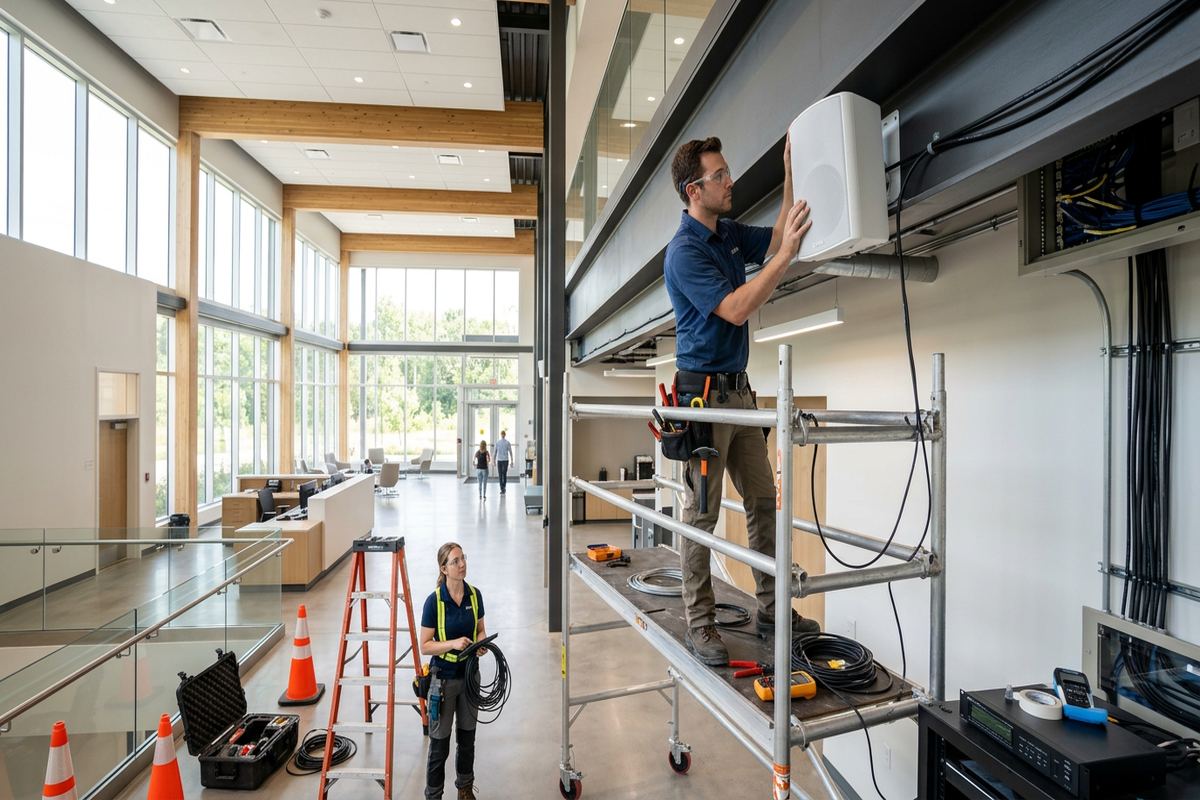
Different spaces call for different loudspeaker formats. In-ceiling speakers keep floors and counters clear, but they require suitable cavity depth and a safe distance from lighting, ductwork and plumbing. In-wall models can create a defined listening position where framing permits. Surface-mounted speakers are useful when walls cannot be opened or when masonry makes recessed installation impractical. For Downtown Brantford lofts and converted industrial spaces, suspended or surface-mounted equipment may fit exposed ceilings better. Each choice is coordinated with the proposed wiring path and the building’s finished appearance.
Zones can be configured for independent sources and volume, grouped playback or a combination of both. The number of zones affects amplifier channels, network requirements and control options, so it should be decided before equipment is purchased. We discuss whether bathrooms, bedrooms, work areas and outdoor spaces should operate separately. We also account for household members who prefer physical controls rather than relying entirely on phones. A well-defined Brantford audio plan avoids creating too many confusing zones while preserving useful separation between quiet areas, entertainment spaces and rooms used at different times.
- In-ceiling, in-wall or surface speakers
- Balanced coverage at practical volume levels
- Independent or grouped listening zones
- Coordination with lights, ducts and plumbing
- Physical and app-based control options
Pathways Through Older Brantford Homes
Older brick houses in Terrace Hill, Henderson Survey and parts of Downtown Brantford often require careful investigation before cable is pulled. Solid masonry exterior walls, plaster and lath, irregular framing and later renovations can prevent direct routes between the equipment location and speakers. We look for accessible basement ceilings, closets, service chases and attic spaces that can reduce disruption. Where concealed routing is not practical, a neatly planned surface pathway may be preferable to unnecessary wall openings. Route choices are reviewed with the customer before work begins and recorded in the project scope.
Masonry and frame construction require different fastening and penetration methods. A framed interior partition may permit cable to pass through drilled members, subject to obstructions and safe clearances. Brick, block or concrete needs appropriate anchors, careful dust control and a route that does not compromise the building envelope. Chimneys, party walls and structural elements are not treated as convenient cable chases. In a converted building, existing conduit may be useful only after its ownership, capacity and destination are confirmed. These checks help protect finishes and keep speaker wiring separated from unsuitable electrical pathways.
Finished surfaces can influence both labour and the final appearance. Decorative plaster, original trim and patterned ceilings may justify an alternate speaker position or a less invasive route. Before cutting, we confirm proposed openings and discuss which party will complete any specialized patching, painting or heritage-sensitive finish work. The scope identifies exclusions so responsibilities are clear. Where access holes are necessary, they are limited to locations that support a continuous cable run. This measured approach is particularly relevant in established Brantford neighbourhoods where several generations of renovations may be hidden behind apparently simple walls.
- Attic, basement and closet route review
- Methods suited to masonry or framing
- Limited, agreed access openings
- Surface pathways where concealment is impractical
- Clear finishing and patching responsibilities
Brantford, Ontario
Whole-home audio installation in Brantford, scoped in writing first
Book a site assessment and get equipment, routes, exclusions, and warranty on paper before anything is installed.
Audio Wiring and Equipment Installation
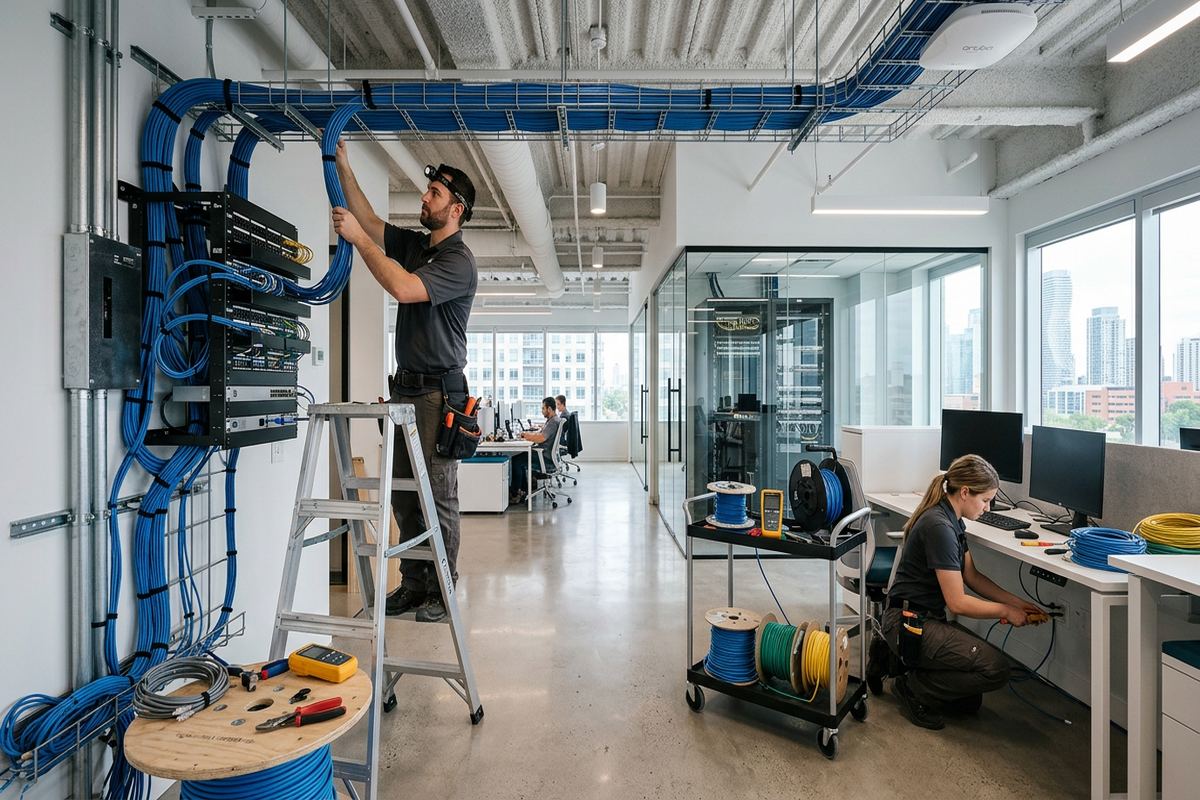
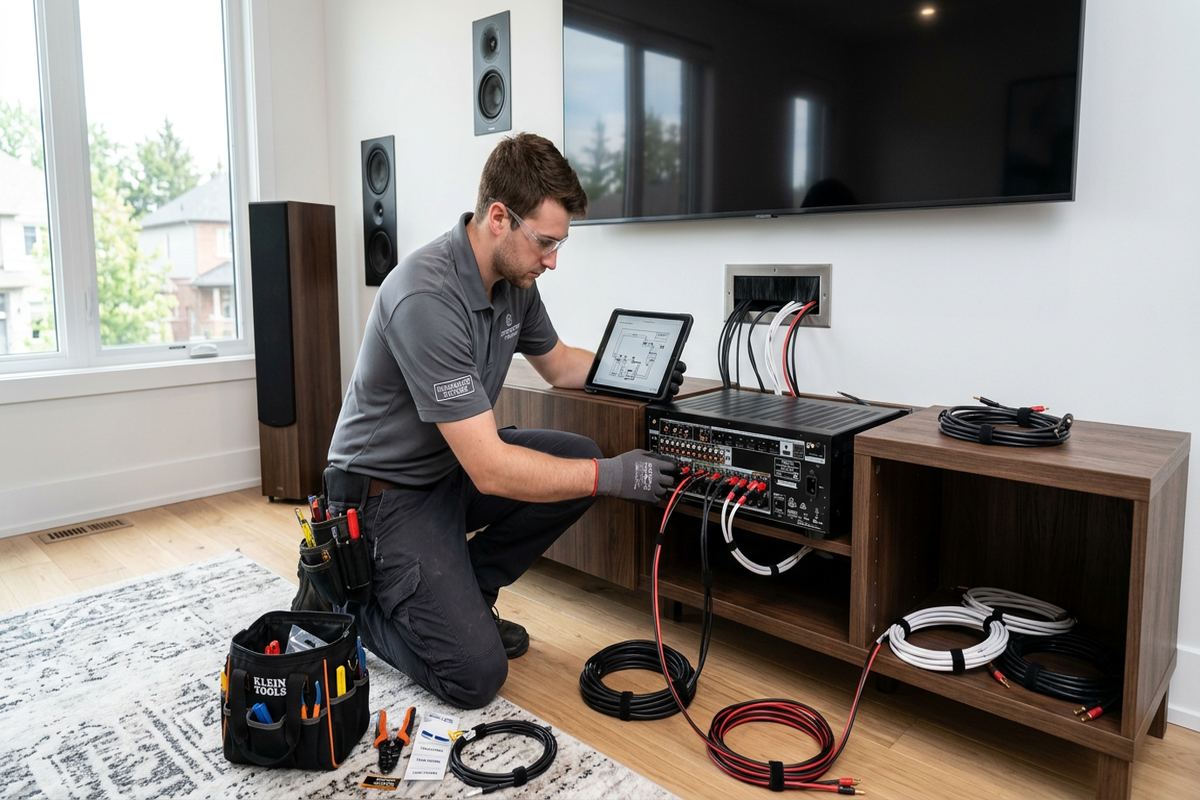
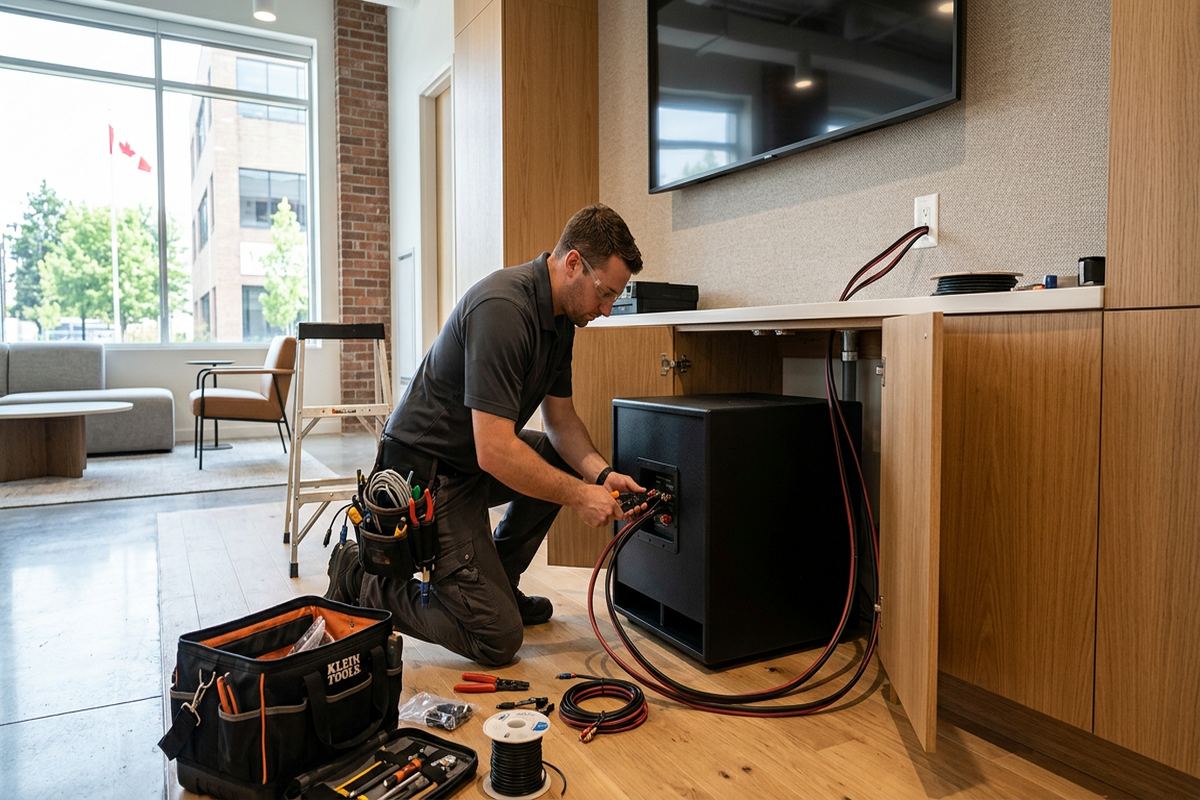
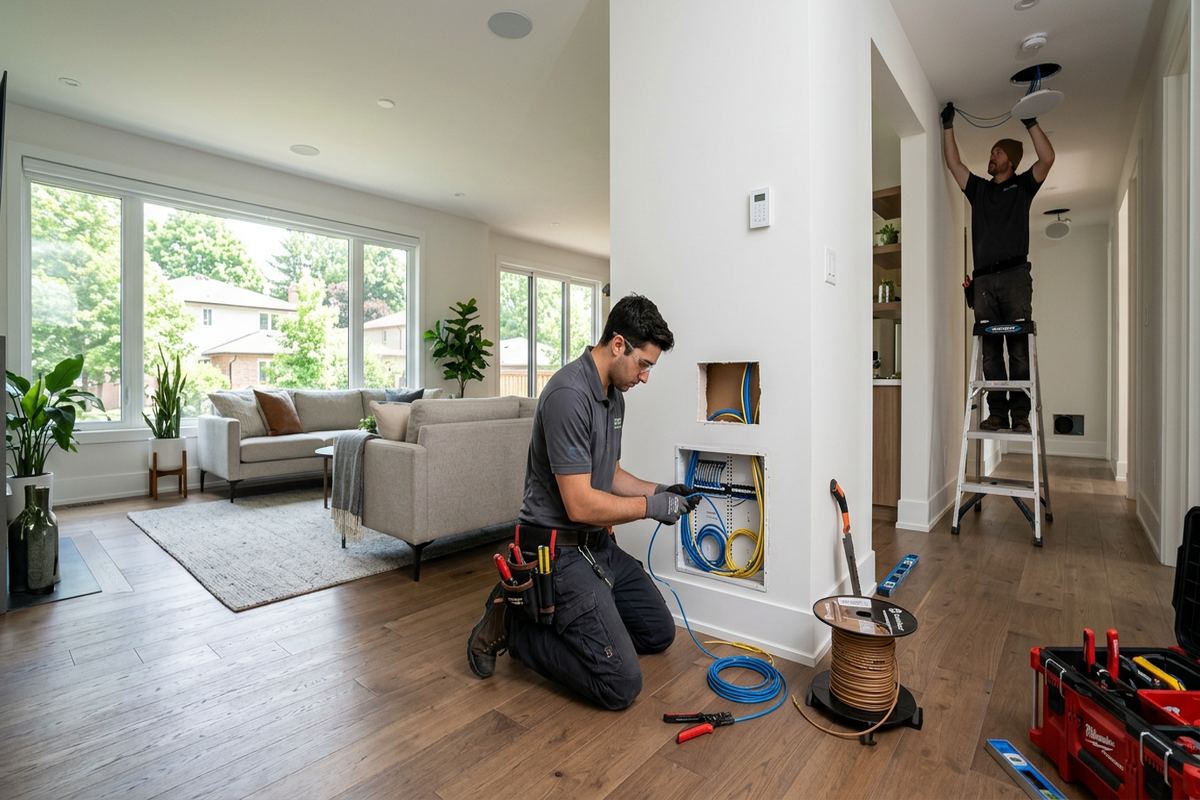
Reliable audio depends on more than the visible speakers. Cable type and conductor size are selected for the planned distance, speaker load and installation environment. Each run is installed continuously between its termination points where the design permits, avoiding inaccessible splices that complicate troubleshooting. Cables are supported, protected from sharp edges and kept away from sources of interference or heat. At the equipment location, runs are dressed and labelled by room or zone. The same identifiers appear in the as-built record, giving the owner a useful reference for future service or renovation work.
The central equipment area needs electrical power, network connectivity, ventilation and enough physical space for service. Amplifiers should not be packed into an enclosed cabinet without considering heat. We review shelf depth, cable bend space and access to controls before locating components. If streaming devices, televisions or other sources are included, their connection method and ownership are documented. UnifiedLink handles the low-voltage audio work within the agreed scope; any new line-voltage circuits or related electrical modifications must be completed through the appropriate trade and coordinated before final commissioning.
Terminations are completed consistently and checked before speakers and amplifiers are placed into normal service. We verify channel assignment, polarity, zone identification and basic operation throughout the system. Speaker grilles and visible hardware are aligned with the room where practical, while racks or shelves are arranged so cables remain traceable. The objective is not simply to make sound on installation day. A serviceable system should allow a future technician or property owner to identify the correct wire, understand the equipment layout and replace a source or amplifier without dismantling unrelated parts of the Brantford installation.
- Continuous, labelled speaker cable runs
- Supported and protected low-voltage wiring
- Ventilated central equipment location
- Consistent terminations and channel assignments
- Traceable rack or shelf organization
Outdoor Audio for Brantford Seasons
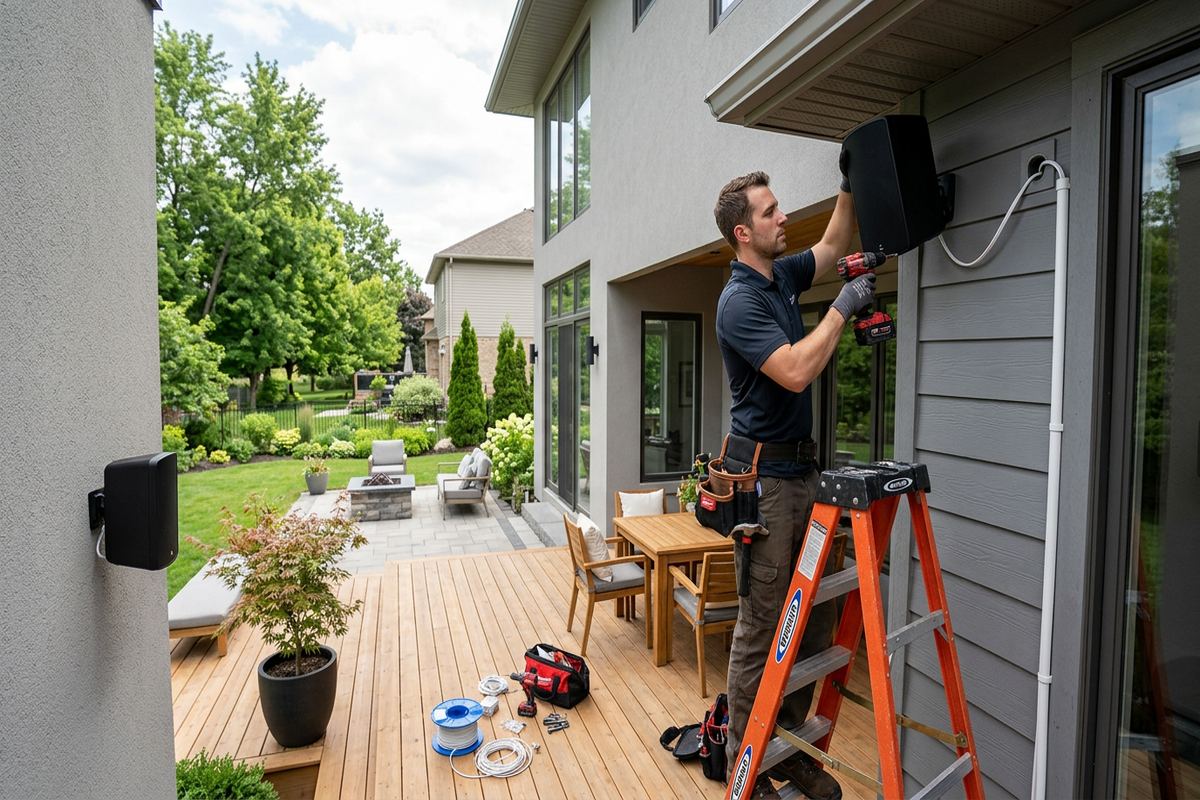
Outdoor speakers need a design suited to changing Brantford weather rather than an indoor product placed under a shallow overhang. We consider the intended listening area, nearby properties, mounting surface, exposure to precipitation and the route back inside. Speaker direction matters because useful coverage at a moderate level is preferable to excessive volume spreading beyond a patio or yard. Equipment is selected for the proposed location, and mounting points are checked for secure attachment. Outdoor zones can be independently controlled so they are not accidentally left playing with interior rooms.
Freeze-thaw cycles can stress exterior penetrations and poorly sealed mounting points. Cable entries should shed water, use suitable exterior sealing methods and avoid creating paths into wall cavities. Fasteners and brackets must match the substrate, whether the surface is brick, concrete or framed construction with siding. Drilling through masonry requires a different plan from passing through a framed wall, particularly around window openings and veneer details. We document exterior routes and keep penetrations limited. Existing openings are used only when they are properly located, large enough and capable of being sealed after installation.
Detached structures, long yards and landscape zones introduce additional questions about distance, burial method and equipment location. A cable should not be laid loosely across soil or shared casually with an unsuitable conduit. We assess the route, the required cable rating and whether other trades or approvals are involved. In a condo townhouse or rented Brantford property, exterior speaker installation may also require consent from a condominium corporation or landlord. Customers are responsible for securing required approvals unless the written scope assigns a specific coordination task to UnifiedLink.
- Weather-suitable speaker selection
- Directed coverage for patios and yards
- Sealed exterior cable penetrations
- Mounting methods matched to substrates
- Approval checks for shared properties
Controls, Streaming and Network Readiness
Modern whole-home audio commonly relies on the property network for streaming, app control and communication between devices. Strong internet service alone does not guarantee reliable control in every room. We review where audio equipment connects, whether wired Ethernet is available and how mobile devices reach the local network. For larger Brantford houses or buildings with dense masonry, Wi-Fi coverage may need attention before audio commissioning. Network changes are included only when stated in the scope, keeping the responsibilities for internet service, routing, wireless access points and audio equipment clearly separated.
Control should be straightforward for the people who use the property. We can configure room names, source access, zone grouping and permitted settings on site using the customer’s own accounts and credentials. Passwords are not retained as a substitute for proper handover. Where supported by the selected system, users can control individual rooms or start synchronized playback across several areas. Physical volume controls or keypads may be appropriate for guests, children, tenants or anyone who should not need an app. The final arrangement follows the agreed operating plan rather than enabling every available feature by default.
Source compatibility should be confirmed before installation, particularly when televisions, turntables, media players or business music sources are involved. Some devices require local inputs, preamplification or specific connection formats, and synchronization may vary between networked and directly connected sources. We identify these dependencies in advance where the equipment can be reviewed. For commercial strips or industrial units in Brantford, account licensing and permitted content use remain the customer’s responsibility. The audio installation provides the physical and configured system described in the scope, not rights to third-party programming or streaming services.
- Network and Wi-Fi readiness review
- Customer-owned accounts and credentials
- Clear room names and zone groups
- App, keypad or volume-control options
- Source connection compatibility checks
Brantford Condos, Rentals and Business Spaces
Audio work in condominiums and rental properties requires permission as well as a practical technical plan. Ceiling cavities, exterior walls and shared service spaces may fall under condominium rules or landlord control even when they border the customer’s unit. Before drilling or routing cable, written approvals may be needed for penetrations, working hours, elevator use or access to common areas. We can describe the proposed low-voltage work for the customer’s approval request. Installation proceeds according to the accepted scope, while the owner or tenant remains responsible for obtaining authorization unless otherwise documented.
Commercial properties often need different zoning from a house. A storefront may require steady background coverage at controlled levels, while an office could separate reception, meeting and staff areas. Converted industrial units may have exposed steel, concrete decks, high ceilings and long cable pathways that affect speaker spacing and mounting. In Brantford commercial strips, neighbouring occupancies also make sound containment and sensible volume control important. We review intended use, equipment access and who may adjust settings. The design should support daily operation without leaving consumer devices unsecured in public or staff-accessible areas.
Mixed-use buildings can involve both residential expectations and commercial constraints. Cable may need to cross fire-separated assemblies, pass near shared infrastructure or remain visible in an architectural space. Those conditions are identified during assessment, and work outside the low-voltage scope is assigned to the appropriate party. We do not assume that an available ceiling void or conduit can be used without confirmation. One accountable contractor manages the agreed audio installation, including device placement, cable work, configuration and documentation, while clearly noting dependencies involving property management, electrical work, access equipment or specialty construction.
- Condo and landlord approval planning
- Residential and commercial zone design
- Secure placement of shared equipment
- Routes reviewed in mixed-use buildings
- Dependencies assigned in writing
Commissioning and Handover in Brantford
Commissioning turns installed components into a usable Brantford audio system. After connections are complete, we confirm that each speaker plays from the assigned channel, that zone names match their actual rooms and that controls respond as intended. Basic level balancing is completed to support consistent coverage without forcing every space to the same output. Grouped playback, source selection and physical controls are tested where included. Any operational limitation discovered during setup is explained rather than hidden behind an overly complicated workaround that may fail after a future app or network change.
Handover is completed with the customer’s own credentials and includes an as-built record of the installation. The record identifies cable runs, speaker locations, zone assignments and the central equipment arrangement at a useful level for future service. We explain normal startup, room selection, grouping, volume adjustment and any shutdown procedure relevant to the chosen equipment. Equipment ownership and warranty details follow the written scope. This gives the Brantford property owner control of the system without relying on an installer-held account or undocumented settings that cannot be recovered later.
Requests sent during business hours are answered the same day, while after-hours requests are answered the next business day. The timing of a Brantford site assessment depends on the requested service and travel distance. Following assessment, pricing is based on a written scope rather than a generic room count. That scope covers equipment, routes, placement, exclusions, ownership and warranty information. From planning through handover, UnifiedLink acts as one accountable contractor for the agreed low-voltage audio work, reducing gaps between cabling, speaker installation, configuration and final documentation.
- Channel and zone operation testing
- Basic level balancing by area
- Customer-controlled system credentials
- As-built cable and device record
- One accountable audio contractor
Brantford neighbourhoods we cover
- Downtown Brantford
- West Brant
- Echo Place
- Henderson Survey
- Terrace Hill
- Lynden Hills
Whole-home audio installation in Brantford — common questions
Can speakers be installed in an older Brantford home?
Yes, but the pathway must be assessed first. Older Brantford houses can contain plaster and lath, solid masonry, blocked framing cavities and several layers of renovation. We look for attic, basement, closet or service routes before proposing openings. Where fully concealed wiring would cause unreasonable disruption, surface-mounted speakers or a neat surface pathway may provide a more practical result.
Do you install audio in condos or rental units?
Yes, subject to the necessary approvals. Brantford condominium rules or lease terms may restrict ceiling openings, exterior mounting, common-area access and working hours. The owner or tenant normally obtains written permission before work begins. We can provide a clear description of the proposed low-voltage installation, including speaker locations and cable routes, to support that approval process.
Can outdoor speakers remain installed through winter?
Outdoor speakers can remain in place when the equipment, brackets, fasteners and cable are suitable for the location. Brantford winters and freeze-thaw conditions make exterior sealing especially important. We assess exposure, mounting material and cable entry points, then use an appropriate route and sealing method. Outdoor equipment still requires reasonable care and must be operated within the manufacturer’s environmental guidance.
Will every room play different music?
That depends on the selected equipment, amplifier channels and zone design. A Brantford system can be planned for independent sources, grouped playback or simpler shared audio with separate volume control. We establish those requirements before equipment selection because they affect wiring and hardware. Not every household benefits from fully independent rooms, so the design should balance flexibility, straightforward control and the way occupants actually listen.
Can television sound use the installed speakers?
Often, but compatibility and the desired behaviour need to be reviewed. Television audio may require a local amplifier, networked interface or a direct cable connection, depending on the selected system. We confirm whether the room needs everyday television sound, music playback or both. The written Brantford scope identifies the included connection method and any source equipment that the customer must provide.
What happens before you provide pricing?
UnifiedLink completes a site assessment before pricing. We review the Brantford property, speaker locations, listening zones, cable pathways, equipment space, controls and network considerations. Assessment timing depends on the service and travel distance. Pricing is then supported by a written scope covering equipment, routes, device placement, exclusions, equipment ownership and warranty, so the proposed installation and customer responsibilities are clear.
Coverage in Brantford is confirmed against the address before we quote. See everything we install in Brantford or the province-wide whole-home audio installation page.