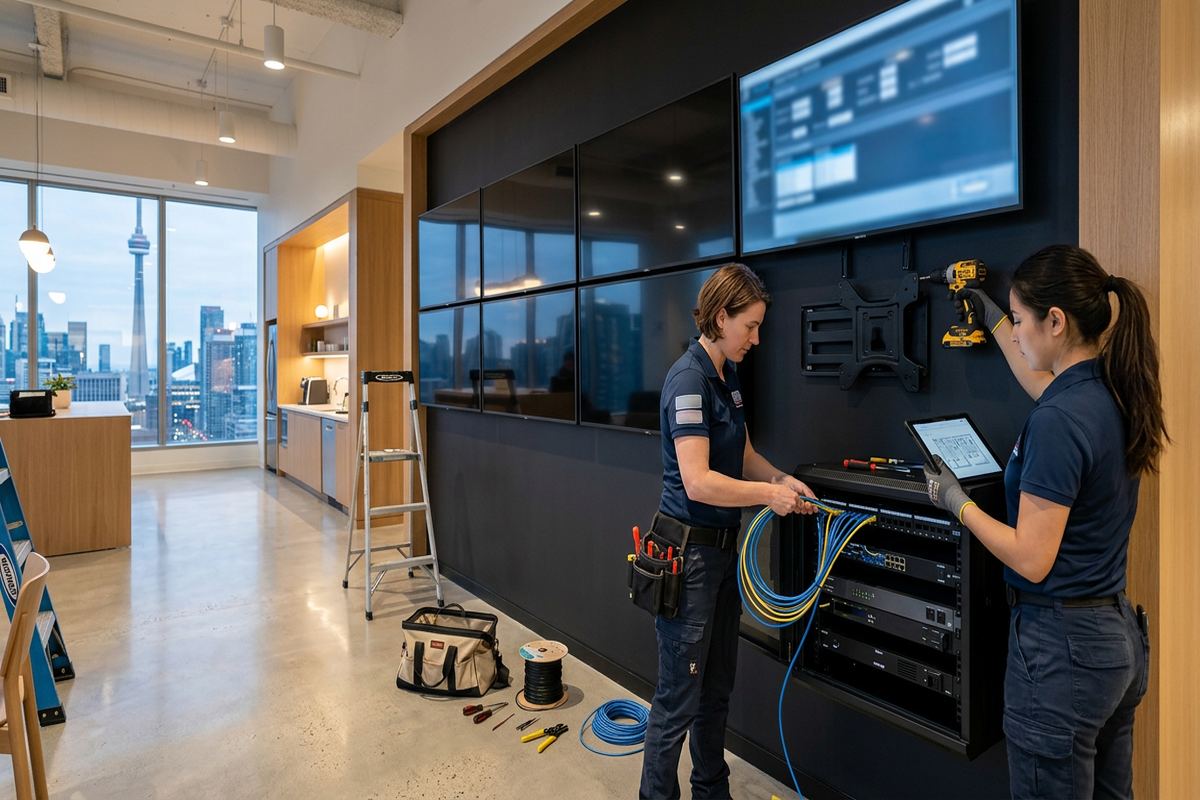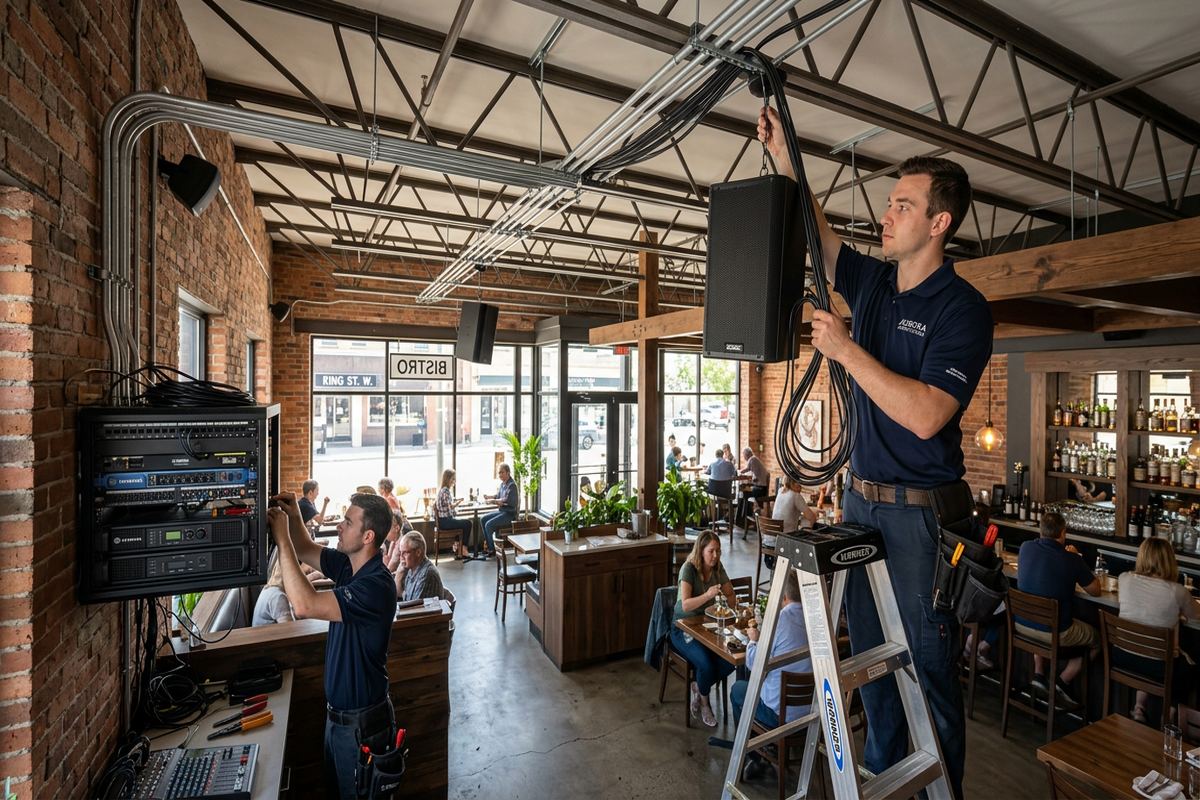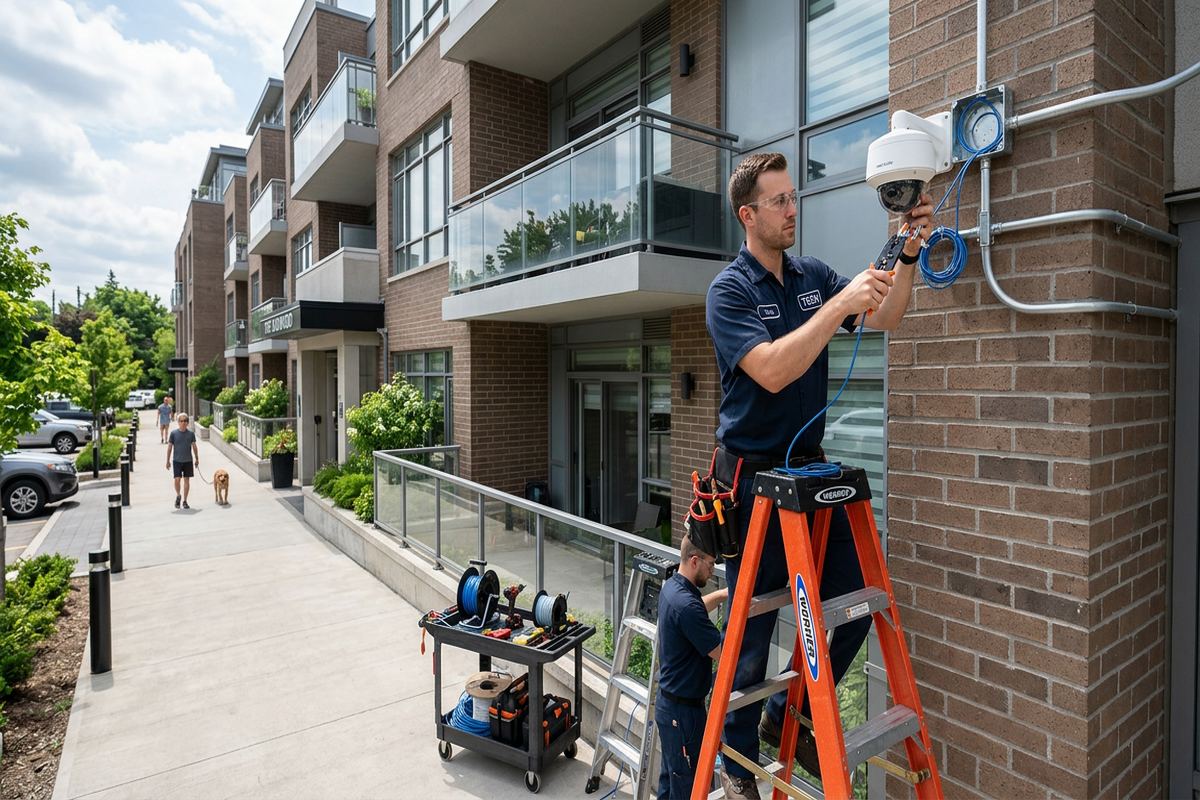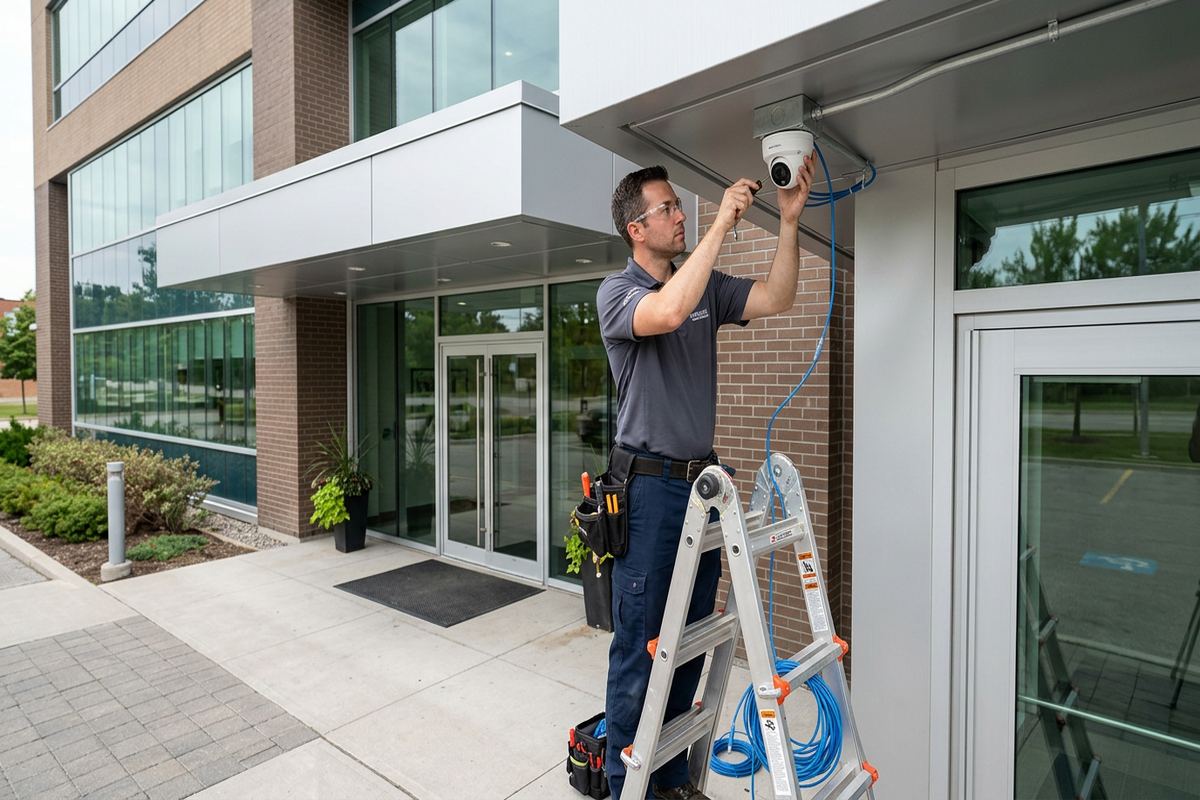
UnifiedLink designs and installs commercial security camera systems for Brampton warehouses, logistics facilities, offices, stores and multi-unit properties. Each project starts with a site assessment and a written scope. We plan camera positions, cable routes, recording, remote access and handover around the building, operating requirements and the areas that need usable coverage.
Commercial Security Camera Planning in Brampton
A useful camera system begins with the incident the business needs to review, not with a camera count. During a Brampton site assessment, UnifiedLink examines entrances, loading areas, cash points, parking, interior routes and restricted rooms. We consider the direction people and vehicles travel, expected viewing distance, available light and likely obstructions. The resulting plan distinguishes broad situational coverage from views intended to identify a face, vehicle or specific activity. This avoids placing wide-angle cameras where detailed evidence is required or using narrow views that leave important movement outside the frame.
Brampton properties vary considerably, from commercial units in older parts of Downtown Brampton to newer plazas around Mount Pleasant and large industrial buildings serving the local warehouse and logistics base. Ceiling height, wall construction, tenant improvements and existing network rooms all affect installation. A finished office may require concealed routes and careful surface restoration, while a warehouse may use tray, conduit or high-level pathways. The assessment also identifies lifts, shutdown coordination or access permissions needed before work begins, reducing changes once cable installation and mounting are underway.
Before pricing, we provide a written scope that identifies proposed equipment, cable routes, camera placement, exclusions, equipment ownership and warranty terms. Drawings or marked plans are used where they make the installation clearer. The scope also addresses recording location, monitor requirements, remote viewing and any integration that has been requested. If a landlord, condominium corporation or property manager controls exterior walls or common areas, approval remains part of the project planning. That documentation gives the customer and installer the same reference for what will be installed and what is outside the work.
- Site assessment before pricing
- Coverage objectives defined by area
- Mounting and access constraints reviewed
- Written equipment and pathway scope
- Approvals identified before installation
Camera Coverage for Brampton Warehouses and Logistics Sites
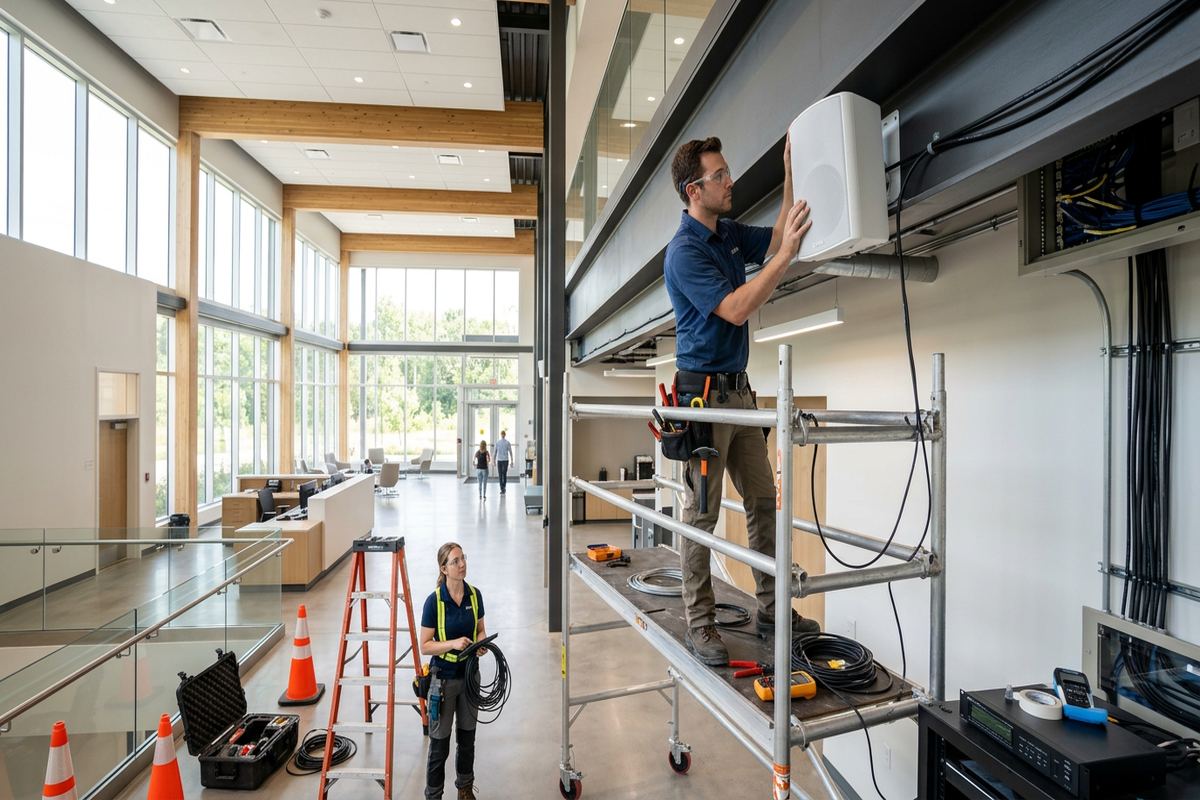
Warehouse and logistics sites need coverage that reflects how the property operates throughout a shift. Dock doors, shipping desks, trailer approaches, pedestrian doors, staging lanes and fenced yards can each require different fields of view. High ceilings may provide a broad overview but can make faces too small for identification. We therefore balance elevated overview cameras with lower, targeted positions at decision points. Vehicle speed, trailer obstruction, racking changes and moving equipment are considered so that the recorded image remains useful rather than merely showing that an event occurred somewhere in a large space.
Lighting transitions are a recurring issue at industrial units across Brampton. A camera facing an open loading door may see bright daylight beyond a comparatively dark interior, while yard lighting can create glare, shadows or reflections overnight. Camera selection and positioning must account for those conditions, but configuration is equally important. Exposure, image orientation, frame rate, motion settings and night modes are adjusted on site using actual views. Where licence plate detail is an objective, the approach angle, distance and lighting must be evaluated separately from general vehicle coverage; a standard overview is not automatically suitable.
Network and recording design must support the selected cameras without disrupting business systems. UnifiedLink reviews available switch capacity, power delivery, uplinks, network segmentation and the physical security of the recorder or server location. Retention is discussed as a design requirement because resolution, frame rate, motion levels and camera count affect storage. We do not present a fixed retention period without checking those variables. For multi-building yards or detached guard structures, pathway availability and distance determine whether copper, fibre or an approved point-to-point link is appropriate. Each link is documented within the project scope.
- Dock and yard coverage planning
- Targeted views at access points
- Lighting and glare assessment
- Storage based on operating requirements
- Network capacity and distance review
Retail, Office and Commercial Strip Cameras
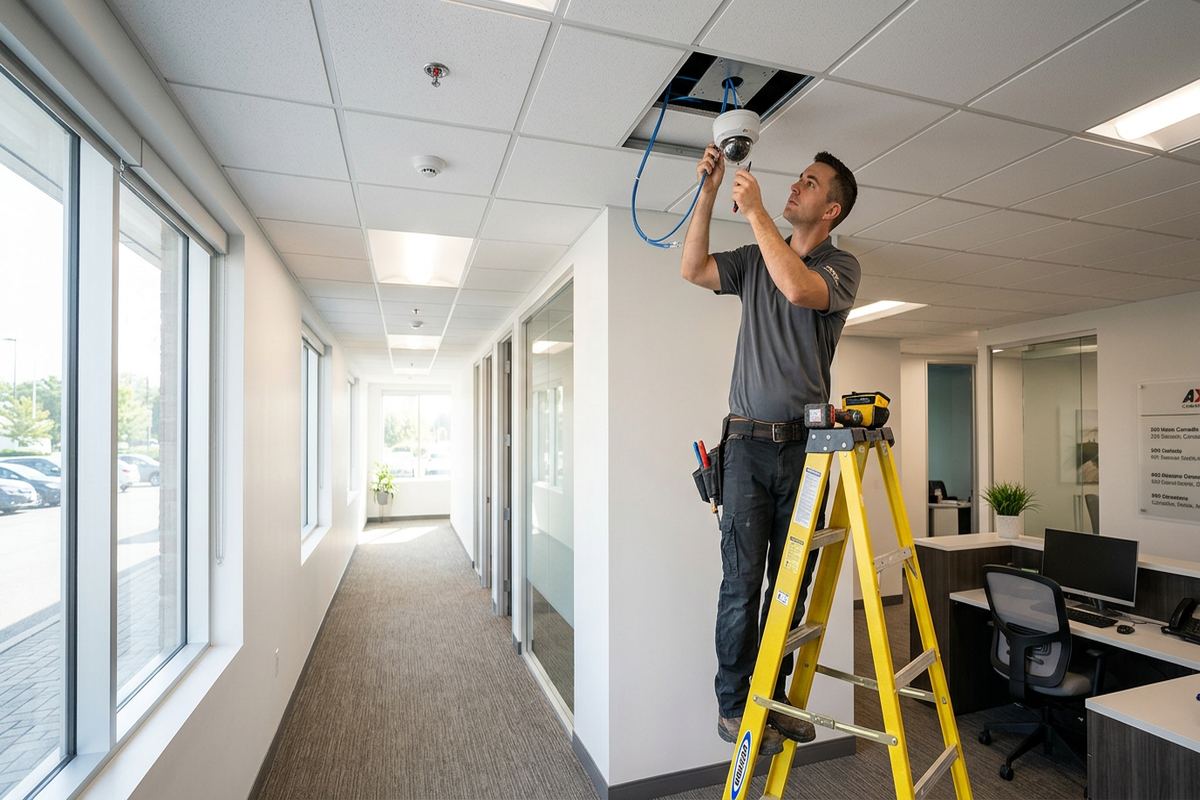
Retail stores and offices typically need a different balance of visibility, discretion and evidence quality. Entrances, transaction areas, stockrooms, receiving doors and public circulation routes are common priorities, while private offices, washrooms and other sensitive areas must be excluded. In Brampton commercial strips, shared parking and neighbouring units can complicate exterior views. Cameras should be aimed at the customer’s controlled area and positioned to limit unnecessary capture beyond it. Monitor placement and live-view access are also planned so staff can use the system without exposing recordings or administrative controls to visitors.
Older commercial premises near Downtown Brampton may have masonry walls, limited ceiling cavities or previous renovations that make cable routes less direct. Newer frame or steel-stud interiors in Springdale and Castlemore can offer accessible pathways, although insulation, fire separations and finished ceilings still require investigation. UnifiedLink selects suitable anchors and routing methods for the actual substrate instead of treating every wall as interchangeable. Penetrations through rated assemblies or exterior envelopes are identified before installation, and any work assigned to another trade is stated as an exclusion rather than being assumed within the camera scope.
For leased premises, the business should confirm what its lease and landlord allow before exterior drilling, roof access or work in shared electrical and communications rooms. Condominium commercial units may also require board or property-management approval for devices facing common corridors, garages or façades. We can provide proposed device locations and pathway information for that review. The system is then installed within the approved boundaries. This is especially important where a Brampton plaza has common exterior lighting, shared service lanes or a central communications room controlled by the building rather than by an individual tenant.
- Entrance and transaction-area views
- Sensitive spaces excluded from coverage
- Routes adapted to finished premises
- Landlord requirements documented
- Shared areas handled through approval
Brampton, Ontario
Commercial security camera installation in Brampton, scoped in writing first
Book a site assessment and get equipment, routes, exclusions, and warranty on paper before anything is installed.
Exterior Camera Installation for Brampton Conditions
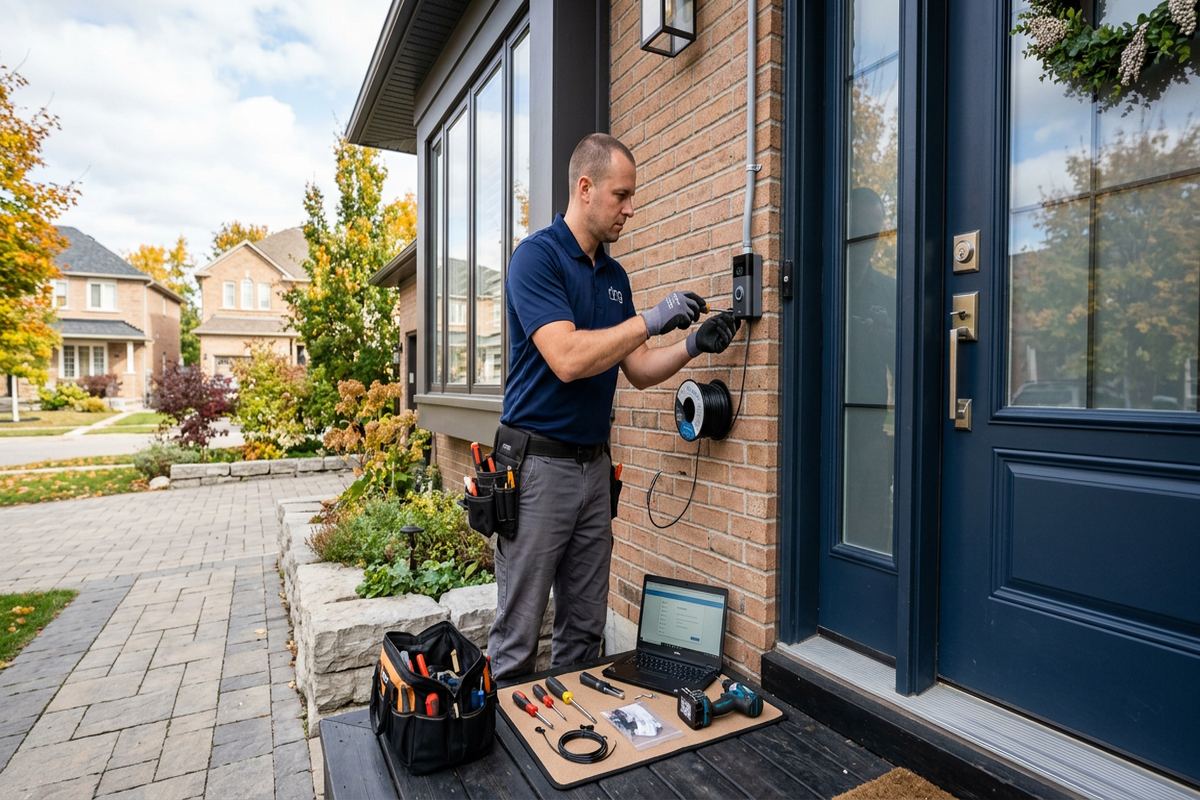
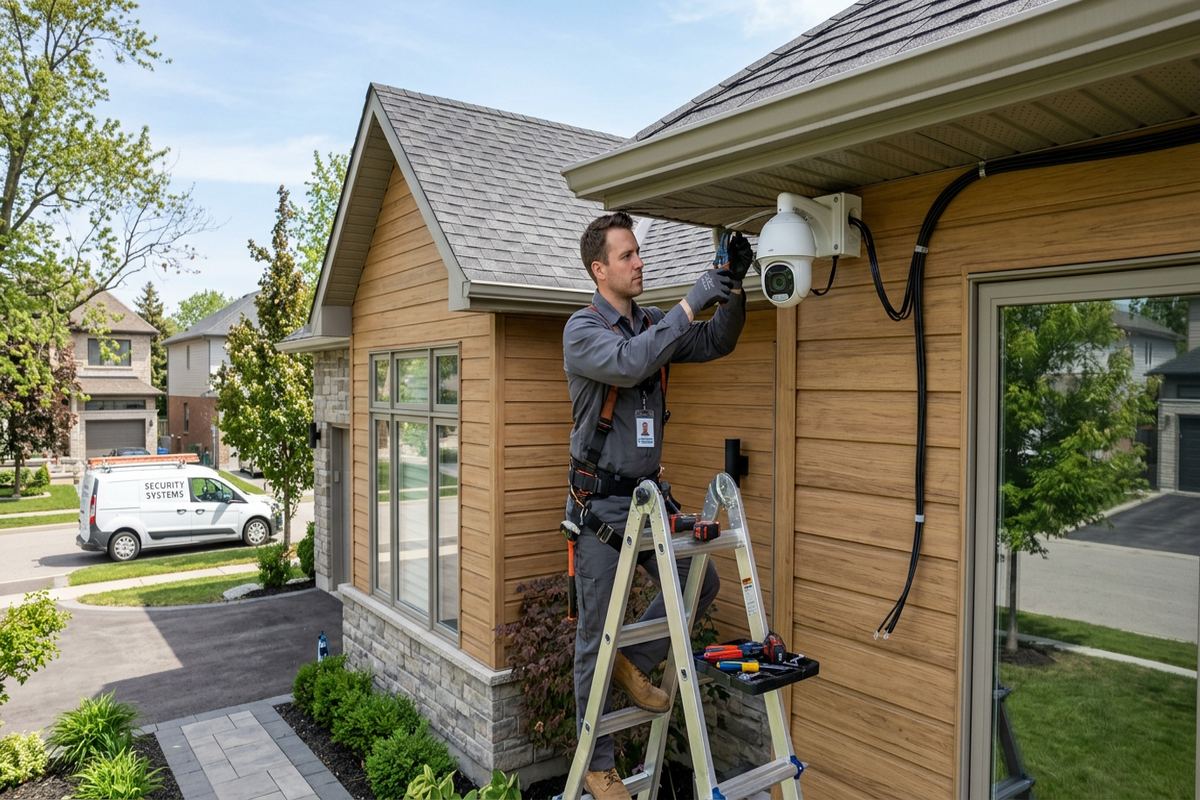
Exterior cameras in Brampton must tolerate winter cold, wind-driven precipitation and repeated freeze-thaw cycles. Equipment suitability is only one part of that requirement. Mounting surfaces, fasteners, junction boxes, cable entries and drip paths determine whether the installation remains physically secure and resistant to moisture. Exterior connections are enclosed rather than left exposed, and penetrations are sealed using methods compatible with the wall assembly. A camera mounted beneath an overhang may receive some protection, but its position still needs to preserve the intended view after snow accumulation, landscaping growth or seasonal changes in daylight.
Masonry, precast concrete, metal cladding and frame construction each call for different mounting decisions. Brick veneer should not be treated like structural concrete, and cladding may require backing or an approved mounting detail to avoid deformation and water entry. On warehouse walls, the desired camera angle may place a device beyond straightforward indoor cable access. In those cases, conduit, interior junction points or alternate positions are reviewed before drilling. The goal is a stable mount and a controlled cable transition, not simply the shortest route between the network room and the exterior view.
Brampton’s fast-growing subdivisions also contain finished basements and mixed residential-commercial uses where visible routing can be disruptive. Although a commercial installation may serve a home office, clinic or small business, finished spaces still require investigation before cable is concealed. Existing utilities, vapour barriers, insulation and inaccessible joist spaces can limit routes. Exterior mounting may need owner, landlord or condominium approval, particularly where a façade is shared. The written scope records whether cable will be concealed, placed in surface raceway or routed through unfinished areas, preventing assumptions about opening or repairing completed finishes.
- Weather-suitable exterior equipment
- Sealed cable and box entries
- Anchors matched to wall construction
- Freeze-thaw exposure considered
- Visible routing agreed in writing
Cabling, Networks and Recording
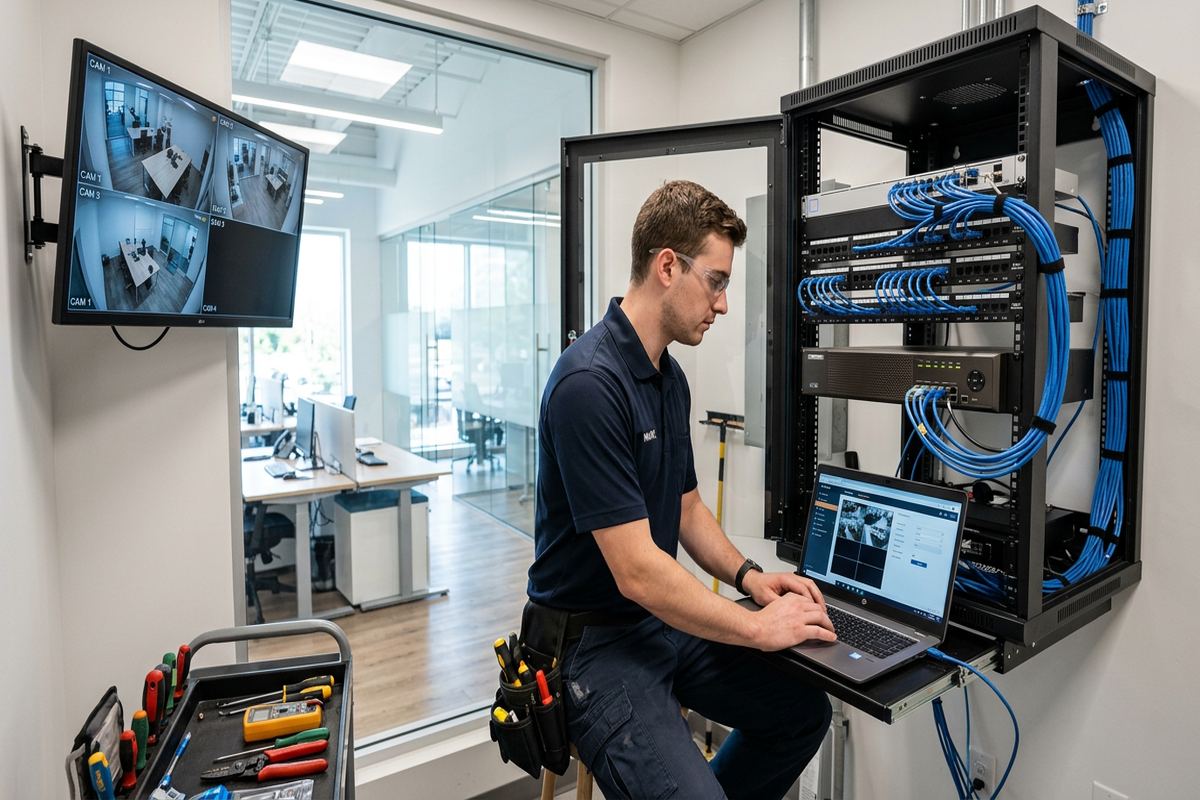
Reliable video depends on the infrastructure behind the cameras. UnifiedLink installs continuous labelled cable runs between defined termination points, avoiding hidden joins that complicate testing and future service. Cable type and pathway are selected for distance, environment and applicable building conditions. In offices, this may involve ceiling pathways and a communications rack; in industrial units, tray, conduit or protected drops may be more appropriate. Labels correspond with camera names and records so a technician can identify a run at both ends without tracing it through the entire Brampton property.
Power-over-Ethernet cameras require more than an available network port. The switch must have sufficient power budget, port capacity and uplink performance for the planned system. Where the customer’s business network is used, responsibilities for addressing, virtual networks, firewall rules and internet access are established before commissioning. Some organizations provide these settings through an internal IT team or managed provider. UnifiedLink coordinates the camera requirements with that party but does not assume authority over systems outside the written scope. Local recording can remain functional even when remote internet access is unavailable, depending on the selected design.
Recording capacity is planned from the required retention objective and image settings rather than from a generic storage claim. Resolution, compression, frame rate, scene activity and continuous or event-based recording all influence the result. The recorder should also be located where casual access, accidental disconnection and environmental problems are reduced. For Brampton facilities with several departments or tenants, user permissions can separate live viewing, playback, export and administration. During configuration, accounts are created for the customer’s operational needs while preserving a clear owner-level credential for the final handover.
- Continuous labelled cable runs
- Power and bandwidth calculations
- IT responsibilities defined
- Storage matched to retention objectives
- Role-based user access
Installation and Configuration Across Brampton
Once the scope is approved, installation is coordinated around site access and normal operations. A store may prefer work outside busy customer periods, while a warehouse may need specific aisles or dock positions kept clear. The customer identifies safety orientation, escort, lift-access and shutdown requirements before arrival. UnifiedLink follows the agreed camera positions and pathways, then reports site conditions that materially differ from the assessment. Changes are documented rather than improvised, particularly when they affect coverage, finishes, equipment quantities or work controlled by a landlord, property manager or another contractor.
Each camera is physically secured, connected and named according to its location or purpose. On-site configuration includes image orientation, focus where applicable, exposure, date and time settings, recording rules and practical motion zones. Views are checked against the original coverage objective from both live and recorded video. In a Bramalea industrial unit, for example, a dock view may need adjustment after observing trailer positioning; at a Heart Lake office, reflected interior lighting may require a different entrance angle. Configuration using actual site conditions is more reliable than applying identical settings to every camera.
Remote viewing is set up only through the method supported by the selected system and the customer’s network policies. Accounts are not left on temporary installer credentials. The customer receives access using credentials under its own control, and administrative permissions are explained during handover. If mobile or desktop applications are included, they are configured on agreed devices when access and compatibility permit. Cybersecurity responsibilities are also made clear: passwords, software updates, internet exposure and departing-user access require ongoing customer management after installation, even when the physical camera equipment remains unchanged.
- Work coordinated with site operations
- Device names matched to locations
- Recorded views checked on site
- Customer-controlled accounts configured
- Changes documented before proceeding
Handover, Training and System Records
A commercial camera system is not complete when the final device appears online. Staff need to know how to find a camera, review a time period, export an incident and confirm that recording is operating. UnifiedLink provides an on-site handover appropriate to the agreed system and user roles. The session can distinguish routine operators from administrators so unnecessary permissions are not shared. Export procedures are demonstrated using available footage, and the customer is shown where recording health, storage status and device connectivity can be checked without changing core configuration.
The handover includes the customer’s own credentials and an as-built record of the completed installation. Depending on the project, that record may identify camera names, installed positions, cable labels, termination points, recorder location and relevant network details. Any approved changes from the original Brampton scope are reflected so the document describes the actual system rather than only the proposal. Equipment ownership and warranty information remain clear, including customer-supplied components or services delivered by other parties. These records make future moves, additions and fault investigation more controlled.
Responsibility after handover is discussed before the project closes. The customer should assign an internal owner for user accounts, incident exports, password custody and requests from staff or authorities. Camera views also benefit from periodic review because racking, signs, displays, landscaping and operational layouts can change. A system that covered an entrance during commissioning may later be obstructed by inventory or a new fixture. UnifiedLink can assess requested additions or alterations, but the original documentation gives one accountable contractor and the customer a shared baseline for evaluating that work.
- Playback and export instruction
- Customer-owned administrator credentials
- As-built camera and cable record
- Warranty responsibilities identified
- Operational ownership explained
Requesting a Brampton Camera Assessment
To prepare for an assessment, identify the incidents or operational questions the camera system should address. Useful information includes floor plans, approximate property boundaries, existing network locations, desired retention, user groups and any known landlord conditions. For active Brampton sites, note operating hours, controlled areas and times when loading lanes or customer spaces are most representative. Existing cameras can be reviewed for position and infrastructure, but they are not assumed compatible until model, condition and access are checked. Clear objectives allow the assessment to focus on evidence quality rather than an arbitrary device count.
During the visit, access is needed to proposed camera areas, communications rooms, ceiling spaces and exterior routes where reasonably available. Representatives from operations, facilities or IT can answer different parts of the design, particularly at larger logistics properties. If drawings are unavailable, observations and marked photographs can support the written scope. Some routes may remain conditional until a ceiling tile is lifted, a controlled room is opened or landlord approval is received. Those limitations are recorded so they are not mistaken for confirmed installation conditions when the proposal is reviewed.
Requests sent during business hours are answered the same day, while after-hours requests are answered the next business day. Site assessment timing depends on the service and travel distance. UnifiedLink serves Brampton communities including Downtown Brampton, Bramalea, Springdale, Heart Lake, Mount Pleasant, Castlemore and Fletcher's Meadow, as well as commercial and industrial properties across Peel Region. After the assessment, the written scope sets out equipment, routes, placement, exclusions, ownership and warranty. This provides a defined basis for pricing and keeps camera work, cabling, configuration and handover under one accountable contractor.
- Objectives reviewed before equipment selection
- Existing infrastructure checked for compatibility
- Conditional routes clearly identified
- Assessment completed before pricing
- One contractor for installation and handover
Brampton neighbourhoods we cover
- Downtown Brampton
- Bramalea
- Springdale
- Heart Lake
- Mount Pleasant
- Castlemore
- Fletcher's Meadow
Commercial security camera installation in Brampton — common questions
How many cameras does my Brampton business need?
The number depends on the views and evidence your operation requires. A Brampton warehouse may need separate overview, dock, pedestrian-door and yard views, while a small office may focus on entrances and restricted rooms. UnifiedLink assesses travel paths, distances, lighting and obstructions before recommending quantities. The written scope identifies each proposed position and its intended purpose.
Can cameras be installed outside during a Brampton winter?
Exterior work may be possible, but conditions, safe access, sealant requirements and the mounting surface must be considered. Brampton freeze-thaw cycles make compatible sealing, enclosed connections and secure fastening important. Site assessment timing and installation sequencing depend on the service, travel distance and conditions. Unsafe access or unsuitable temperatures for a required material can affect when exterior work proceeds.
Do I need landlord or condo approval?
Approval may be required if the installation affects exterior walls, common corridors, shared garages, roofs or building communications rooms. Brampton tenants and commercial condominium owners should check their lease, rules and property-management requirements before work begins. UnifiedLink can document proposed camera positions and cable routes for review, but authorization from the property owner or corporation remains the customer’s responsibility.
Can you use my existing cameras or cabling?
Existing equipment can be assessed, but reuse depends on model compatibility, condition, credentials, cable type, test results and the required coverage. Older analogue or network cameras may not integrate with a proposed recorder or provide suitable detail. In Brampton properties with several previous tenant improvements, labels and routes may also be unclear. Any approved reused components and related exclusions are identified in the written scope.
Will I be able to view cameras remotely?
Remote viewing can be configured when the selected system, internet connection and customer network policies support it. UnifiedLink reviews account roles and coordinates technical requirements with the customer’s IT provider where needed. Brampton businesses receive their own credentials at handover rather than relying on an installer-owned account. Ongoing password management, software updates and removal of departing users remain customer responsibilities.
How quickly will you respond to my request?
Requests sent during business hours are answered the same day, and after-hours requests are answered the next business day. The timing of a Brampton site assessment depends on the service and travel distance. Pricing follows an assessment because camera placement, construction, cable pathways, access equipment, storage requirements and approval conditions must be understood before a reliable written scope can be prepared.
Coverage in Brampton is confirmed against the address before we quote. See everything we install in Brampton or the province-wide commercial security camera installation page.