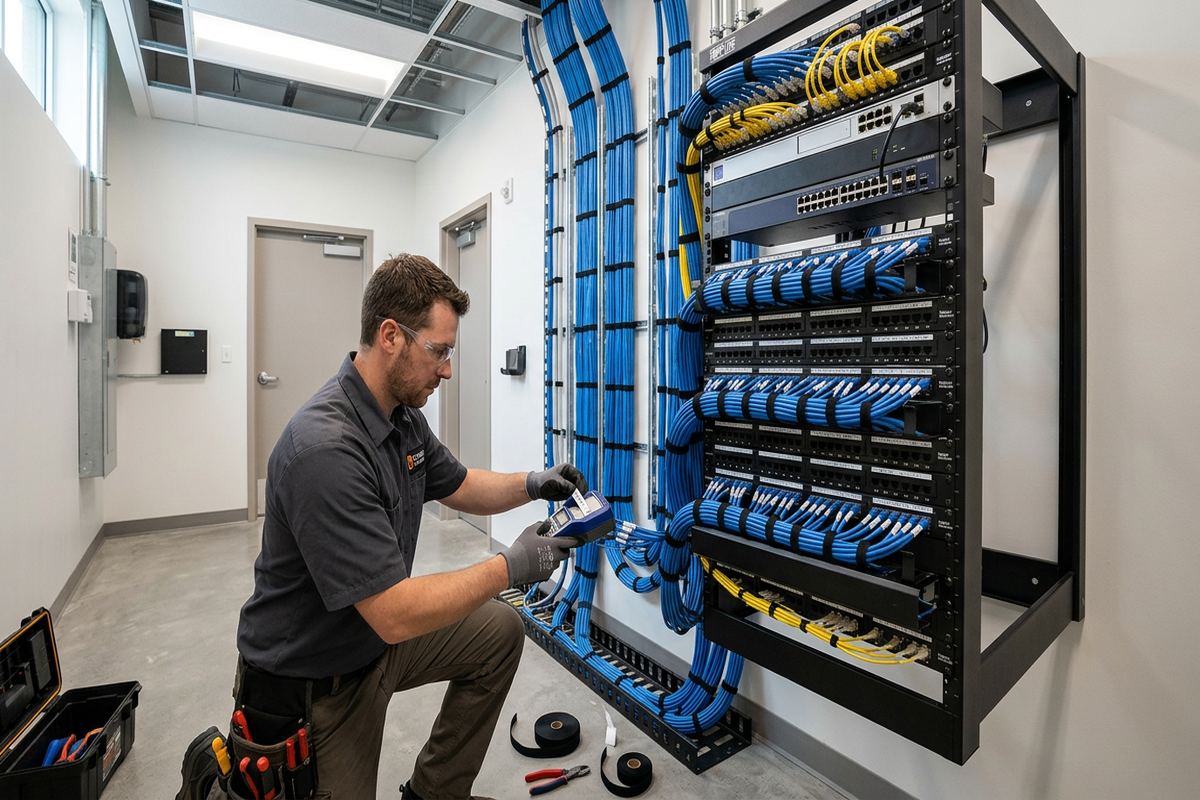
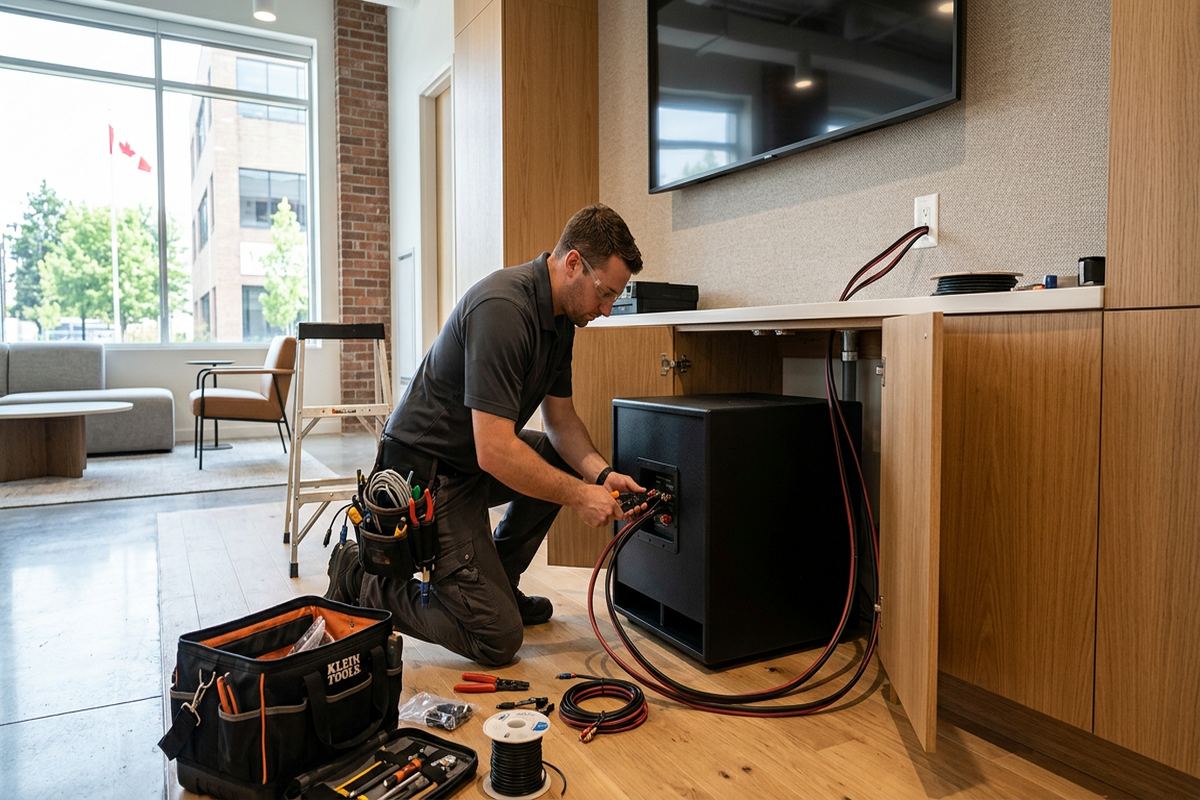
UnifiedLink installs whole-home audio systems for houses, condos and small commercial properties in Bowmanville. We plan speaker locations, cable routes, listening zones and controls around the building rather than relying on a standard layout. Each project begins with a site assessment, followed by a written scope that explains the proposed equipment, installation work, ownership, exclusions and warranty.
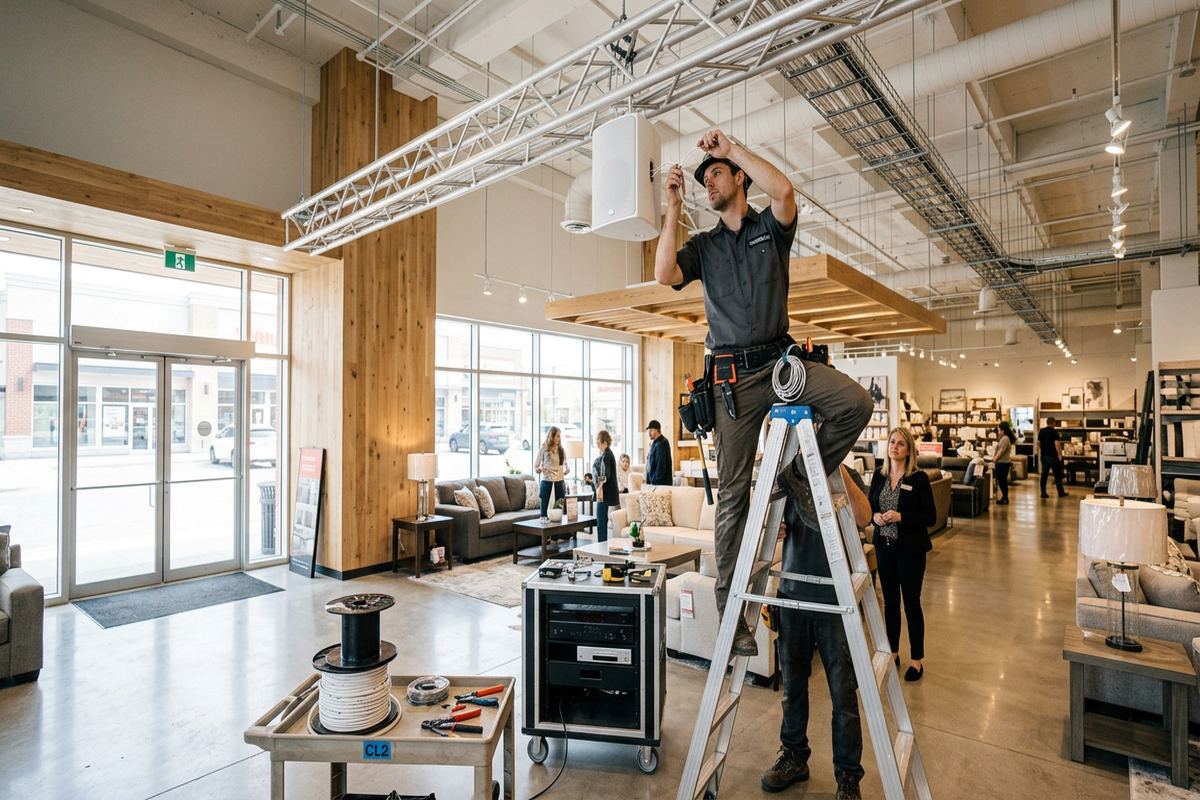
Whole-Home Audio Planning in Bowmanville
A useful whole-home audio system starts with decisions about where sound is needed and how each area will be used. During a Bowmanville site assessment, we discuss music sources, television audio, preferred controls, listening habits and the rooms that should operate together or independently. A kitchen may need clear, even background sound, while a family room may require focused television and music performance. Bedrooms, offices, decks and workshops can become separate zones, allowing occupants to choose different sources and volumes without affecting the rest of the property.
Building type has a direct effect on speaker selection and cable routing. Bowmanville’s historic main street and surrounding older properties can involve masonry, plaster, finished basements, additions and framing that differs between sections of the same building. West-side subdivision homes are often better suited to planned pre-wire work when construction or renovations expose the framing. We assess ceiling depth, joist direction, insulation, access points and likely obstructions before proposing a layout. This helps avoid poorly positioned speakers, unnecessary openings and cable routes that interfere with other building systems.
The written scope sets out what will be installed and where. It covers equipment, cable routes, speaker and control placement, exclusions, equipment ownership and applicable warranty information. The scope also identifies work that may depend on another trade, such as drywall repair, electrical receptacles, cabinetry changes or structural alterations. By documenting the system before installation, the homeowner, builder or property manager can review how the zones will function and understand which parts of the project are included. Pricing follows the site assessment rather than assumptions made from a floor plan alone.
- Room and outdoor-zone requirements
- Speaker type and placement
- Amplifier and source locations
- Control methods and user access
- Documented scope before installation
Speaker Placement for Bowmanville Homes
Speaker placement is based on coverage, room shape, ceiling height and the way furniture is arranged. Simply placing one speaker in the centre of every room can create uneven sound and limited stereo separation. We consider walking paths, seating positions, reflective surfaces and competing noise from appliances or ventilation. In open kitchens and living areas, several lower-output speakers may provide more consistent listening than a small number played loudly. For bedrooms and offices, a single stereo-input ceiling speaker may be appropriate where space is limited and critical stereo imaging is not required.
Different properties call for different mounting methods. A newer frame-built home in Northglen or Liberty may allow in-ceiling speakers to be positioned between predictable joist spaces, although ducts, plumbing and engineered framing still require verification. Older buildings near Downtown Bowmanville may include dense plaster, strapping, masonry walls or previous renovations that complicate concealed installation. Surface-mounted speakers can sometimes reduce disruption while still providing controlled coverage. We confirm available cavity depth and construction materials before cutting finished surfaces, and we coordinate visible placement with lighting, smoke alarms, ceiling fans and architectural details.
Bathrooms, kitchens and exterior areas require equipment suited to their environment. Moisture-resistant speakers may be appropriate in selected indoor locations, while outdoor models must be designed for changing temperatures and exposure. Bowmanville winters, freeze-thaw cycles and wind-driven moisture affect brackets, fasteners, cable entries and terminations. Exterior speaker placement should avoid directing unnecessary sound toward neighbouring properties, particularly on smaller subdivision lots. Eaves and sheltered walls can offer useful protection, but every proposed location still needs secure support, practical cable access and proper sealing where wiring passes through the building envelope.
- Balanced coverage across each room
- Layouts coordinated with lights and vents
- In-ceiling, in-wall or surface options
- Moisture-appropriate speaker selection
- Outdoor placement with controlled sound direction
Audio Pre-Wiring in New Bowmanville Construction
Pre-wiring is most effective before insulation and drywall conceal the framing. Rapid subdivision growth on Bowmanville’s west side keeps this type of work relevant for new houses, finished-basement projects and substantial renovations. At the open-wall stage, cable can be routed more directly, speakers can be centred accurately and future zones can be prepared without cutting finished surfaces later. We coordinate the proposed routes with electrical, plumbing, heating and structural components. Speaker back boxes, mounting supports and conduit can also be considered where the chosen equipment or future service access requires them.
Each speaker cable is installed as a continuous labelled run from its destination to the agreed equipment location. Intermediate splices can complicate testing and future troubleshooting, so routes are planned to avoid them. The central location needs adequate space, ventilation, power and network connectivity for amplifiers, streamers and related equipment. It should also remain accessible after storage, cabinetry or mechanical equipment is added. Labels identify zone and channel at both ends, helping installers complete termination accurately and giving the owner a clearer record if equipment is changed or additional rooms are activated later.
Construction schedules can change quickly, making documented coordination important. Before wiring begins, the builder or homeowner should confirm ceiling treatments, cabinetry, bulkheads, television locations and any rooms where speakers may be omitted. Photographs and measurements taken before drywall can preserve the location of concealed cable and blocking. Following installation and configuration, we provide an as-built record showing the completed arrangement. If only a pre-wire is being installed initially, the scope can identify which cables are terminated, which remain concealed for future use and what access will be needed when speakers are added.
- Continuous labelled speaker cables
- Routes coordinated before insulation
- Central equipment location planning
- Optional provision for future zones
- As-built records for concealed wiring
Bowmanville, Ontario
Whole-home audio installation in Bowmanville, scoped in writing first
Book a site assessment and get equipment, routes, exclusions, and warranty on paper before anything is installed.
Retrofitting Audio in Bowmanville Properties
Finished homes require a different approach from open-wall construction. The first step is to identify usable routes through basements, attics, closets, mechanical areas and existing service openings. In Waverley or Downtown Bowmanville, renovations completed at different times may leave blocked cavities or unexpected framing changes. Small inspection openings may be needed when route conditions cannot be verified from accessible areas. We explain likely access requirements before work proceeds and identify where patching or finishing by another trade may be necessary. The objective is a practical concealed route without making unsupported assumptions about hidden conditions.
Masonry and frame construction require different tools, fixings and routing decisions. A cable can often travel through framed interior partitions, but solid brick, concrete or stone may require a surface raceway, cabinetry route or carefully placed penetration. Exterior walls can contain insulation and vapour-control layers that should not be disturbed unnecessarily. Where a concealed path would create excessive damage, a neat surface-mounted option may be the more responsible choice. The site assessment compares these approaches based on the room layout, construction and finish expectations rather than promising that every wire can be made completely invisible.
Existing audio equipment can sometimes remain part of the system, but compatibility needs to be checked. Speaker impedance, power requirements, wiring condition, source connections and control methods all influence whether older components can be reused. We do not assume that installed volume controls, unidentified cables or abandoned speakers are suitable. Accessible wiring can be inspected and tested, with findings reflected in the proposed scope. If replacement is recommended, the reason should be clear, such as damaged cable, unsuitable ratings, incompatible controls or an equipment arrangement that cannot support the requested number of independently operated zones.
- Attic, basement and closet route assessment
- Options for masonry and finished walls
- Existing speaker-wire testing where accessible
- Neat surface routing when concealment is impractical
- Clear identification of repair exclusions
Audio Zones, Sources and Everyday Control
Audio zones determine which spaces operate together. A zone may be one room, several connected rooms or an exterior listening area, depending on how the property is used. Separate zones let a homeowner play different sources or adjust volume without changing every speaker in the house. Too many zones, however, can add equipment and control complexity without improving daily use. We review common routines before defining the design. Kitchens and adjacent living spaces often work well together, while bedrooms, offices, garages and patios usually benefit from independent control.
Source selection should match the services and devices the customer already uses. Depending on the chosen equipment, sources may include streaming applications, television audio, radio, local media players or a turntable with the required interface. Reliable operation also depends on the home network, particularly when amplifiers or streamers are controlled through mobile applications. We review network availability at the equipment location and identify where wired data or Wi-Fi improvements may be needed. Audio installation does not automatically correct weak wireless coverage, so network requirements are documented rather than left as an untested assumption.
Controls should be straightforward for regular occupants and understandable to guests. Options can include mobile applications, wall controls, handheld remotes or integration with compatible automation platforms. The system is configured on site using the customer’s own credentials, helping ensure that accounts and subscriptions remain under the customer’s control. During handover, we demonstrate source selection, zone grouping, volume adjustment and basic recovery steps. The as-built information records installed equipment and zone assignments, providing a reference if a router, mobile device, streaming account or audio component is replaced in the future.
- Independent or grouped listening zones
- Streaming and television audio options
- Network requirements checked during planning
- Controls matched to daily routines
- Customer-owned accounts and credentials
Outdoor Audio for Bowmanville Seasons
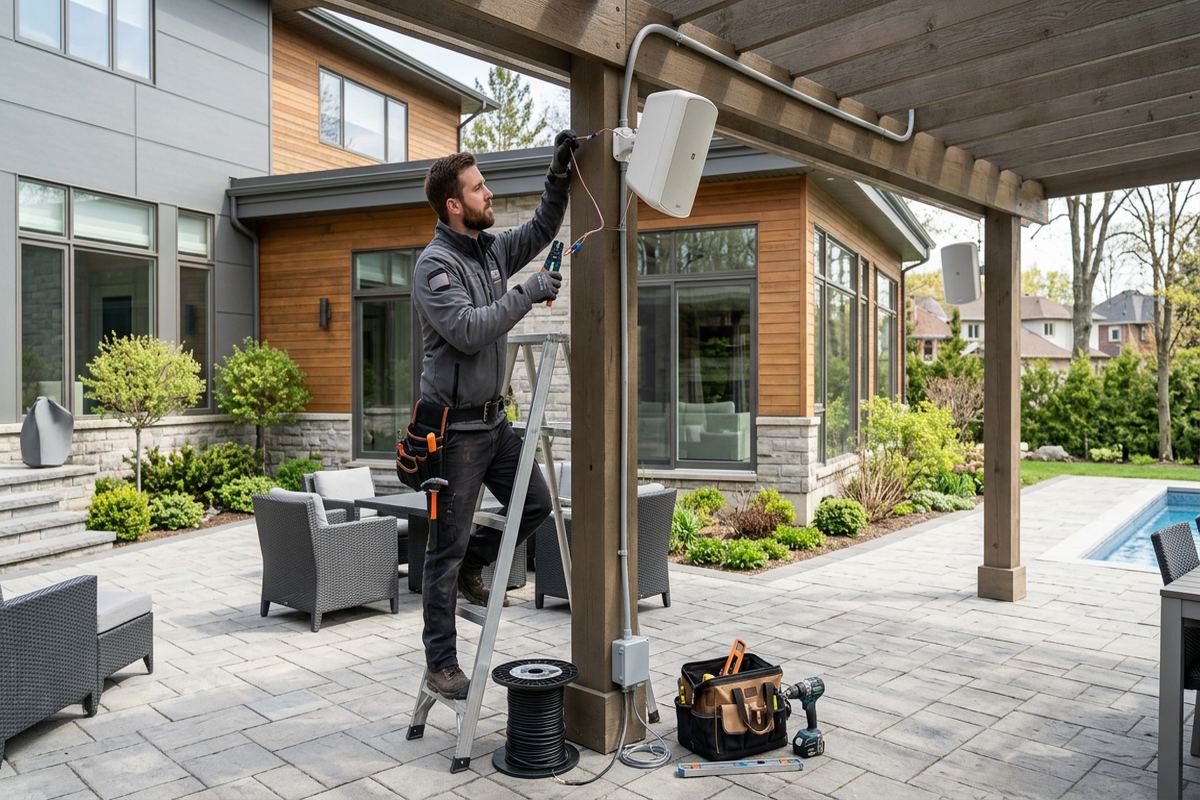
Outdoor audio requires more than installing an indoor speaker beneath an overhang. Equipment must be selected for the mounting location, expected moisture exposure and temperature changes. In Port Darlington and other exposed areas, wind and weather can place additional demands on brackets and connection points. We assess wall material, structural support and the path from indoor equipment to each outdoor speaker. The proposed layout also considers where people sit and how nearby properties are arranged, allowing useful coverage at moderate volume rather than relying on speakers that project sound farther than necessary.
Cable penetrations through exterior walls need careful placement and sealing. The entry should shed water, avoid creating a path into the wall assembly and use materials compatible with the surrounding surface. Brick masonry, siding and poured concrete each call for different drilling and fastening methods. Bowmanville’s freeze-thaw conditions make unsealed or poorly positioned openings a particular concern because trapped moisture can contribute to movement and deterioration. Cable should also be supported and protected from abrasion, landscaping work and accidental impact. Exterior connections remain accessible where practical so their condition can be checked during future service.
Patio, deck and garden systems can use wall-mounted speakers, discreet landscape models or a combination designed around the site. The right approach depends on coverage goals, available routes and how permanent the landscaping is. Before ground-level cable is proposed, we discuss hardscaping, drainage, planting beds and areas that may be excavated later. Some properties also require approval from a condominium corporation, landlord or property manager before exterior equipment or penetrations are added. Those permissions remain the customer’s responsibility and should be confirmed before installation dates or final mounting locations are established.
- Weather-appropriate outdoor equipment
- Sealed exterior cable penetrations
- Fasteners selected for mounting material
- Coverage planned around neighbouring properties
- Approval requirements identified before work
Bowmanville Commercial and Multi-Unit Audio
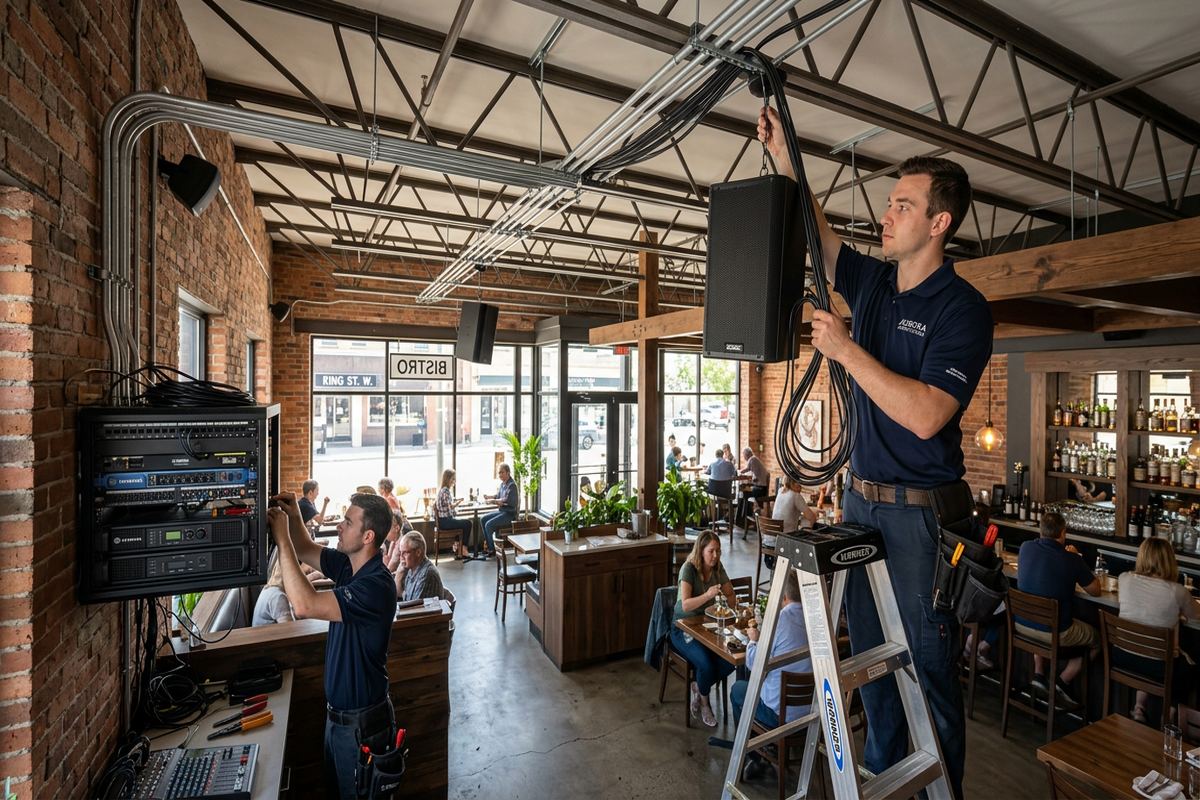
Background audio in a commercial space has different priorities from residential listening. Retail units, offices, restaurants and service businesses may need consistent coverage, simple staff controls and defined operating zones rather than high output in one location. Commercial strips and industrial units around Bowmanville can include open ceilings, concrete walls, metal framing and shared service areas. We assess mounting height, ambient noise, equipment security and cable pathways before preparing the scope. The design can separate customer areas, offices, meeting rooms, staff spaces or showrooms where different volume levels are useful.
Commercial projects may also involve landlord, condominium or property-management approvals. Tenants should confirm permission for ceiling openings, wall penetrations, equipment mounting and access to shared spaces before installation. Where fire-rated assemblies or designated pathways are involved, the work must be coordinated with the building’s requirements and relevant trades. We identify known dependencies in the written scope rather than treating a leased unit like a detached house. Scheduling may also need to account for customer traffic, deliveries, other contractors and restrictions on noisy work within the property.
Multi-unit residential properties need particular attention to sound transfer and common-property boundaries. A speaker mounted near a shared wall or ceiling can affect neighbouring occupants even when volume seems moderate inside the room. Device placement, bass expectations and operating limits should reflect the construction and building rules. In a condo, cabling above a ceiling or through a common wall may require formal approval and may not be permitted. A site assessment helps establish what is physically practical, but owners and tenants must obtain required permissions before UnifiedLink proceeds with affected work.
- Even coverage for customer and staff areas
- Simple controls for daily operation
- Planning for concrete and open ceilings
- Coordination with landlord requirements
- Sound-transfer considerations in multi-unit buildings
Installation, Testing and Handover in Bowmanville
Once the scope is approved and site conditions are ready, installation follows the documented routes and device locations. Cables are kept as continuous labelled runs, and terminations are completed for the specified speakers, amplifiers and controls. Any significant hidden condition that changes the planned route is discussed before related work continues. This is especially important in older Bowmanville properties, where concealed renovations, masonry or blocked cavities may only become clear after limited access is opened. One accountable contractor coordinates the low-voltage audio work, reducing uncertainty about responsibility for cabling, configuration and documentation.
Testing confirms more than whether sound comes from each speaker. We check channel assignment, zone operation, source playback, control response and reasonable volume balance across the covered area. Where network-connected components are included, they are joined to the agreed network and configured on site with the customer’s credentials. Outdoor speakers and visible cable entries are reviewed for secure mounting and sealing. The completed system is compared with the written scope, and material departures are recorded. This process provides a clear basis for handover rather than leaving unidentified cables, default accounts or unexplained controls.
Handover includes practical instruction and an as-built record of the installed system. Customers are shown how to select sources, group or separate zones, adjust volume and perform routine application or device checks. Equipment ownership and warranty information follow the written scope, so there is no ambiguity about supplied and customer-provided components. Requests sent during business hours are answered the same day, while after-hours requests are answered the next business day. Timing for a Bowmanville site assessment depends on the required service and travel distance, and pricing is prepared only after the assessment.
- Labelled installation and terminations
- On-site system and zone testing
- Configuration with customer credentials
- Operating guidance at handover
- As-built system record provided
Bowmanville neighbourhoods we cover
- Downtown Bowmanville
- Waverley
- Northglen
- Liberty
- Port Darlington
Whole-home audio installation in Bowmanville — common questions
Can you install audio without opening every wall?
Often, but the available routes depend on the property. Bowmanville homes may provide access through an attic, unfinished basement, closet or mechanical area. Older plaster, masonry and completed additions can limit concealed routes. We assess the building first and explain any likely access openings, surface raceways or finishing work before pricing. Complete concealment cannot be promised until route conditions are understood.
When should audio pre-wire be installed?
Pre-wire should normally be completed after speaker locations and framing are confirmed but before insulation and drywall close the cavities. For new subdivision construction or renovations in Bowmanville, coordination with electrical, plumbing, HVAC and cabinetry work is important. We install continuous labelled runs and can document concealed cable locations. The exact visit timing depends on the construction schedule and site readiness.
Can my patio be a separate audio zone?
Yes, a patio or deck can usually operate as an independent zone if the amplifier, controls and wiring are designed accordingly. For Bowmanville properties, outdoor equipment and mounting methods must account for moisture, winter temperatures and freeze-thaw conditions. We also plan speaker direction around seating areas and nearby homes. Exterior penetrations are positioned and sealed for the wall material.
Can you reuse my existing speakers or receiver?
Potentially. Reuse depends on speaker impedance, power requirements, cable condition, available inputs and the number of requested zones. During a Bowmanville assessment, accessible equipment and wiring can be reviewed and tested. The written scope identifies customer-provided components and any limitations associated with them. Replacement may be recommended where equipment is damaged, incompatible or unable to support the intended control arrangement.
Do I need approval for condo audio work?
Possibly. A condominium corporation may regulate ceiling openings, wall penetrations, common-property access, exterior speakers and work affecting shared assemblies. Landlords can impose similar requirements in rental properties or commercial units. Bowmanville owners and tenants should obtain written permission before affected work begins. We can describe proposed cable routes and mounting locations for review, but approval remains the customer’s responsibility.
What do I receive after installation?
After a Bowmanville installation, UnifiedLink tests the specified zones, sources, controls and network-connected components. Configuration is completed using your own credentials. Handover includes instruction on normal operation and an as-built record showing the installed arrangement. The written scope also addresses equipment ownership, exclusions and warranty. This documentation provides a reference when changing internet equipment, mobile devices, streaming accounts or audio components.
Coverage in Bowmanville is confirmed against the address before we quote. See everything we install in Bowmanville or the province-wide whole-home audio installation page.