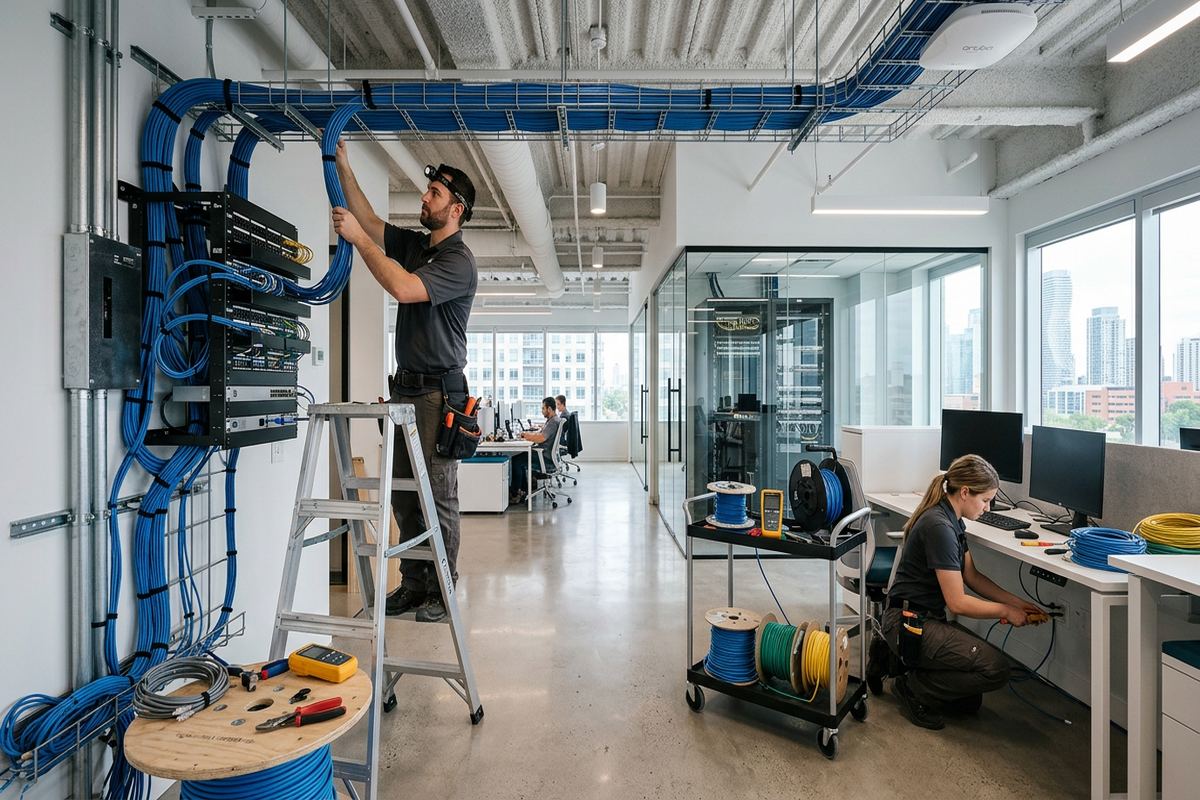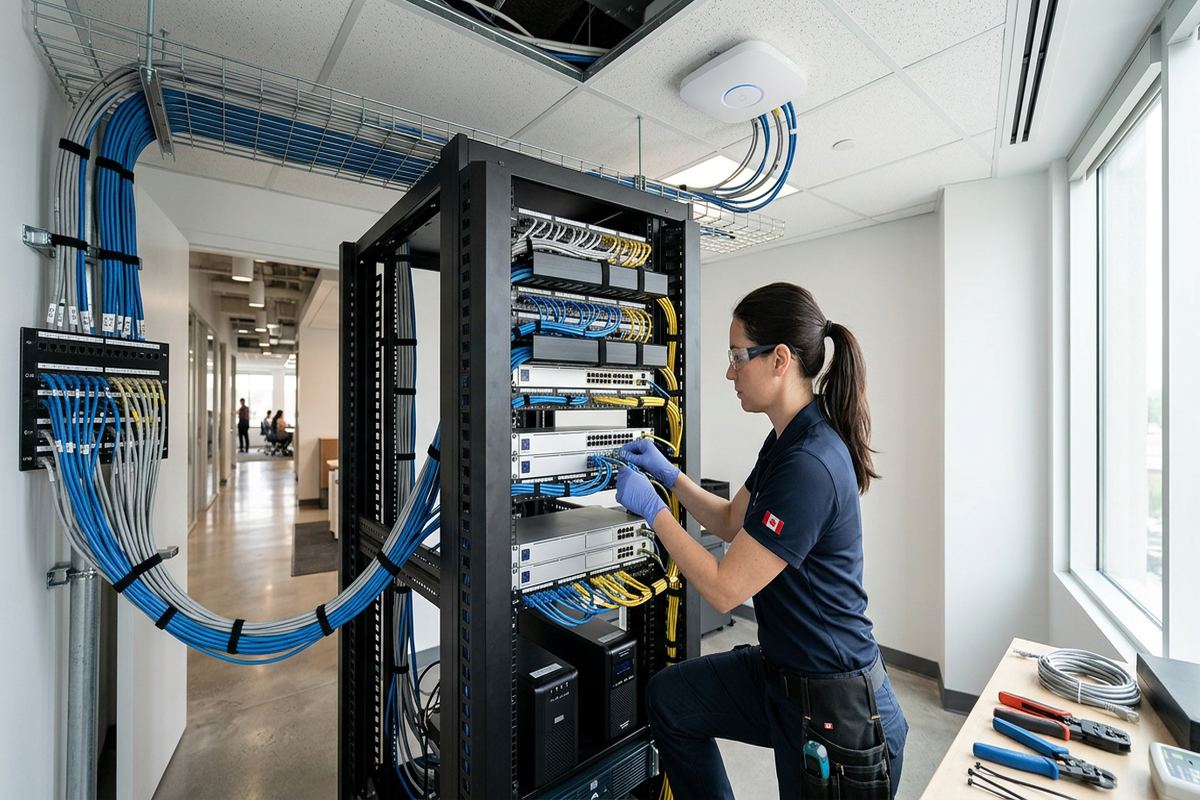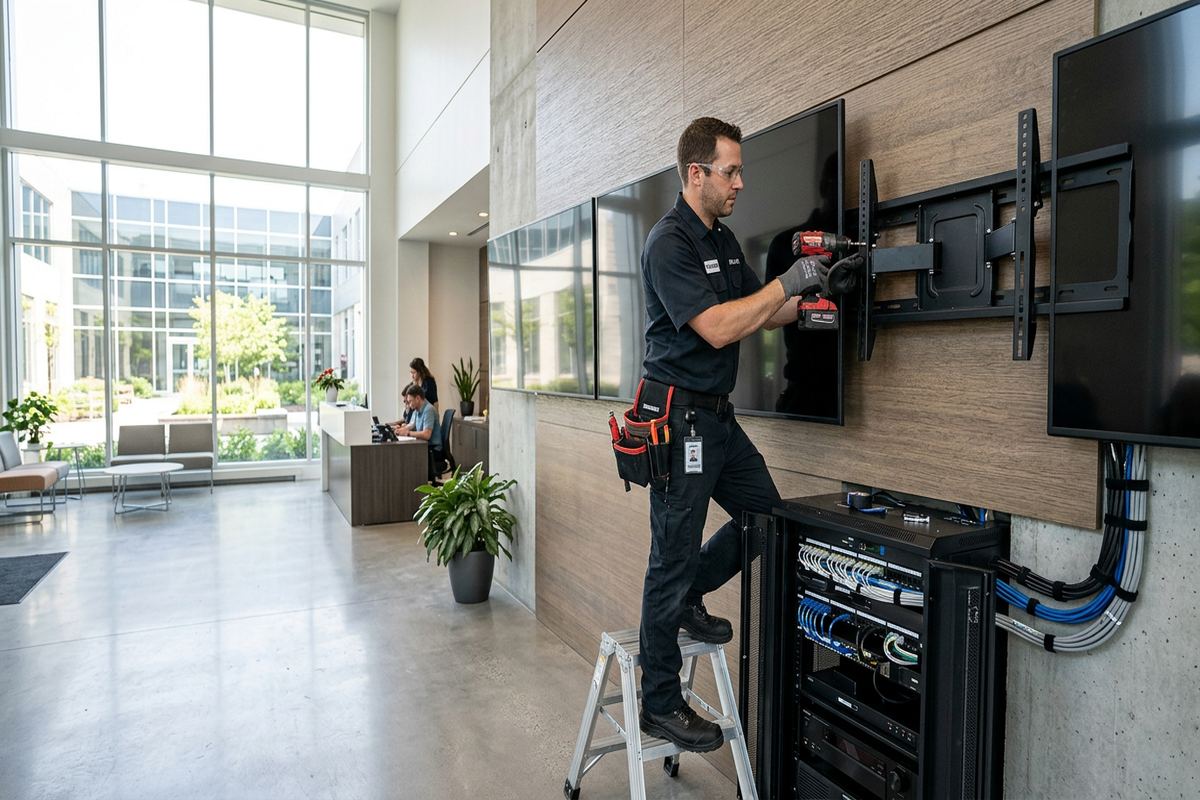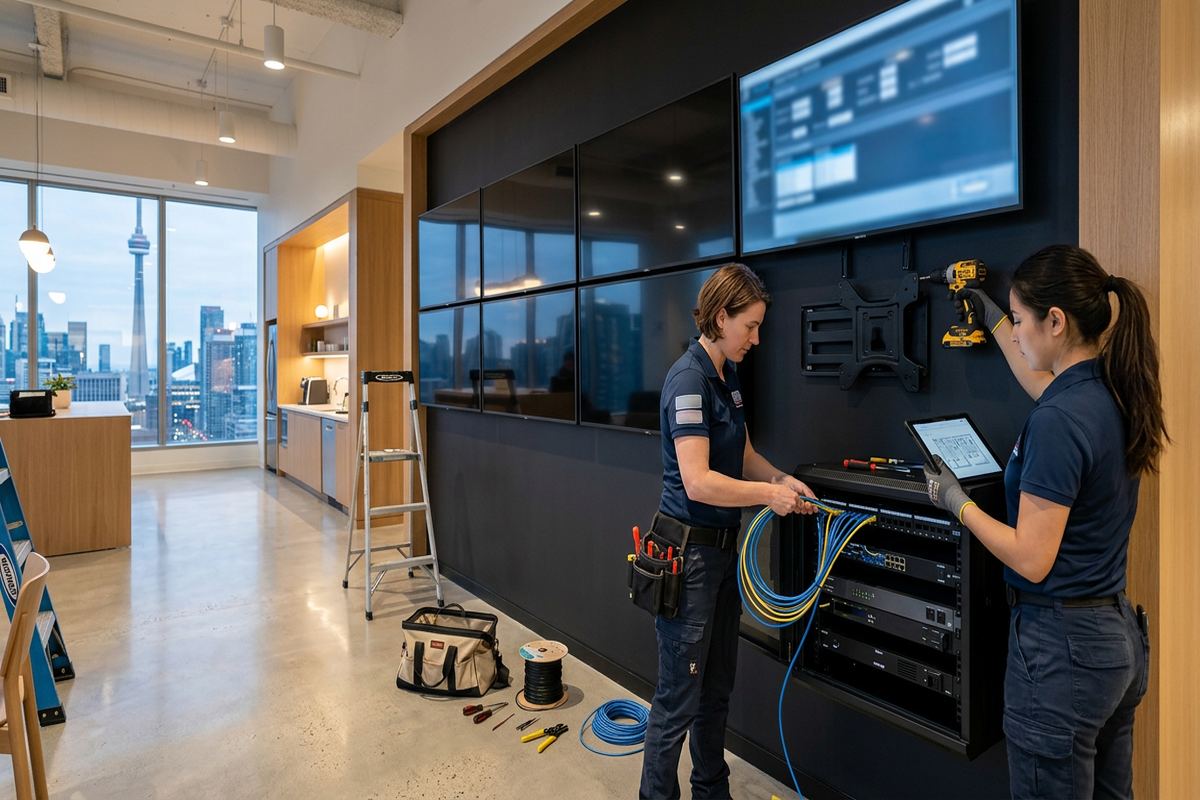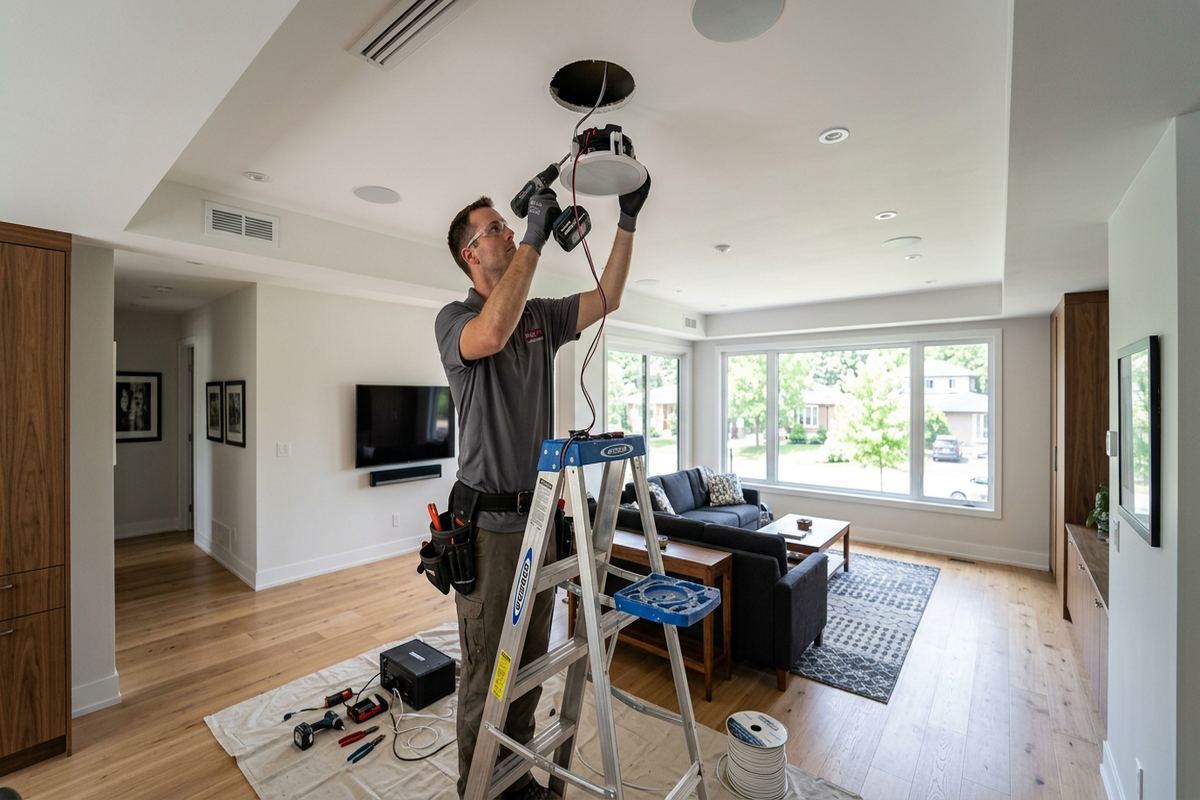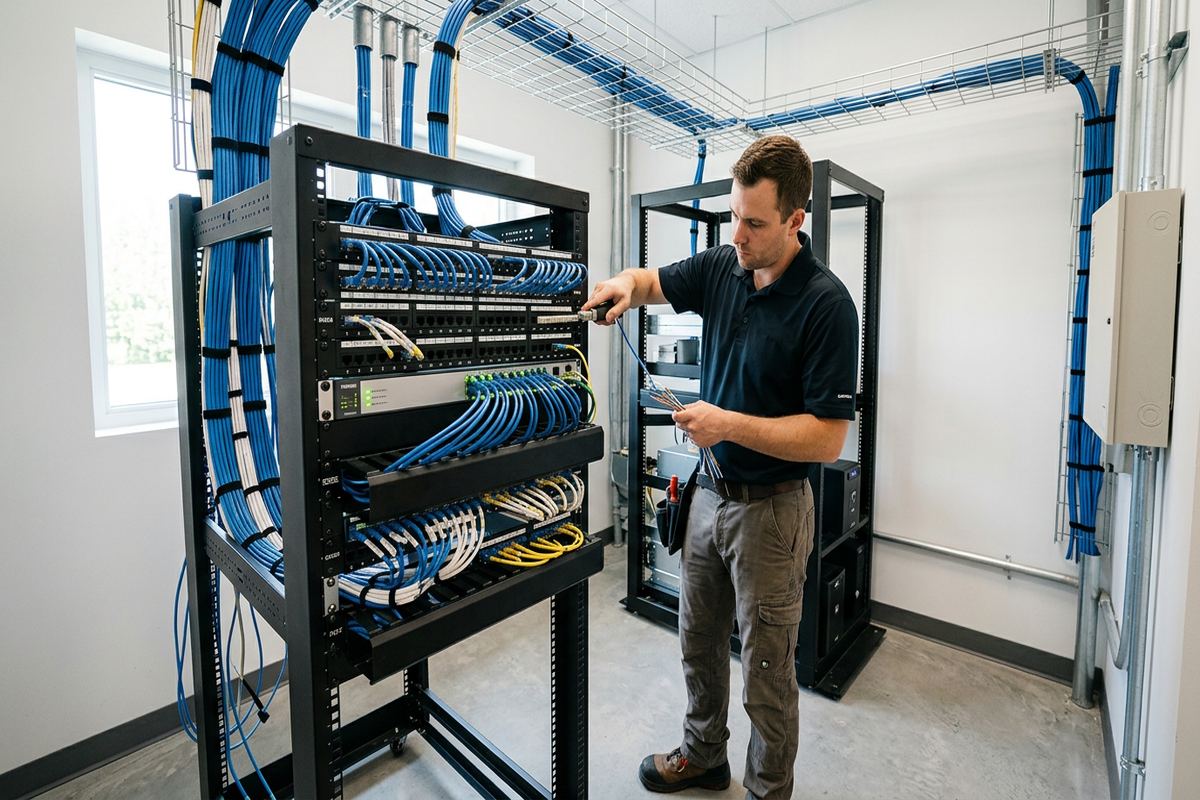
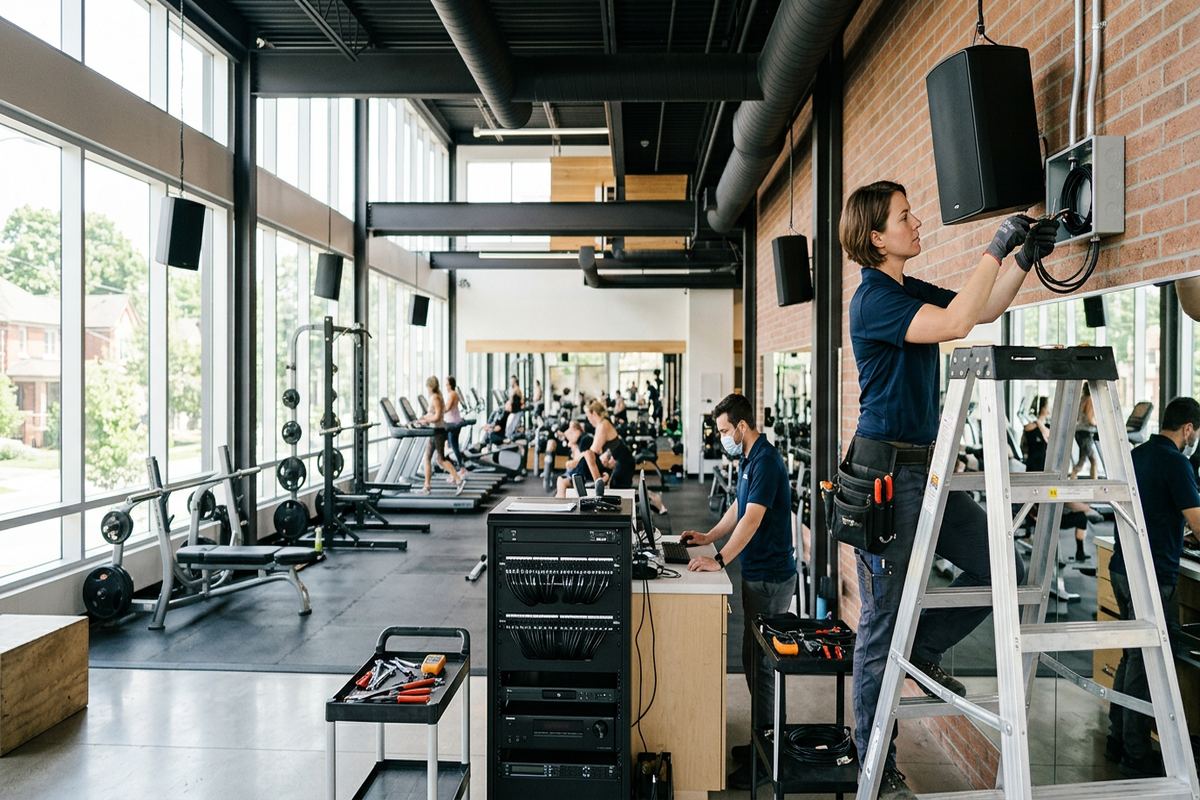
UnifiedLink installs in-ceiling speakers for homes and businesses across Bowmanville, from finished-room retrofits to pre-wiring during construction. We assess the ceiling structure, listening area, cable routes and equipment before providing a written scope. Installation includes labelled cabling, careful speaker placement, on-site configuration and a documented handover using your own system credentials.
In-Ceiling Speaker Planning for Bowmanville Properties
A successful in-ceiling audio system starts with the room rather than a speaker catalogue. We review ceiling height, seating positions, room dimensions, finishes and expected listening levels before choosing locations. In a Bowmanville living room, kitchen or commercial space, speaker quantity and spacing determine whether sound feels even or noticeably louder in certain areas. We also consider lighting, smoke alarms, heating registers and structural members. This planning helps keep speaker cut-outs aligned, avoids unnecessary ceiling repairs and establishes whether the proposed locations can be reached with continuous cable runs from the amplifier or equipment area.
Bowmanville combines a historic main street with rapid subdivision growth on the west side, so installation conditions vary considerably. Older properties near Downtown Bowmanville may have plaster, masonry sections, renovations from different periods or limited access between floors. Newer homes around Northglen and Waverley are often easier to pre-wire before insulation and drywall, but framing, ductwork and engineered floor systems still affect routes. A site assessment identifies these conditions before pricing. Where concealed pathways cannot be confirmed visually, we explain the uncertainty, practical investigation methods and any exclusions that should appear in the written installation scope.
System planning also depends on how each area will be used. Background music in a kitchen, reception area or retail floor needs different coverage from focused television audio or higher-output entertainment. We discuss independent volume zones, source selection, amplifier location and control preferences before equipment is finalized. The written scope covers equipment, proposed cable routes, speaker placement, exclusions, equipment ownership and warranty. This gives Bowmanville property owners a defined plan before openings are made. It also prevents common mismatches, such as too many speakers on an amplifier channel or controls that do not support the desired zones.
- Room dimensions and listening positions reviewed
- Ceiling obstacles identified before cutting
- Speaker spacing planned for consistent coverage
- Amplifier loads and audio zones confirmed
- Written scope provided before installation
Retrofit Installation in Finished Bowmanville Homes
Retrofitting speakers into a finished ceiling requires a workable route, not simply an open spot for each grille. We inspect accessible basements, utility rooms, closets, attic areas and existing low-voltage pathways to determine how cables can reach the equipment location. Small inspection openings may be necessary where framing direction or concealed obstructions cannot otherwise be verified. In finished Bowmanville homes, the goal is to limit disruption while maintaining proper cable support and separation from electrical wiring. We do not treat loose cable dropped through inaccessible cavities as an acceptable substitute for a planned, continuous run that can be identified later.
Older homes in Downtown Bowmanville and established areas such as Liberty can include plaster ceilings, strapping, additions and masonry walls that change the installation method. Plaster requires controlled cutting to reduce cracking, while masonry sections may prevent the direct routes available in frame construction. Previous renovations can also hide abandoned wiring or unexpected blocking. We account for the ceiling material when selecting tools, mounting methods and grille positions. If the requested route would create disproportionate damage, we present alternatives such as a different equipment location, adjusted speaker placement or an accessible surface pathway rather than proceeding without clear approval.
Once routes are confirmed, speaker openings are measured against manufacturer templates and checked for nearby framing. Cables are installed as continuous labelled runs from the amplifier or zone controller to each speaker position, without concealed joins. Speakers are secured according to their mounting design, with insulation and vapour barriers handled carefully where encountered. Fine construction dust is controlled around the work area, and grilles are aligned consistently across the room. After installation, we test every channel, confirm polarity and listen for rattles or ceiling vibration. Any patching or painting exclusions are identified in the scope before work begins.
- Controlled openings in finished ceilings
- Routes assessed through accessible spaces
- Continuous cables without concealed splices
- Speaker grilles aligned to the room
- Channels tested for polarity and vibration
Pre-Wiring New Bowmanville Construction
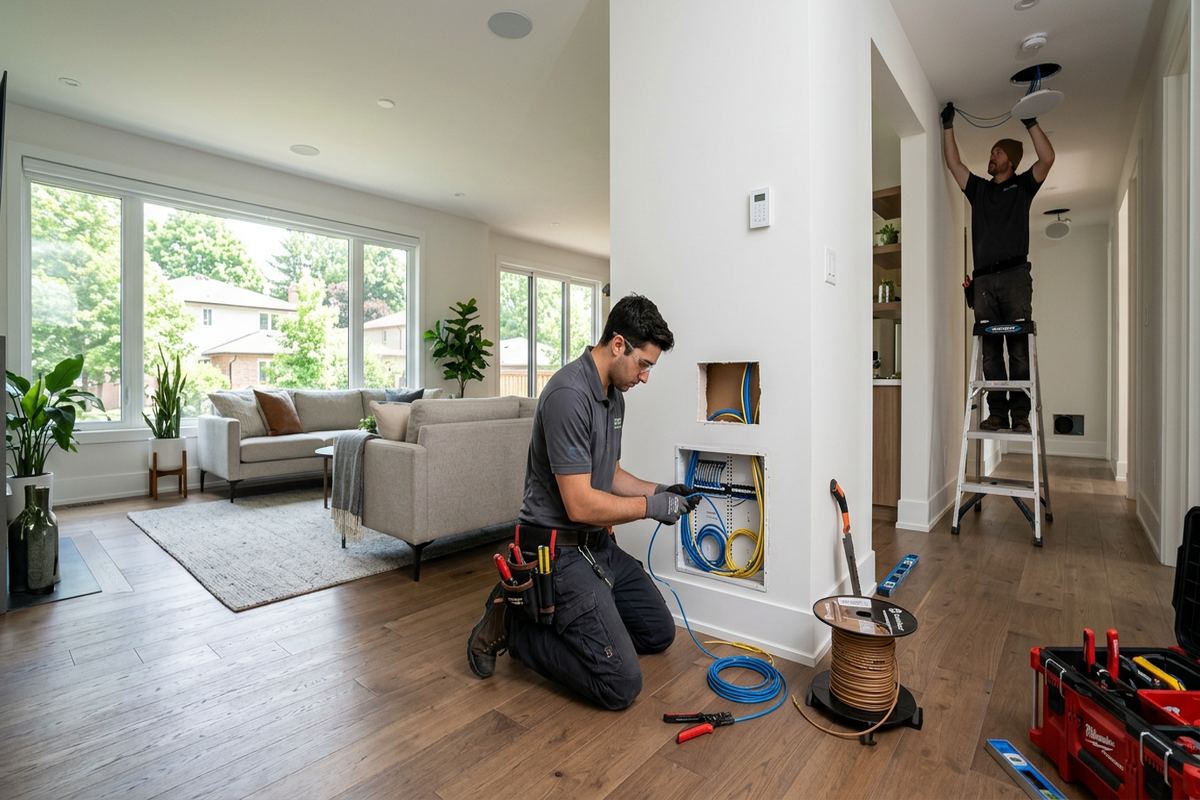
Pre-wiring before drywall provides the greatest control over cable routes and speaker placement. In Bowmanville’s growing west-side subdivisions, this stage allows audio wiring to be installed around ductwork, plumbing and electrical services while framing remains visible. We coordinate the proposed amplifier position, room zones and speaker locations with the construction schedule. Cable is supported independently, kept appropriately separated from line-voltage wiring and labelled at both ends. Photographs and route details can then be included in the as-built record, giving the owner useful information when speakers are installed or system changes are considered later.
A pre-wire should preserve exact locations rather than leaving cable loosely somewhere above the future ceiling. Speaker positions can be marked with suitable brackets or reference measurements, depending on the selected equipment and construction sequence. We consider pot lights, ceiling fans, bulkheads, cabinetry and smoke alarms before finalizing each point. If speakers will be installed after closing, the cable ends remain protected and identifiable. For insulated ceilings, advance planning also helps address vapour barrier penetrations and appropriate enclosures. These details reduce searching, unnecessary cuts and conflicts once finished surfaces conceal the framing and mechanical systems.
Construction plans do not always show every field condition, so on-site verification remains important. Framing revisions, relocated lights or added ducts can affect an otherwise symmetrical layout. We review significant changes before cable is installed and document accepted adjustments. The scope states whether UnifiedLink supplies speakers immediately, completes only the rough-in, or returns for trim-out and configuration. Equipment ownership and warranty responsibilities are also recorded. For custom homes, renovations and commercial fit-outs in Bowmanville, having one accountable contractor for the low-voltage audio work keeps routing, labelling, testing and final documentation connected throughout the project.
- Cable installed while framing is visible
- Locations coordinated with lights and ductwork
- Both cable ends clearly labelled
- Rough-in changes documented on site
- Trim-out can follow after finishing
Bowmanville, Ontario
In-ceiling speaker installation in Bowmanville, scoped in writing first
Book a site assessment and get equipment, routes, exclusions, and warranty on paper before anything is installed.
Speaker Placement and Audio Zones in Bowmanville
Even coverage usually comes from several correctly spaced speakers operating at moderate output, not one speaker playing loudly from the centre of a room. Placement considers where people spend time, how sound reflects from hard surfaces and whether adjoining areas should share a source. Open-plan Bowmanville homes may combine kitchens, dining spaces and family rooms, yet each area can need different volume. We plan speaker pairs and zones so normal movement through the space does not produce abrupt changes. Stereo, mono and distributed-audio layouts are selected according to room width, listener position and the capabilities of the amplifier.
Bathrooms, kitchens and covered exterior areas introduce additional equipment considerations. Moisture-resistant speakers may be appropriate, but that designation does not make every model suitable for direct weather exposure. Ceiling depth, insulation contact, steam and nearby exhaust fans must be checked. For outdoor audio around Port Darlington or other exposed Bowmanville locations, we assess wind-driven moisture, winter temperatures and freeze-thaw conditions. Exterior penetrations require suitable sealing and drip-conscious cable routing. A protected soffit can still experience condensation and seasonal movement, so indoor speakers and untreated connections should not be assumed acceptable simply because they are beneath an overhang.
Multi-zone control can be straightforward or highly integrated. A basic system may use an amplifier with separate zone outputs and local volume controls, while networked audio can provide source selection through an app. We confirm network dependence, device compatibility and how household or staff users will operate the system. Where television audio is included, delay and connection limitations are reviewed before installation. UnifiedLink configures the agreed equipment on site and hands over administrative access using the customer’s own credentials. The as-built record identifies speaker runs, equipment locations and zone labels, making future troubleshooting or expansion more manageable.
- Coverage based on occupied listening areas
- Independent zones planned where practical
- Moisture and exterior ratings verified
- Controls matched to daily user needs
- As-built zone and cable records supplied
Commercial In-Ceiling Audio for Bowmanville
Commercial audio needs clear coverage at the required level without interfering with normal work or customer interaction. For offices, clinics, restaurants and shops along Bowmanville’s commercial strips, we assess ceiling type, ambient noise, operating hours and the intended audio source. Suspended ceilings offer access but still require properly supported cable and independently secured equipment where applicable. Open ceilings and finished drywall need different mounting methods. We also determine whether the system is for background music, presentations, paging support or a combination, since each purpose affects speaker spacing, amplifier selection and the number of controllable zones.
Industrial units can contain high ceilings, loud mechanical equipment and long cable routes that make residential speaker layouts unsuitable. A warehouse office, showroom and work floor may each require different loudspeakers or volume levels. We inspect construction materials, including concrete or masonry walls, steel framing and insulated roof assemblies, before selecting pathways. Cable routes must avoid sources of interference and remain accessible where future servicing is likely. If fire-rated assemblies or shared building areas are involved, the property’s requirements and necessary approvals need to be established before penetrations are made. These conditions are documented rather than assumed.
Businesses often need straightforward controls that staff can use without access to system administration. We can configure named zones, establish normal operating levels and document source connections during handover. Customer-supplied streaming services remain under the customer’s credentials and account terms. If the premises are leased, landlord approval may be required for ceiling cuts, cable pathways or equipment fixed to the building. Bowmanville tenants should confirm these permissions before installation dates are set. The written scope identifies supplied equipment, ownership, exclusions and warranty, helping distinguish permanent building infrastructure from components the tenant may remove when a lease ends.
- Layouts suited to commercial noise levels
- Suspended and open ceilings assessed
- Staff controls kept clear and practical
- Lease and landlord requirements identified
- Equipment ownership documented in writing
Ceiling Construction, Insulation and Sealing
The material above and around a speaker affects both installation and sound. Standard drywall over wood framing is generally straightforward once joists and services are located, while plaster, concrete, masonry and decorative ceilings require different cutting or mounting strategies. Some Bowmanville properties contain more than one construction type because of additions or renovations. We do not assume that a ceiling cavity continues unobstructed across a room. Inspection from accessible areas, electronic detection and limited exploratory work may be used to verify conditions. The findings guide placement and determine whether the original route remains practical without avoidable surface damage.
Insulated ceilings need particular attention because speaker openings may intersect air barriers or vapour control layers. Unmanaged penetrations can permit air leakage or condensation, especially through Ontario winters. Where the design calls for speakers beneath an attic, garage or exterior overhang, we consider suitable back enclosures, sealing methods and clearances based on the assembly and equipment requirements. Freeze-thaw cycles also matter for exterior-mounted audio and cable entry points. Sealants, fittings and fasteners must suit the substrate and exposure rather than relying on a general-purpose interior product. These measures protect the building assembly as well as the audio components.
Speaker backboxes or enclosures can reduce sound transfer and protect the rear of a speaker, but they must be selected for the available depth and acoustic purpose. They are not a complete soundproofing solution. Bedrooms above entertainment areas, attached homes and commercial suites may need broader isolation measures involving framing, resilient channels, insulation or specialty ceiling assemblies. We explain what the audio installation can reasonably address and identify work outside the low-voltage scope. In condos, ceiling cavities may be common elements or rated assemblies, so board approval and building rules should be confirmed before drilling, cabling or adding enclosures.
- Drywall, plaster and masonry assessed separately
- Insulated ceiling penetrations planned carefully
- Exterior openings sealed for local weather
- Backbox depth and purpose verified
- Rated assemblies treated as approval-dependent
Equipment, Amplifiers and System Integration
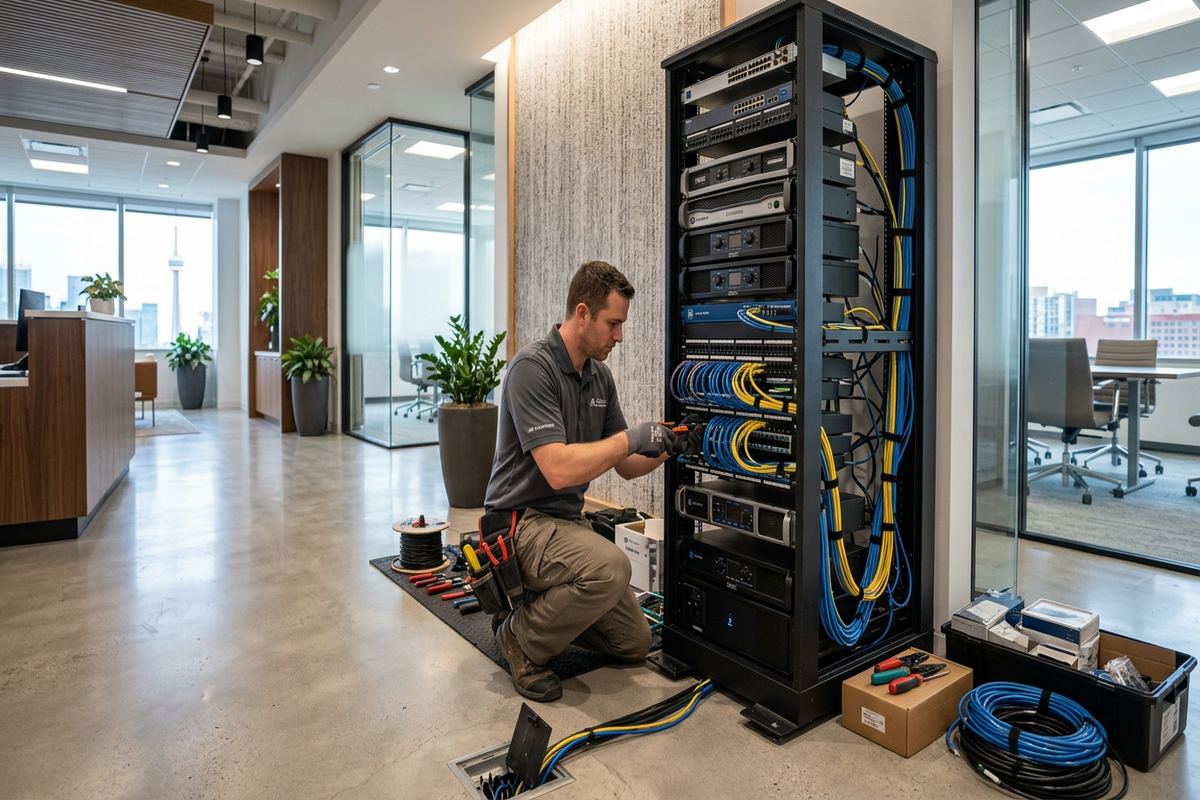
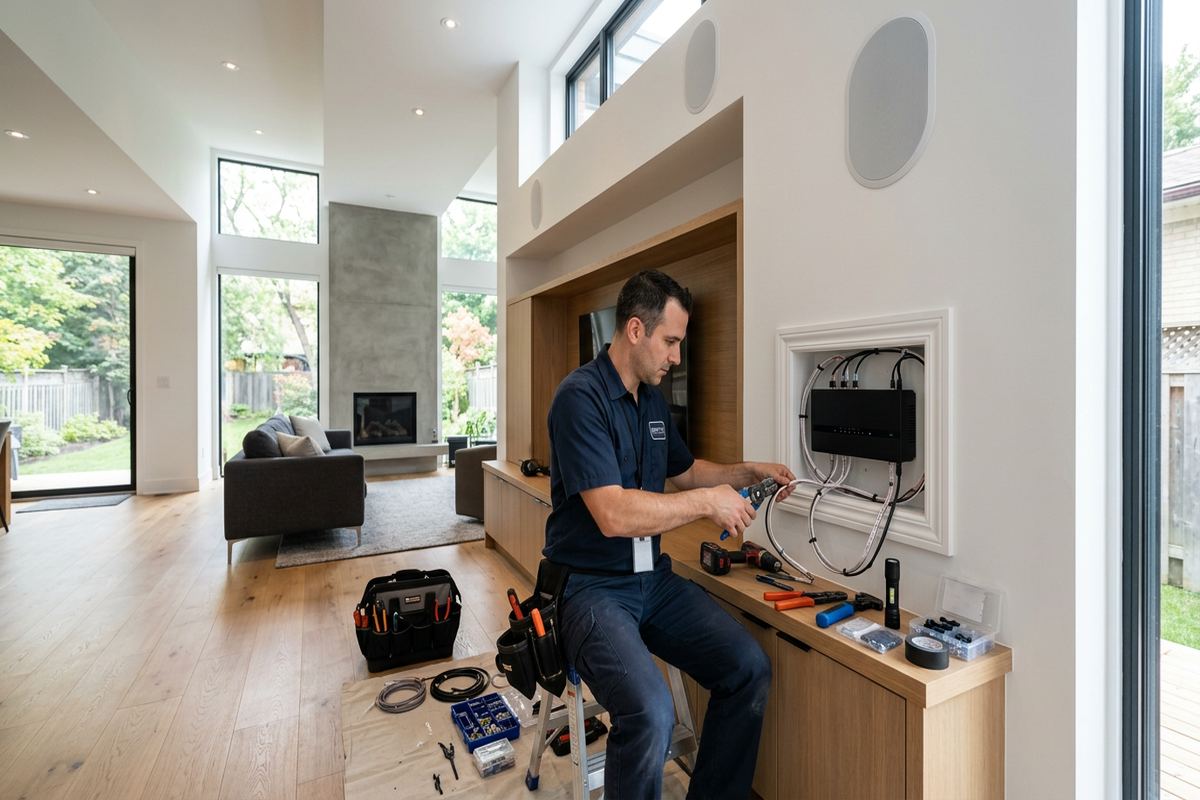
In-ceiling speakers must be compatible with the amplifier and the way zones are wired. We review speaker impedance, channel capacity, expected listening level and manufacturer requirements before connecting equipment. Distributed commercial systems may use a different design from conventional home stereo, and the two approaches should not be mixed without proper interfaces. Existing receivers can sometimes be retained, but their available channels and zone functions need verification. A written equipment schedule clarifies what UnifiedLink supplies, what the customer already owns and which accessories are required. This prevents missing controls, unsuitable amplifiers or unsupported combinations from appearing at the installation stage.
Audio sources can include televisions, streaming devices, computers, media players and dedicated network audio hardware. Each has practical limitations involving output type, control, delay and account access. We test the agreed source paths on site and configure network-connected components on the customer’s network where included in scope. Credentials belong to the customer and are entered or created under their control. For Bowmanville businesses, we also distinguish system installation from music licensing or subscription permissions, which remain the operator’s responsibility. The handover explains normal operation, zone selection, volume control and the correct shutdown or restart procedure.
Existing cabling is evaluated before reuse. A visible speaker wire at each end does not confirm its full route, condition, gauge or hidden connections. We inspect, identify and test accessible runs, then advise whether they are suitable for the planned amplifier and speaker load. When new wiring is installed, each run is continuous and labelled at both ends. Rack, cabinet or shelf placement also needs ventilation, power and service access. Equipment should not be buried behind stored items or placed where amplifiers overheat. The as-built record documents final connections so later changes can be made methodically.
- Amplifier and speaker compatibility checked
- Existing wiring tested before reuse
- Customer-owned equipment listed in scope
- Network audio configured with customer credentials
- Final connections recorded for future service
Bowmanville Assessment, Installation and Handover
Every project begins with information about the property, rooms and intended use. Photos and plans can help with an initial discussion, but pricing follows a site assessment because ceiling access, routes and construction details affect the work. Assessment timing depends on the service and travel distance. Requests sent during business hours are answered the same day, while after-hours requests are answered the next business day. At the property, we review device positions, equipment location, available power, network needs and likely cable pathways. We also identify permissions that the owner, condo corporation or landlord must provide before installation.
After the assessment, the written scope records equipment, cable routes, device placement, exclusions, equipment ownership and warranty. Once accepted and scheduled, we protect work areas, verify locations again and install the agreed continuous labelled cable runs. Speaker openings are made only after practical checks for framing and concealed services. Hardware is mounted, connections are terminated and system configuration is completed on site. One accountable contractor manages the low-voltage audio portion rather than dividing responsibility between separate cabling and setup providers. Any condition that materially changes the planned work is discussed before the affected portion proceeds.
Handover includes testing each speaker, confirming zones and demonstrating everyday controls. We check for correct channel operation, reasonable level balance and obvious vibration or rattling at the time of completion. Networked products are handed over with the customer’s own credentials, not an installer-owned account. The as-built record identifies cable labels, speaker locations, zones and core equipment connections. For Bowmanville homeowners and businesses, this documentation is useful when rooms are renovated, amplifiers are replaced or additional audio areas are considered. It also provides a clear reference for warranty questions and future troubleshooting without relying on memory.
- Site assessment completed before pricing
- Detailed written scope provided
- Installation managed by one contractor
- System tested and configured on site
- Customer credentials and as-built record handed over
Bowmanville neighbourhoods we cover
- Downtown Bowmanville
- Waverley
- Northglen
- Liberty
- Port Darlington
In-ceiling speaker installation in Bowmanville — common questions
Can speakers be installed in my finished Bowmanville ceiling?
Often, yes, provided there is a practical cable route and enough ceiling depth. We assess attic, basement, closet and utility access, along with joist direction and concealed obstacles. Older Bowmanville homes may require limited exploratory openings or adjusted speaker positions. The written scope identifies expected access points and any patching or painting exclusions before installation begins.
How many in-ceiling speakers does my room need?
The number depends on room dimensions, ceiling height, listening positions, desired volume and whether the room needs stereo or general background coverage. Open-plan Bowmanville kitchens and family rooms may benefit from separate zones even when the spaces connect. We establish spacing during the assessment rather than using a fixed speaker count for every room.
Can you pre-wire speakers in a new Bowmanville home?
Yes. Pre-wiring during framing provides clear routes and allows speaker positions to be coordinated with lighting, ductwork and other services. This is particularly useful in Bowmanville’s newer west-side subdivisions. Cables are installed as continuous labelled runs, protected for the construction sequence and documented so the final speaker locations can be found after drywall.
Do outdoor ceiling speakers need special protection?
Yes. A covered soffit does not eliminate exposure to moisture, condensation, winter temperatures or Bowmanville’s freeze-thaw conditions. The speaker, connections, fasteners and cable entry method must suit the location. We assess the mounting surface and seal exterior penetrations appropriately. Indoor-rated equipment should not be installed outside solely because the area has an overhead cover.
Do I need condo or landlord approval?
Possibly. Condo ceilings may contain common elements, rated assemblies or building services, and leased premises may restrict permanent cuts and cable routes. Bowmanville condo owners and commercial tenants should obtain the required written approvals before work is scheduled. The installation scope can provide proposed locations and pathways for review, but property permissions remain the customer’s responsibility.
Can you connect speakers to my existing receiver?
Sometimes. We first confirm the receiver’s available channels, impedance limits, zone functions and source compatibility. Existing speaker cable also needs identification and testing before reuse. If the receiver cannot safely support the proposed Bowmanville installation, we explain the limitation and specify an appropriate alternative in the written scope rather than connecting an unsupported load.
Coverage in Bowmanville is confirmed against the address before we quote. See everything we install in Bowmanville or the province-wide in-ceiling speaker installation page.