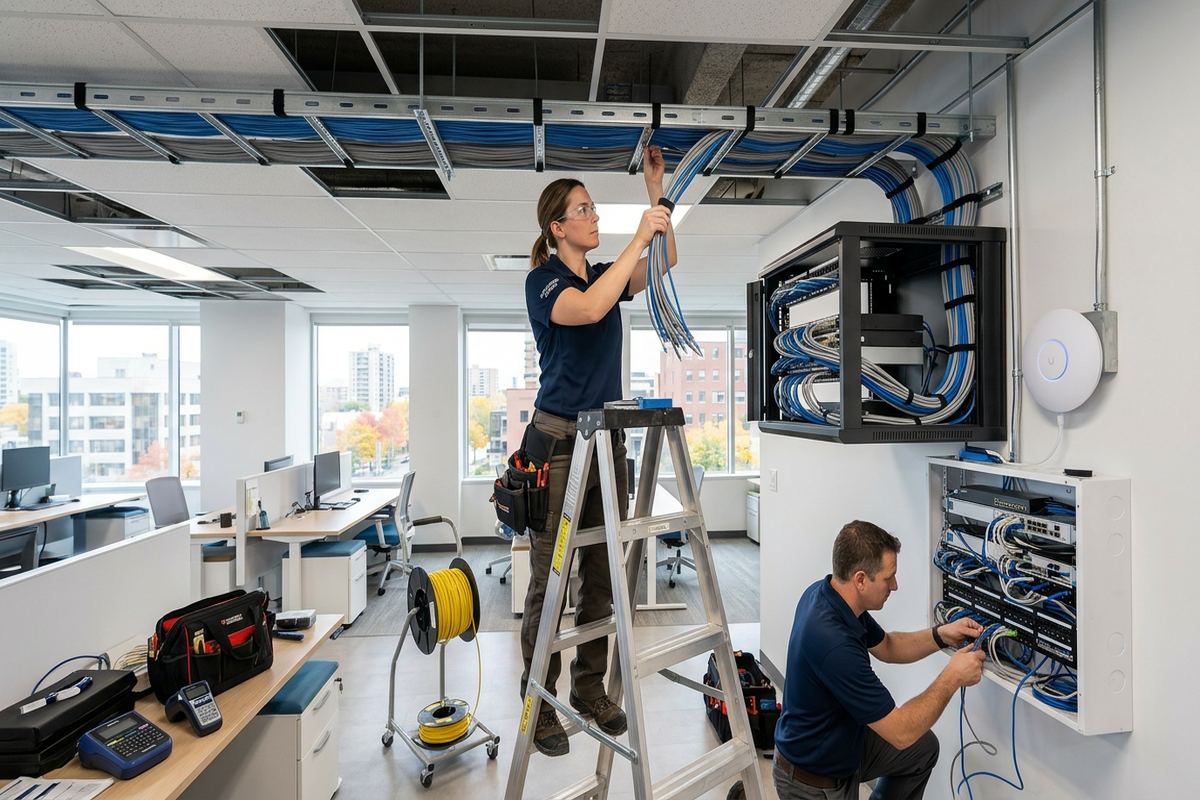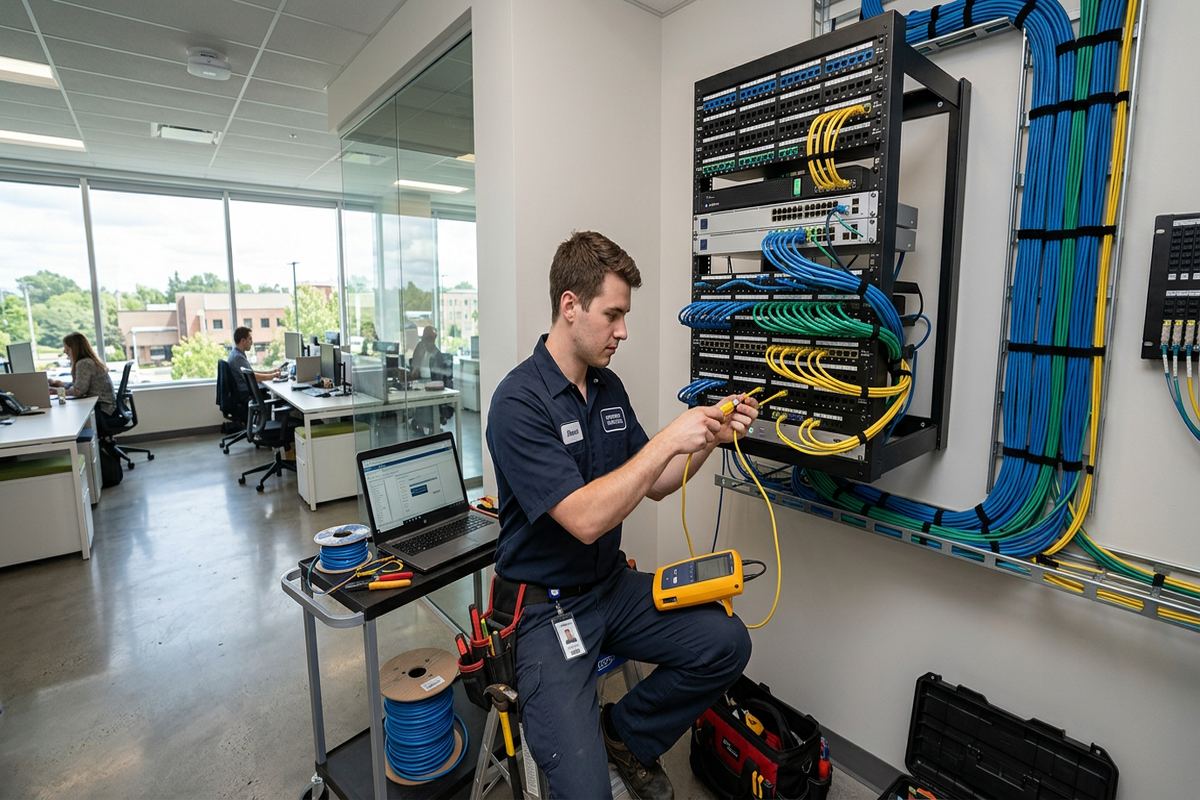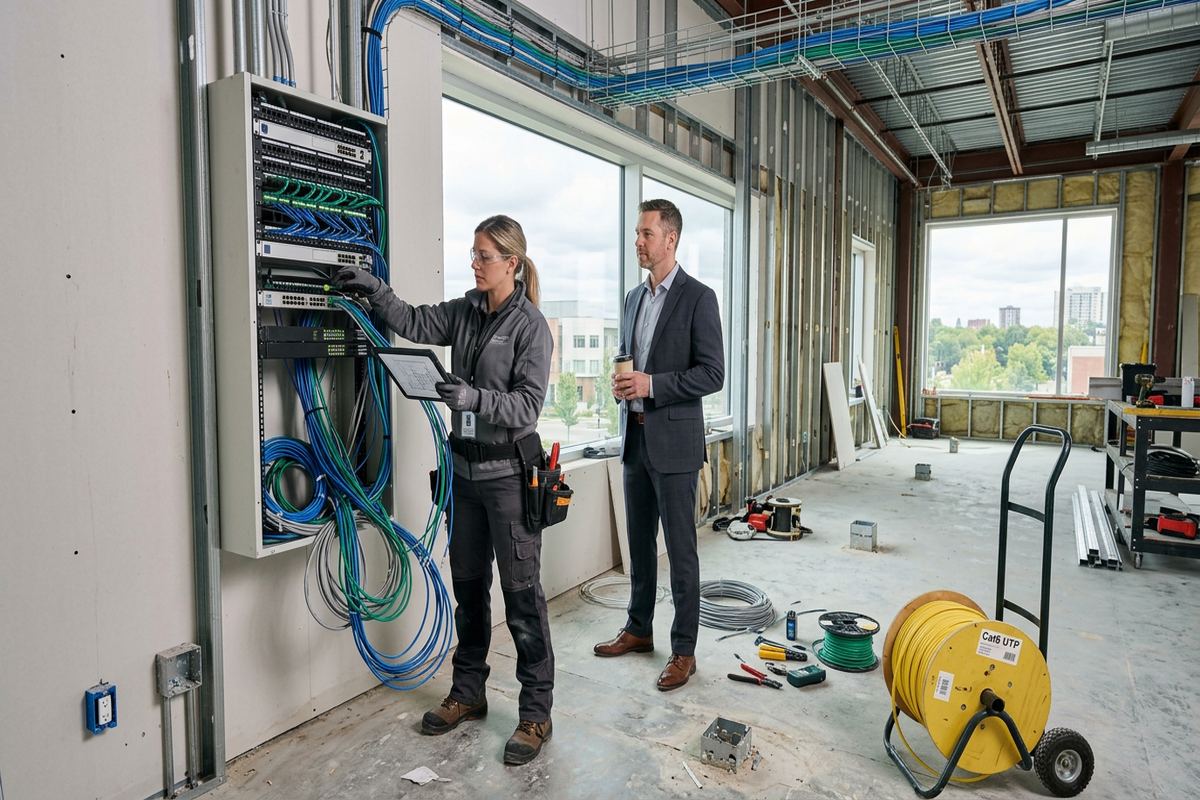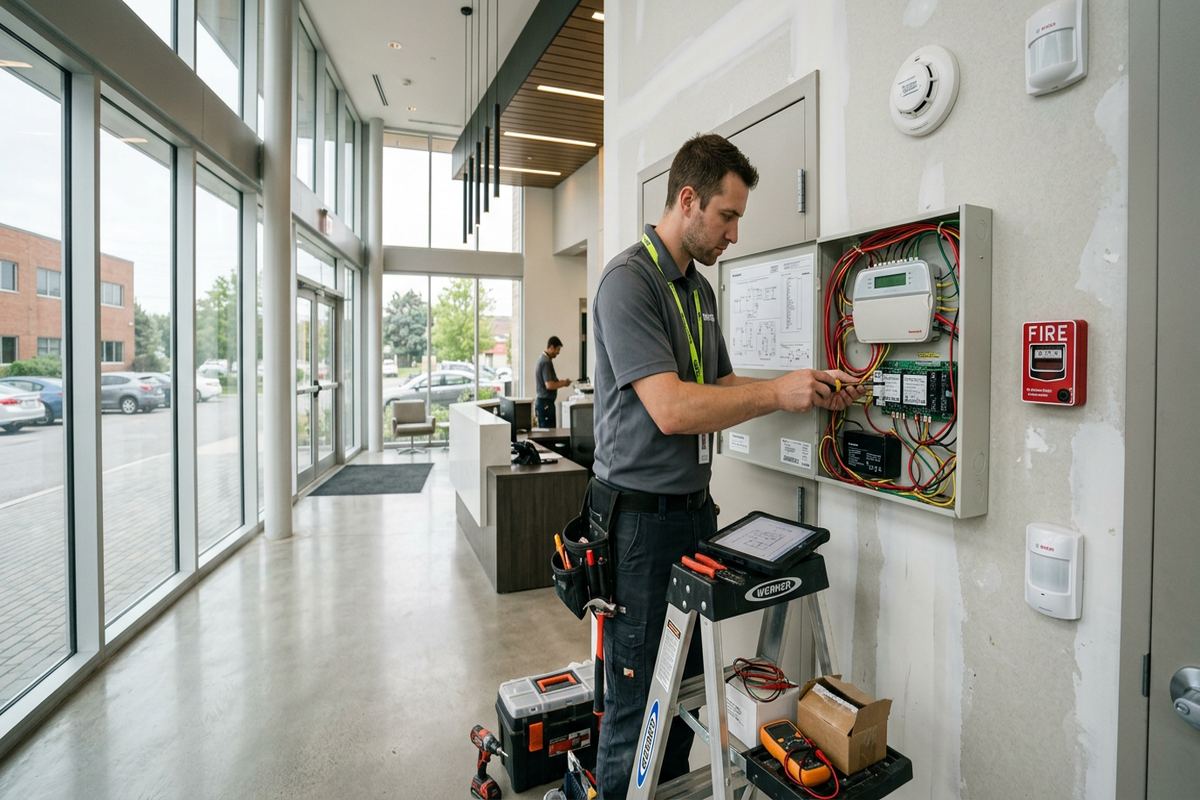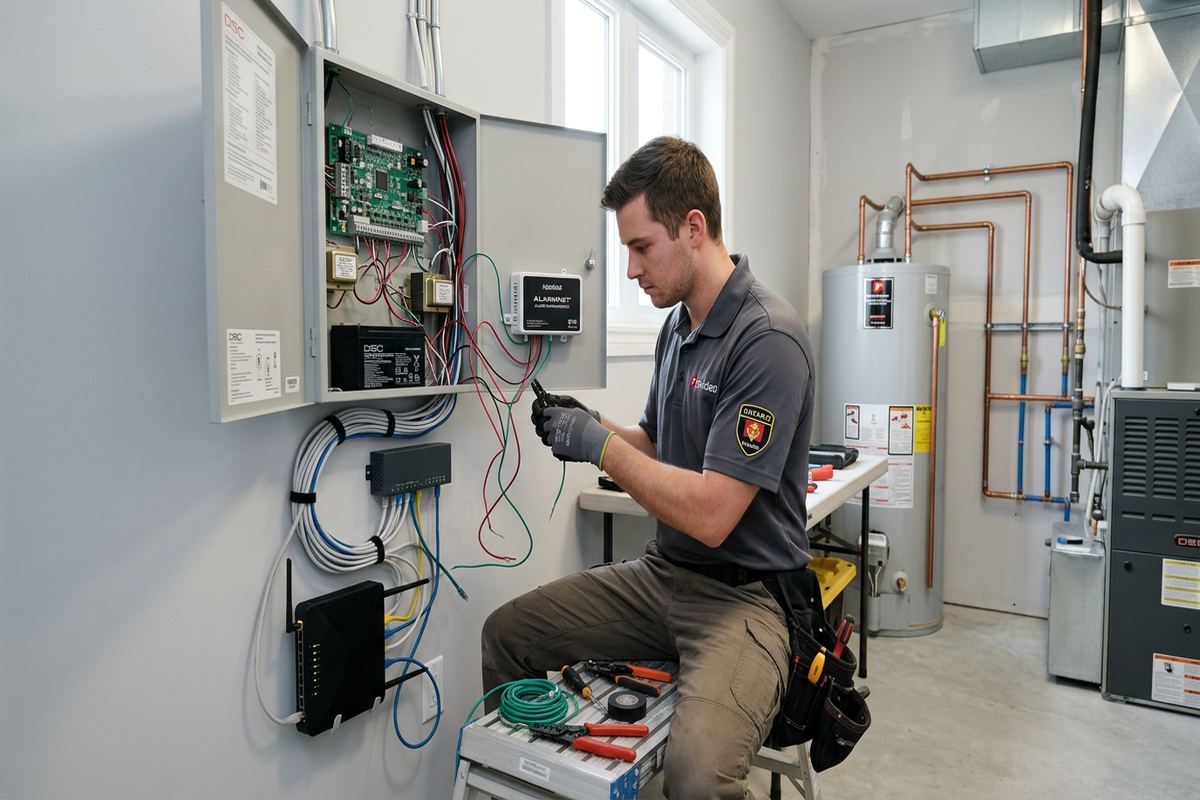
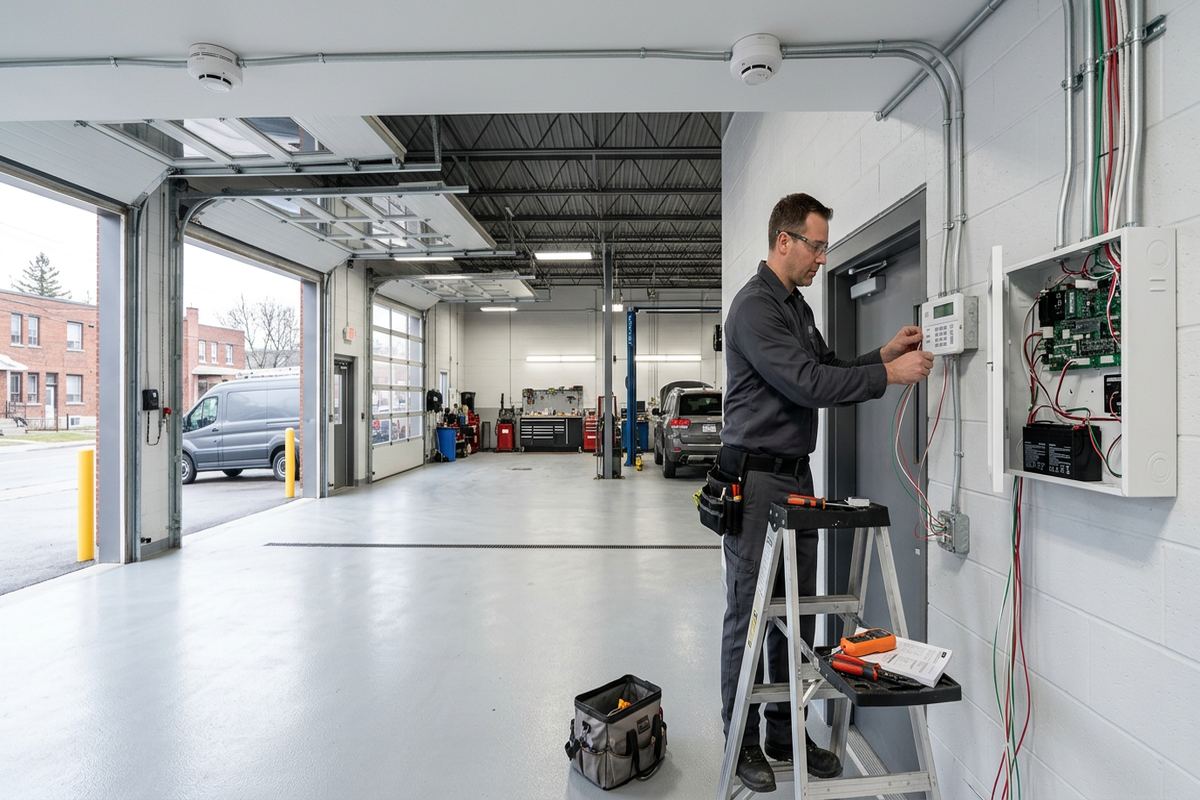
UnifiedLink installs wired, wireless and hybrid home alarm systems in Bowmanville, including new pre-wires and retrofits for existing properties. We assess the site before pricing, plan sensor and keypad locations, configure the system on site, and provide a written scope. Each handover uses the customer’s own credentials and includes an as-built record.
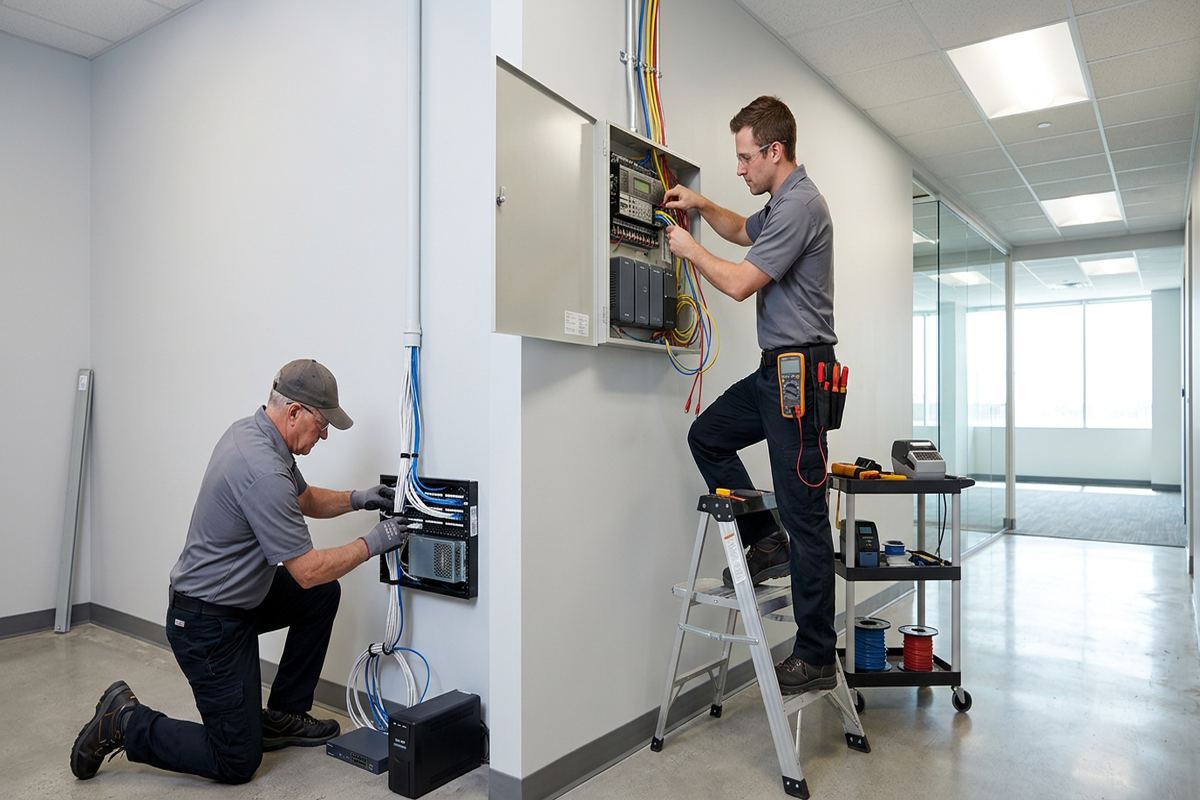
Home Alarm Installation for Bowmanville Properties
Bowmanville includes older properties near the historic main street, established residential areas, newer west-side subdivisions, condominiums and mixed-use buildings. Alarm design needs to account for those differences rather than applying one standard package. An older detached house may need discreet cable routing around finished plaster or masonry, while a new build can support concealed pre-wire before insulation and drywall. We begin with a site assessment, review the entrances and normal routines, then identify practical locations for contacts, motion detectors, keypads, sirens and communication equipment without placing devices where everyday activity will cause avoidable alarms.
A useful home alarm system protects likely entry points while remaining simple enough for everyone in the property to operate. We review front, side and patio doors, accessible windows, attached garages, basement entries and interior travel routes. Device selection depends on the opening, construction and environmental conditions. A door contact suitable for a modern frame may not fit an older, irregular opening without careful preparation. Motion coverage must also consider pets, heating sources, stairs and large windows. The objective is layered detection, clear notification and dependable daily use, not an unnecessary quantity of sensors installed without a coverage plan.
Before pricing, UnifiedLink documents the proposed system in a written scope. It covers equipment, cable routes, device placement, exclusions, equipment ownership and warranty. This step is particularly important when comparing wired, wireless and hybrid options because each approach affects installation work, future battery maintenance and expansion. The scope also identifies customer responsibilities, such as providing internet access, electrical receptacles or property approvals. Once installed, components are configured and tested on site. The customer receives control using their own credentials, along with an as-built record showing installed devices and relevant cable or panel information.
- Door, window and interior motion detection
- Keypad, siren and control-panel installation
- Wired, wireless or hybrid system planning
- Site assessment completed before pricing
- Written equipment and installation scope
Retrofit Alarm Systems in Downtown Bowmanville
Homes and mixed-use properties around Downtown Bowmanville can present retrofit conditions that are absent in recent subdivisions. Wall cavities may be obstructed, additions may use different framing, and renovations can leave undocumented wiring behind finished surfaces. Masonry walls require different drilling, fastening and cable-routing methods than wood-frame partitions. During the assessment, we look for usable basement, attic, utility-room and closet routes before proposing openings in finished areas. Where concealed cabling is impractical, wireless devices or carefully placed surface pathways can limit disruption while still providing sensible coverage at doors, windows and circulation areas.
Older windows and doors are not always square, and decorative trim can leave little room for a conventional contact. Rather than forcing a standard sensor into an unsuitable location, we evaluate the opening, operating clearance and material. Recessed, surface-mounted or wireless contacts may each be appropriate under different conditions. Exterior doors also move slightly as temperatures and humidity change, so contact alignment needs enough tolerance for normal seasonal movement. For heritage-sensitive finishes or recently restored interiors, mounting and cable routes should be agreed upon before work begins, with visible components placed consistently and unnecessary penetrations avoided.
Retrofit planning should also account for the existing alarm equipment, even when it is no longer active. Some panels, keypads, sirens and wired contacts may be reusable after inspection and testing; others may be incompatible, damaged or tied to a former provider. We do not assume that an existing cable is serviceable simply because it reaches the right location. Conductors are checked, identified and labelled before inclusion in the new system. The written scope states what will be retained, replaced or excluded, helping the owner understand equipment ownership and avoid uncertainty about abandoned devices or inaccessible wiring.
- Assessment of existing alarm wiring
- Options for finished walls and ceilings
- Careful routing around historic finishes
- Masonry and wood-frame mounting methods
- Clear identification of reused equipment
New-Build and Pre-Wire Work in Bowmanville
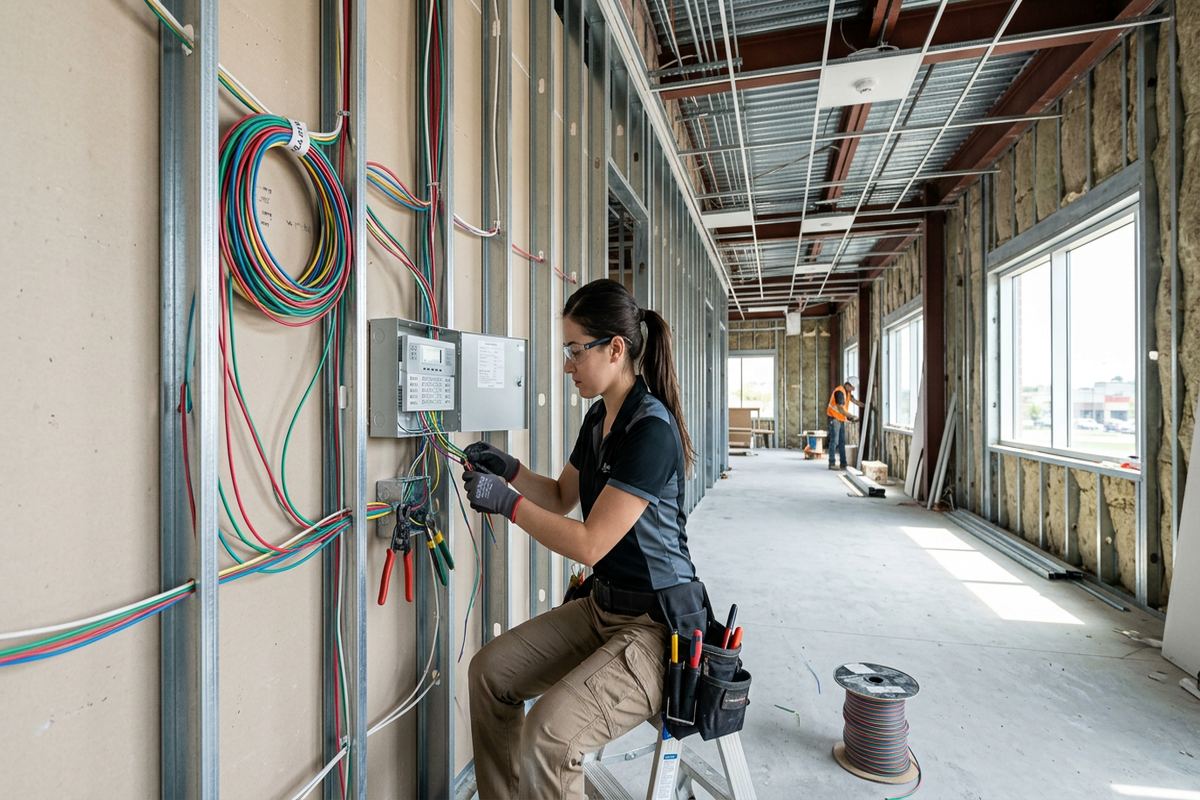
Rapid subdivision growth on Bowmanville’s west side keeps pre-wire work active alongside local retrofits. Installing alarm cable before insulation and drywall gives the owner more freedom to place recessed contacts, keypads, sirens, motion detectors and future expansion points. Timing matters because framing, mechanical work and electrical rough-ins can change available routes. We coordinate the low-voltage plan against the current layout, confirm door handing and window details, and keep cables away from likely fastener zones. Continuous labelled runs return to the agreed panel location, reducing concealed splices and making later termination or troubleshooting more straightforward.
A pre-wire plan should reflect how the finished house will be used, not just the framing drawing. Mudroom entries, patio doors, garage access, basement windows and upper-floor balconies can alter the security priorities. We discuss where occupants will arm or disarm the system, whether a secondary keypad is useful, and how alarm notifications will reach the owner. If construction details remain undecided, spare or future-use runs can be documented without promising compatibility with unknown equipment. Every proposed cable has a defined purpose, destination and label, allowing the final installation team to understand what is behind completed walls.
Pre-wire and final installation are separate stages, and both need verification. At rough-in, cable condition, labels and routing are recorded before surfaces close. At trim-out, contacts and devices are installed only after doors, windows, finishes and power are ready. We then test zones individually, confirm keypad functions, configure user access and verify available communication paths. The handover includes an as-built record rather than relying on memory or construction photographs alone. For homeowners arranging work through a builder, the written scope also clarifies which equipment belongs to the customer and which tasks remain under another contractor.
- Continuous labelled home-run cabling
- Pre-drywall device and panel planning
- Coordination with current construction drawings
- Rough-in and final-stage verification
- Documented provisions for future devices
Bowmanville, Ontario
Home alarm system installation in Bowmanville, scoped in writing first
Book a site assessment and get equipment, routes, exclusions, and warranty on paper before anything is installed.
Choosing Wired, Wireless or Hybrid Alarms
The right alarm architecture depends on the property, available routes and maintenance preferences. Wired sensors can be practical in open framing, unfinished basements or houses with usable existing cable. Wireless devices reduce the need to open finished walls and are often suitable for completed homes, but they introduce batteries and radio considerations. A hybrid panel combines both approaches, allowing hardwired devices where cable access is reasonable and wireless coverage elsewhere. During the assessment, we explain these trade-offs in relation to the actual building rather than treating one technology as the default for every Bowmanville installation.
Radio devices need thoughtful placement because construction materials affect performance. Masonry, metal ductwork, foil-backed insulation, large appliances and multiple finished floors may weaken or redirect signals. The control panel or receiver should not be hidden in a location chosen only for convenience if that location compromises communication. We test enrolled wireless devices from their installed positions and verify the system recognizes openings, closures and alarm conditions. Wired zones receive continuity and functional checks as well. This testing confirms present operation, although later renovations or major changes to the building can require devices to be reassessed.
System features should match realistic household needs. Useful options may include separate user codes, entry and exit delays, stay and away modes, local sirens, app access, event notifications and monitored communication where supported by the selected service. Feature availability varies by panel, communicator and service arrangement, so the written scope identifies what is included and any recurring third-party requirements without assuming them. We configure agreed functions on site, show the owner how to arm, disarm and review basic events, and transfer administration through the customer’s own credentials instead of retaining control under an installer account.
- Wired, wireless and hybrid comparisons
- Signal testing from installed positions
- Separate household user-code setup
- Stay and away mode configuration
- Communication options reviewed before installation
Bowmanville Exterior Devices and Winter Conditions
Bowmanville winters and repeated freeze-thaw cycles affect exterior mounting decisions. Devices placed on porches, detached garages or exposed doors need suitable environmental ratings and stable mounting surfaces. Water can enter around poorly sealed fasteners or cable penetrations, then expand when temperatures drop. We select routes that limit exposure, form appropriate drip paths where required, and seal penetrations using materials compatible with the surrounding surface. Exterior devices are not installed as though indoor components can simply be placed outside. Their location must also allow inspection, maintenance and reliable operation through seasonal changes.
Brick veneer, solid masonry, siding and wood trim each require different fastening and sealing methods. Drilling location matters because mortar joints, hollow cavities and concealed services can affect long-term stability. On frame construction, a secure attachment point is needed behind or through the finished surface without crushing siding or leaving an unsealed opening. For detached structures, we also assess how alarm communication and power will reach the building. Wireless coverage cannot be assumed across a driveway or through several exterior walls, while buried or overhead cabling involves additional route and protection considerations.
Environmental conditions also influence door contacts and motion detection. Metal overhead garage doors, loose weatherstripping and seasonal frame movement can cause a marginally positioned contact to report inconsistently. Unheated spaces may exceed the operating range of devices designed for conditioned interiors. Sunlight, insects and moving vegetation can make exterior motion detection more complex than indoor coverage. We review these factors before specifying equipment and explain any limitations in the scope. Where a dependable alarm device cannot be supported at a proposed location, we recommend an alternative layer of detection rather than presenting an unsuitable placement as reliable.
- Weather-suitable exterior device selection
- Sealed cable and fastener penetrations
- Mounting for masonry, siding and trim
- Seasonal door-alignment allowances
- Detached-garage communication assessment
Alarm Coverage for Bowmanville Homes and Rentals
A family house in Northglen or Waverley may need different operating arrangements from a rental property, condo unit or multi-generational home. Multiple users should receive individual codes where the selected system supports them, avoiding shared credentials that cannot be managed separately. Entry delays must provide enough time to reach the keypad without leaving an excessive disarm window. We discuss daily routes, children, visitors, cleaners and pet activity before configuring zones. The resulting setup should be understandable to regular users while preserving clear records of who can access system controls or receive notifications.
Condo installations require confirmation of ownership boundaries and building rules. A unit owner may control interior devices but still need approval before drilling an exterior door, altering common-area surfaces or routing cable through shared spaces. Landlords and tenants should likewise establish who authorizes installation, owns the equipment, manages user access and receives alarm notices. UnifiedLink records these responsibilities in the scope where they affect our work, but property permission remains the customer’s responsibility. We avoid beginning restricted work until the required approval is available, reducing the risk of removal, repair or disputes after installation.
Port Darlington properties can include layouts where attached garages, rear entrances, balconies or waterside exposure change the device plan. Liberty homes may have finished basements used as living or rental space, adding separate entry patterns and accessible lower-level windows. Local advice therefore starts with the actual floor plan and property use, not neighbourhood assumptions. We identify practical protection layers, explain where coverage ends and note areas excluded from the project. If renovations are planned, the alarm layout can include documented provisions for later devices so finished work does not unnecessarily limit future expansion.
- Individual codes for supported systems
- Pet and household routine considerations
- Condo and landlord approval checks
- Coverage for garages and basement entries
- Documented exclusions and future provisions
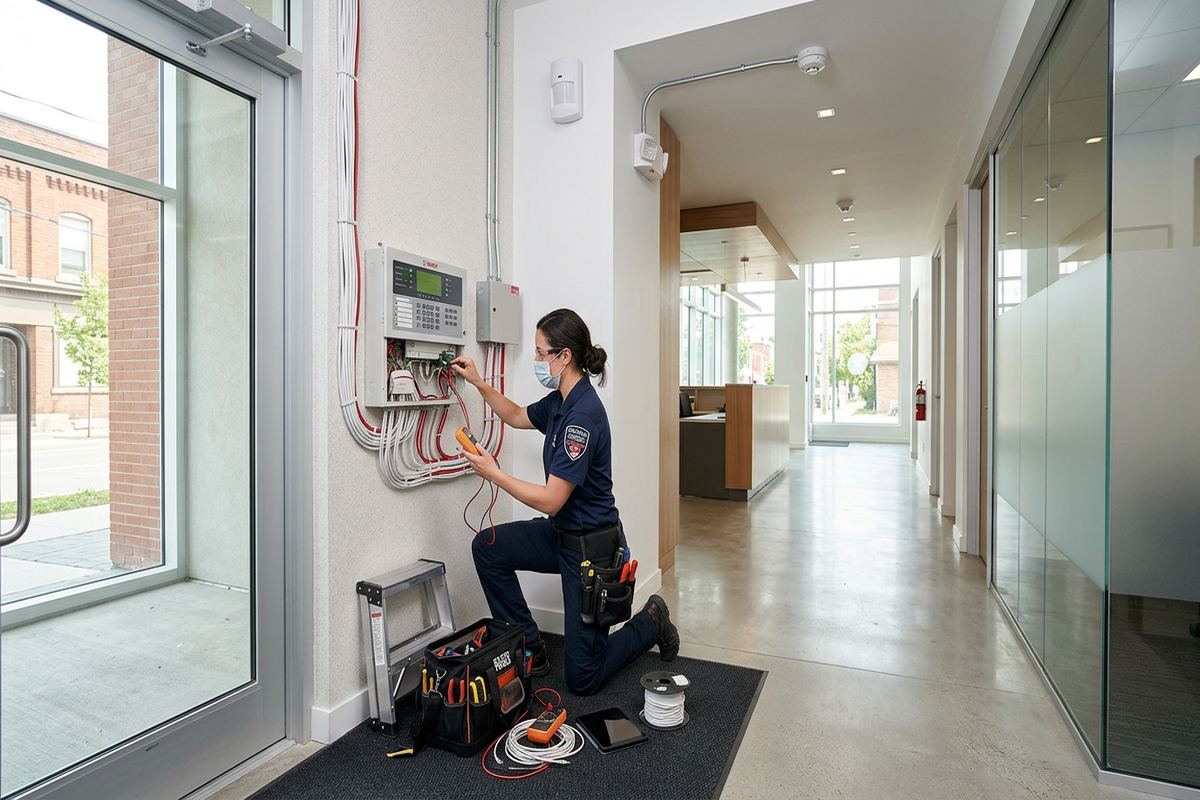
Alarm Systems for Local Shops and Work Units
Although the service focuses on home alarm installation, many Bowmanville owners also need protection for a small shop, office, mixed-use property or light industrial unit. Commercial strips can have rear service doors, shared walls, display windows and public entrances that create different risks from a detached house. Industrial units may add overhead doors, stock areas and restricted rooms. We map openings and interior routes, then divide devices into useful zones so staff can understand an event location. The scope distinguishes alarm work from access control, video surveillance and fire alarm systems, which require separate planning.
Business operating routines influence configuration as much as the floor plan. Owners may need separate staff codes, opening and closing notifications, defined entry delays or restricted access to system administration. A shared code makes personnel changes difficult and reduces accountability, so individual credentials are preferable when supported. We also confirm who receives notifications and who is authorized to request changes. If monitoring or cellular communication is selected, the service relationship and equipment requirements are identified before activation. Internet-only communication should be reviewed in light of router location, power availability and what happens when the local connection is interrupted.
Leased commercial units require approval for drilling, cabling and equipment attached to the building. The lease or property manager may also control roof spaces, utility rooms and common corridors. Masonry demising walls, open ceilings and steel framing each influence cable routes and fasteners. We plan around active operations where possible and state access assumptions in the written scope. At completion, installed zones are tested with the designated representative, administrative access is transferred using the customer’s credentials, and an as-built record is supplied. One accountable contractor remains responsible for the alarm installation described in our scope.
- Door, window and overhead-door zones
- Separate supported codes for staff
- Planning for leased commercial units
- Clear separation from fire alarm work
- As-built zone and device records
Bowmanville Alarm Installation and Handover
Every Bowmanville alarm project begins with enough information to define the work responsibly. We ask about the property type, construction stage, known existing equipment, desired notifications and any renovation schedule. A site assessment follows before pricing; its timing depends on the service and travel distance. Requests sent during business hours are answered the same day, while after-hours requests are answered the next business day. The assessment is not only a device count. It is used to examine routes, mounting surfaces, environmental conditions, internet or cellular requirements, approvals and the practical way occupants will use the system.
Installation follows the accepted written scope. Continuous new cable runs are labelled, agreed devices are mounted, and the panel and communication equipment are configured on site. We test each opening and detector rather than relying only on a panel-ready indication. Entry and exit delays, siren operation, user permissions and available notifications are checked against the planned configuration. Where a condition differs from the assessment, such as a blocked route or unsuitable mounting surface, it is addressed before unplanned work proceeds. This keeps exclusions and changes visible instead of burying them in the finished installation.
Handover is part of the work, not an optional final step. The owner receives access through their own credentials and is shown routine operation, including arming, disarming, bypassing a zone where supported, and responding to common status messages. We provide an as-built record identifying installed devices and relevant panel or cable information. Equipment ownership and warranty terms follow the written scope, so the customer knows what they own and whom to contact about covered components. For future renovations, the record gives another contractor a practical starting point without requiring assumptions about concealed wiring.
- Same-day replies during business hours
- Assessment completed before project pricing
- Installation tested zone by zone
- Customer-controlled administrative credentials
- As-built record supplied at handover
Bowmanville neighbourhoods we cover
- Downtown Bowmanville
- Waverley
- Northglen
- Liberty
- Port Darlington
Home alarm system installation in Bowmanville — common questions
Can you reuse my existing alarm wiring?
Possibly. In Bowmanville retrofits, existing contacts and cable may be useful, but age, damage, labelling and panel compatibility must be checked first. We inspect accessible wiring, identify conductors and test them before including them in a new system. The written scope states which components will be reused, replaced or abandoned, so reuse is not assumed merely because old alarm equipment remains in place.
Is wireless better for an older Bowmanville house?
Wireless equipment can reduce disruption in older Downtown Bowmanville homes where plaster, masonry or finished additions make new cable routes difficult. It is not automatically the better choice. Building materials, radio paths and battery maintenance must be considered. A hybrid system may use existing or accessible wiring for some zones and wireless devices elsewhere. We assess the property and test wireless devices from their proposed installed locations.
When should alarm pre-wire be installed?
For a new Bowmanville home or renovation, pre-wire is normally planned after the layout and opening details are sufficiently stable but installed before insulation and drywall close the framing. Coordination with electrical, mechanical and other trades is important. We label continuous cable runs, record their destinations and return them to the agreed panel location. Final devices are installed and tested after doors, windows, finishes and power are ready.
Do I need approval in a condo or rental?
Often, yes. A Bowmanville condo corporation, property manager or landlord may restrict drilling, changes to exterior doors, common-area cabling or equipment attached to shared property. Customers are responsible for obtaining the required permission before restricted work begins. The installation scope can identify approval-dependent work, ownership and access responsibilities. Tenants should also confirm who will control credentials, receive notifications and own equipment when the tenancy ends.
Will the alarm work during an internet outage?
That depends on the selected panel, communication path and service arrangement. Some local alarm functions may continue while app access or remote notifications become unavailable. Cellular or other communication options may provide an alternate path when supported, but they can have separate equipment and service requirements. For a Bowmanville installation, we explain the proposed communication method, its dependencies and relevant limitations before equipment is selected and configured.
How quickly can you assess my Bowmanville property?
Requests sent during business hours are answered the same day, and after-hours requests are answered the next business day. The timing of a Bowmanville site assessment depends on the service and travel distance. We first gather basic details about the building, construction stage and existing alarm equipment. The assessment must occur before pricing because cable routes, mounting conditions, device needs and property approvals affect the written scope.
Coverage in Bowmanville is confirmed against the address before we quote. See everything we install in Bowmanville or the province-wide home alarm system installation page.