UnifiedLink installs outdoor speaker systems for homes and businesses in Barrie. We plan speaker coverage, mounting, cable routes, amplification and controls around the property and its intended use. Each project starts with a site assessment, followed by a written scope that addresses equipment, installation details, exclusions, ownership and warranty.
Outdoor Speaker Planning for Barrie Properties
A useful outdoor audio system begins with coverage planning rather than simply attaching speakers to the nearest wall. During a Barrie site assessment, we review listening areas, neighbouring properties, doors, windows, rooflines and normal gathering points. The objective is even, understandable sound at moderate volume, not excessive output from one location. Waterfront homes may have open exposure and fewer sound-reflective surfaces, while compact south-end lots can place patios close to adjacent homes. Speaker quantity, direction and mounting height are selected around those conditions and the way the space will actually be used.
Barrie properties include older construction near Downtown Barrie and Allandale, newer frame-built homes in Painswick and Innis-Shore, and commercial units with masonry or metal exterior surfaces. Those differences affect how cable can be routed and how each bracket should be anchored. We inspect accessible basements, utility rooms, soffits, garages and ceiling cavities before proposing a route. Where concealed wiring is impractical, we discuss neat surface-mounted options, suitable conduit and the visible impact. The written scope identifies planned speaker positions, cable paths, equipment locations and any areas that require further access or approval.
System design also accounts for the source equipment and the people who will operate it. A simple patio may need one outdoor zone connected to an existing amplifier, while a larger yard or plaza may need several controlled areas. We confirm whether users want streaming audio, television sound, paging, scheduled playback or independent volume control. Compatibility is checked before installation because speaker impedance, amplifier capacity and cable distance must work together. Equipment ownership, customer-supplied components and warranty responsibilities are recorded clearly, reducing uncertainty when new audio equipment is integrated with an existing network or entertainment system.
- Listening-area and boundary review
- Speaker coverage and direction planning
- Amplifier and impedance checks
- Cable-route assessment
- Written equipment and placement scope
Weather-Ready Installation in Barrie
Barrie winters place repeated stress on exterior hardware, cable entries and exposed connections. Freeze-thaw cycles can enlarge poorly sealed openings, while wind-driven rain and snow can reach locations that appear protected during summer. We select mounting methods according to the surface and use exterior-rated materials where the installation requires them. Cable penetrations are positioned and sealed to reduce water entry without blocking intended drainage paths. Speaker orientation also matters: suitable downward angles and protected connection points help limit direct exposure while maintaining the coverage established during the site assessment.
Exterior mounting requires different methods for brick, concrete, siding, wood and metal cladding. Masonry anchors must suit the substrate rather than relying on mortar joints as a convenient attachment point. On frame construction, mounting locations should provide dependable support without crushing siding or creating unstable stand-offs. Some newer Barrie subdivisions combine brick veneer, vinyl siding and finished soffits, so one elevation may require several approaches. Before drilling, we consider likely electrical, plumbing and structural locations. Any limitations, visible fasteners, conduit sections or required backing are discussed before work proceeds and noted in the installation scope.
Outdoor-rated speakers are not automatically suitable for every exposed location. Product ratings, manufacturer mounting instructions and connector protection must align with the proposed placement. We avoid leaving indoor connectors or unprotected splices outside, and we plan drip loops where appropriate so water does not follow cable toward an entry point. Continuous labelled cable runs are used between defined termination points, avoiding inaccessible joints that complicate future troubleshooting. At completion, cable labels and the as-built record identify routes and connections, giving the property owner practical information for later renovations, landscaping work or equipment replacement.
- Exterior-rated cable and fittings
- Surface-appropriate anchors and brackets
- Sealed wall penetrations
- Protected terminations and drip loops
- Routes documented for future work
Speaker Placement Around Patios and Yards
Good placement keeps music near the listening area instead of sending it across the property line. For patios, decks and pools, several speakers operating at lower levels often provide more consistent coverage than one powerful pair mounted high on the house. We consider seating direction, outdoor kitchens, walkways, landscaping and seasonal furniture before fixing locations. In Ardagh Bluffs or Holly, where grades and fences can change how sound travels, mounting height and speaker angle deserve particular attention. The design should remain useful when people move between cooking, dining and yard areas without requiring constant volume changes.
Waterfront properties can introduce wide, open listening areas and strong weather exposure. Sound may disperse differently where there are fewer nearby walls, while mounting surfaces can face sustained wind, rain or snow. We assess whether speakers belong on the building, under a covered structure or on purpose-built landscape locations. Any detached mounting position requires a practical cable route and a stable attachment method. Burial, conduit and landscape restoration expectations must be defined before installation. We also identify irrigation, lighting and other known services when discussing routes, although concealed underground conditions may require separate locating or coordination.
Outdoor speakers should support normal use without creating avoidable disturbance. Directional placement, zone controls and appropriate speaker spacing allow occupants to lower the overall level while preserving clarity. This is especially important on compact lots in Painswick and Innis-Shore, and around mixed residential properties near Downtown Barrie. We can configure independent zones where a deck and farther yard do not always need audio together. The written design explains which areas each zone serves, where volume is controlled and how sources are selected, so users understand the system rather than relying on trial and error.
- Patio and deck coverage
- Pool-area placement planning
- Neighbour-conscious speaker direction
- Independent outdoor audio zones
- Landscape route coordination
Barrie, Ontario
Outdoor speaker installation in Barrie, scoped in writing first
Book a site assessment and get equipment, routes, exclusions, and warranty on paper before anything is installed.
Audio Equipment and Controls for Barrie Systems
Speakers are only one part of an outdoor audio system. Amplifiers, receivers, streaming devices, volume controls and network connections must be selected and configured as a working system. We calculate the expected speaker load and confirm whether an existing amplifier can support the proposed arrangement. Long cable runs and multiple zones may require a different distribution approach than a single patio pair. Where customer-supplied equipment is involved, model information is reviewed during planning. Unsupported assumptions can lead to low output, protection shutdowns, uneven levels or equipment damage, so compatibility is addressed in the written scope.
Control should match how the property is used. A Barrie homeowner may prefer phone-based streaming with a simple wall control near the patio, while a restaurant or small commercial plaza may need staff-accessible controls that customers cannot adjust. We discuss source selection, zone grouping, volume limits and network requirements before configuration. If an app or cloud account is needed, the system is handed over using the customer’s own credentials. UnifiedLink does not make the installer’s personal account the permanent owner of customer equipment, helping preserve access when phones, staff members or service providers change.
Network reliability can affect modern audio even when the speakers themselves use cable. Outdoor control areas may sit beyond the dependable range of an existing Wi-Fi system, particularly through masonry walls, low-emissivity glass or foil-backed insulation. During assessment, we identify whether streaming and app control work where users expect to operate them. Wi-Fi improvements, wired network connections or equipment relocation can be scoped where necessary. Audio installation and related low-voltage work remain under one accountable contractor, allowing speaker cabling, network needs and display or television integration to be coordinated rather than handled as disconnected tasks.
- Amplifier load verification
- Streaming source configuration
- Customer-owned account setup
- Volume and zone controls
- Network coverage review
Commercial Outdoor Audio Applications
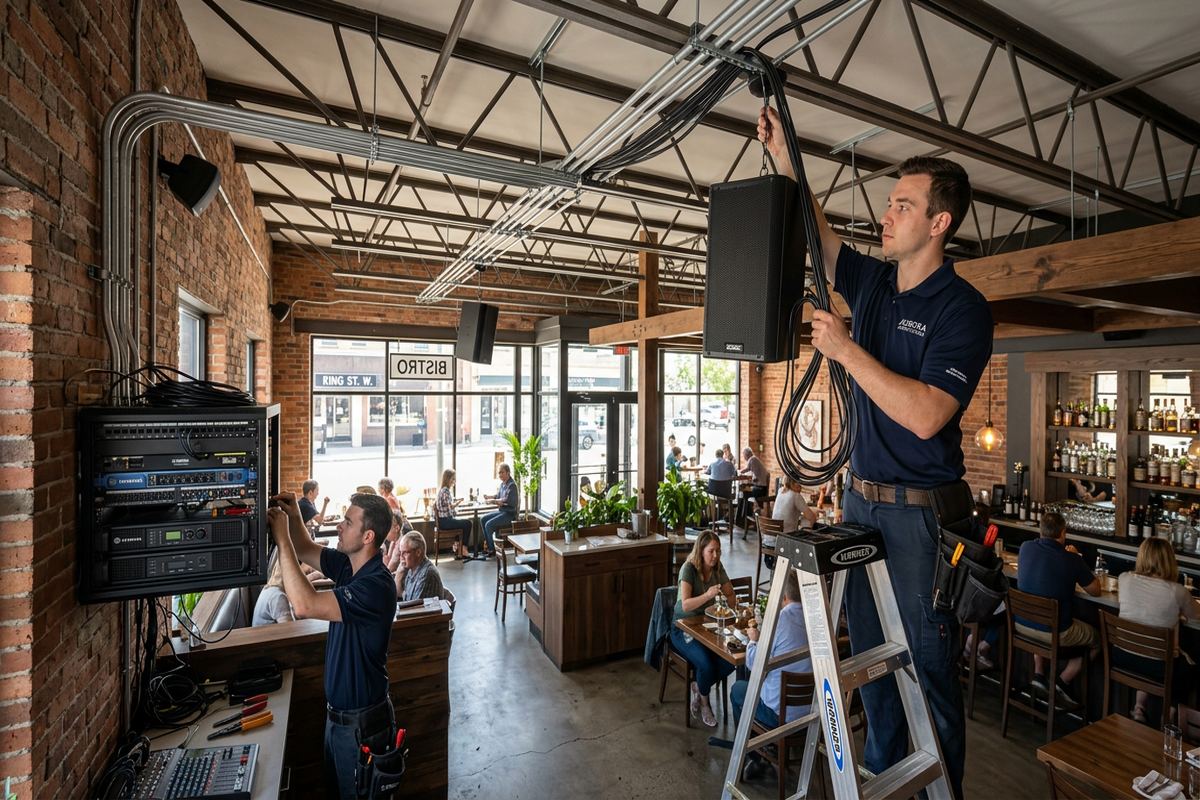
Small commercial plazas and street-facing businesses in Barrie may use outdoor speakers for background music, announcements or defined customer areas. Commercial planning begins by identifying who controls the system, when audio is used and which spaces require coverage. A restaurant patio has different needs from a storefront entrance, service yard or loading area. We consider nearby tenants, residences and public-facing boundaries when directing speakers. Equipment locations should remain accessible to authorized staff while being protected from casual adjustment, weather and routine cleaning. Operating expectations are recorded before installation so controls support daily staff procedures.
Commercial strips and industrial units often combine concrete block, steel framing, suspended ceilings and finished tenant spaces. Cable routes may cross areas controlled by a landlord or property manager, and exterior penetrations can affect the building envelope. We identify required approvals before work begins and document assumptions about ceiling access, roof areas, shared electrical rooms and fire-rated assemblies. Outdoor audio cabling is kept distinct and labelled at termination points. If other trades must provide power, coring, lift access or building-envelope work, those responsibilities and exclusions are identified in the scope rather than discovered during installation.
A commercial audio handover should give the operator enough information to manage normal changes without guessing. We demonstrate source selection, zone control, permitted volume settings and basic restart procedures on site. The as-built record lists speaker locations, cable destinations and installed equipment, while customer credentials are used for any supported management accounts. For multi-tenant properties in Barrie, the record can also help distinguish landlord-owned infrastructure from tenant-owned equipment. Warranty information and ownership are stated in writing, making it clearer who should retain documentation and arrange future service when occupancy or management changes.
- Restaurant patio audio
- Storefront and entrance coverage
- Staff-controlled operating zones
- Landlord approval coordination
- Documented commercial handover
Cabling and Building Access in Barrie
Cable routing has a major effect on both reliability and appearance. We look for paths through unfinished basements, mechanical spaces, garages, accessible attics and suitable soffits before recommending visible exterior runs. Older homes in Allandale or Downtown Barrie may have renovated cavities, masonry additions or limited access between floors. Newer homes can be tightly finished with insulated rim joists and complex exterior assemblies. No route should be assumed until access is reviewed. Proposed paths, access openings and restoration limitations are described in advance, allowing the owner to understand what will remain visible and what other work may be required.
Where cable remains exposed, it needs support and protection appropriate to the location. Loose wire across siding, fences or ground surfaces is vulnerable to movement, impact and landscaping work. We use continuous labelled runs and suitable fastening methods, with conduit considered where physical exposure or appearance warrants it. Cable type is matched to the route, including exterior, wet-location or underground conditions as applicable. Low-voltage cabling is planned separately from line-voltage wiring, and equipment still requires compliant power supplied from an appropriate source. Electrical modifications are not treated as incidental speaker work and are identified for coordination.
Access rules are particularly important for condominiums, rental homes and leased commercial units. Exterior walls, balconies, soffits and common areas may be controlled by a corporation, landlord or property manager even when the customer occupies the space. Barrie clients should obtain written approval before permanent mounting or cabling where their authority is limited. We can provide proposed locations and route information to support that review, but we do not represent the customer in an approval process. Installation proceeds according to the accepted scope, site rules and confirmed access, avoiding unapproved penetrations or last-minute route substitutions.
- Concealed route assessment
- Neat surface-mounted alternatives
- Continuous labelled cable
- Condo and landlord coordination
- Access and restoration expectations
Installation, Configuration and Testing
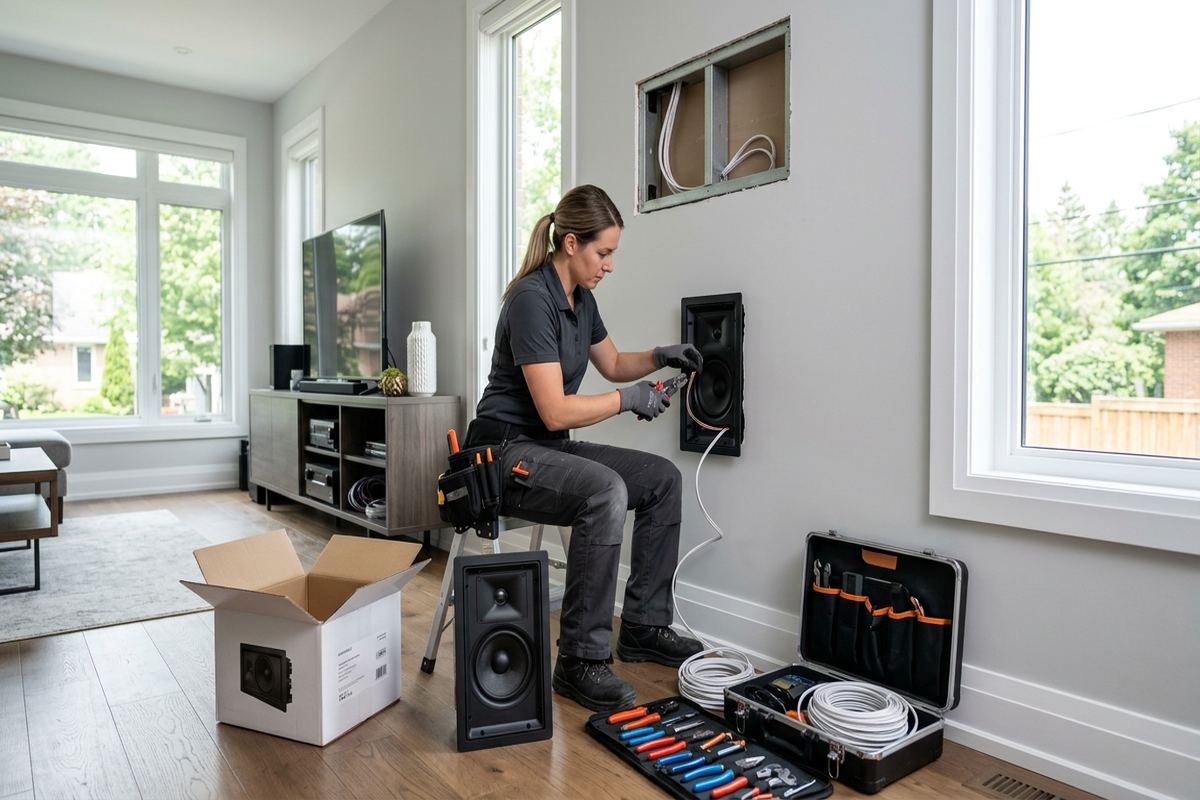
Once the scope is accepted and site conditions are confirmed, installation follows the documented device locations and cable routes. Brackets are anchored to suitable surfaces, speakers are aligned toward their intended areas and exterior entries are sealed using methods appropriate to the assembly. Cables are supported, labelled and terminated without hidden intermediate splices. If field conditions differ from what was accessible during assessment, work affecting scope is discussed rather than improvised. This approach is useful across Barrie’s varied building stock, where finished additions, concealed masonry and changed framing can become apparent only after approved access is opened.
Configuration is completed on site using the installed amplifier, sources and controls. We set up available zones, confirm channel assignment and establish practical operating levels without presenting volume settings as a substitute for responsible use. Streaming or network functions are connected through customer-owned accounts where supported. Each speaker is checked for output, polarity and obvious distortion, and controls are tested from the locations where users will operate them. For systems integrated with televisions, paging inputs or existing receivers, the agreed functions are checked together so the handover reflects the complete scoped system rather than isolated components.
The final walkthrough explains normal operation and identifies equipment that should remain powered or accessible. Customers receive their own credentials along with an as-built record showing installed devices, cable routes and termination details. We also provide the applicable equipment and workmanship warranty information stated in the scope. Outdoor systems should be visually checked after severe weather, exterior renovations or landscaping changes, particularly where brackets, conduit or buried routes could be disturbed. Documented installation details make later diagnosis more efficient and help another authorized contractor understand the system if additions are requested in the future.
- Bracket and cable installation
- On-site zone configuration
- Speaker and control testing
- Customer credential handover
- As-built installation record
Requesting Outdoor Speaker Installation in Barrie
A project request is most useful when it describes the property, intended listening areas and any equipment already owned. Photos of the exterior, equipment labels and approximate source locations can help with initial review, but they do not replace a site assessment. We confirm whether the work involves a detached home, waterfront property, condominium, rental unit or commercial space in Barrie. The assessment also considers access, wall construction, cable distance, network availability and approval requirements. Timing for the assessment depends on the requested service and travel distance, and no installation price is set from unsupported assumptions.
After assessment, UnifiedLink provides a written scope before pricing. It covers proposed equipment, cable routes, device placement, exclusions, equipment ownership and warranty. Any customer-supplied products are identified, along with known compatibility or condition limitations. For work involving landlords, condominium corporations or plaza management, approvals and site responsibilities are recorded where relevant. This gives the customer a defined basis for review and helps prevent differences between the expected result and the physical work. Changes requested after approval can then be evaluated against a clear original plan rather than an informal conversation or incomplete product list.
Requests sent during business hours are answered the same day, while after-hours requests are answered the next business day. The initial response can clarify the service area, basic project type and information needed to arrange an assessment. From Downtown Barrie and Holly to Ardagh Bluffs, Painswick and Innis-Shore, the same planning process applies: inspect the site, define the work, install continuous labelled runs, configure equipment on site and complete a documented handover. One accountable contractor coordinates the scoped low-voltage work, including related network or display integration when those elements form part of the project.
- Site assessment before pricing
- Written scope before installation
- Clear ownership and warranty terms
- One accountable low-voltage contractor
- Documented system handover
Barrie neighbourhoods we cover
- Downtown Barrie
- Ardagh Bluffs
- Painswick
- Holly
- Allandale
- Innis-Shore
Outdoor speaker installation in Barrie — common questions
Can outdoor speakers stay installed through Barrie winters?
Yes, when the selected equipment is rated for the proposed location and installed using suitable exterior mounting, cabling and connection protection. Barrie’s snow, moisture and freeze-thaw conditions make placement and sealing important. Weather-resistant equipment still needs correct installation and occasional visual inspection, especially after severe weather or exterior work that may have moved a bracket, cable or seal.
How many speakers does my patio need?
The number depends on the patio size, listening positions, surrounding walls and acceptable sound at the property boundary. In many Barrie yards, several properly directed speakers at moderate volume provide more even coverage than one loud pair. A site assessment lets us consider seating, neighbouring lots, elevation changes and whether the deck, pool or farther yard should operate as separate zones.
Can you connect speakers to my existing receiver?
Possibly. We need the receiver model, available channels, supported speaker load and intended number of zones. Existing equipment is not assumed compatible simply because it has spare terminals. During the Barrie site assessment, we review the proposed cable lengths, speaker impedance and control requirements. Any customer-supplied equipment, limitations and ownership responsibilities are identified in the written scope before installation.
Do I need condo or landlord approval?
Approval may be required if speakers, brackets or cables affect an exterior wall, balcony, soffit, common area or landlord-owned building system. This applies to many condominium, rental and leased commercial properties in Barrie. Customers are responsible for securing authorization. UnifiedLink can document proposed locations and routes for review, then complete the installation according to the approved scope and applicable site access rules.
Can speaker wiring be hidden?
Often, but the available route depends on the building. Finished basements, insulated cavities, masonry walls and inaccessible soffits can limit concealed options in both older Barrie homes and newer subdivisions. We assess practical paths before pricing. Where full concealment is not feasible, the scope can identify neat surface-mounted cable or conduit, along with visible sections, access openings and any restoration handled by others.
What do I receive after installation?
You receive an on-site walkthrough, configuration of the scoped controls and access through your own credentials where accounts are required. UnifiedLink also provides an as-built record identifying installed equipment, cable routes and termination details, plus the ownership and warranty information stated in the scope. This documentation supports future service, renovations or system expansion at your Barrie home or business.
Coverage in Barrie is confirmed against the address before we quote. See everything we install in Barrie or the province-wide outdoor speaker installation page.