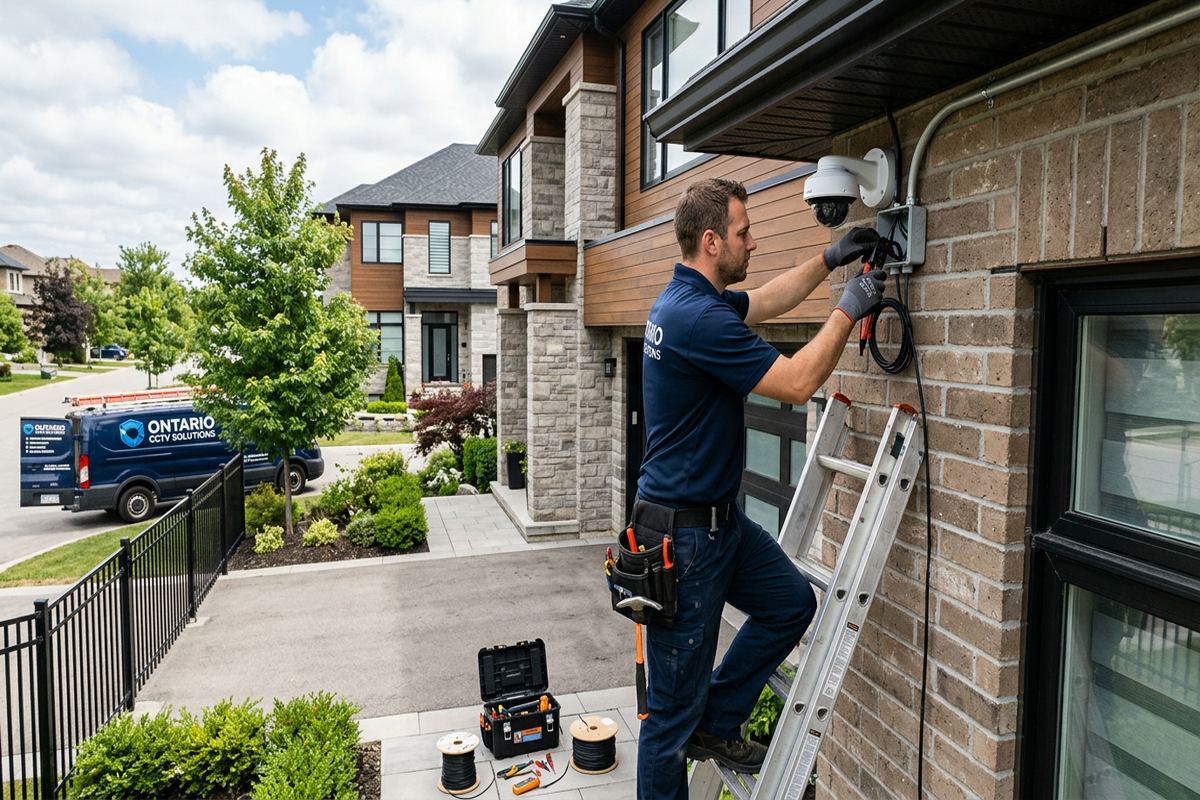
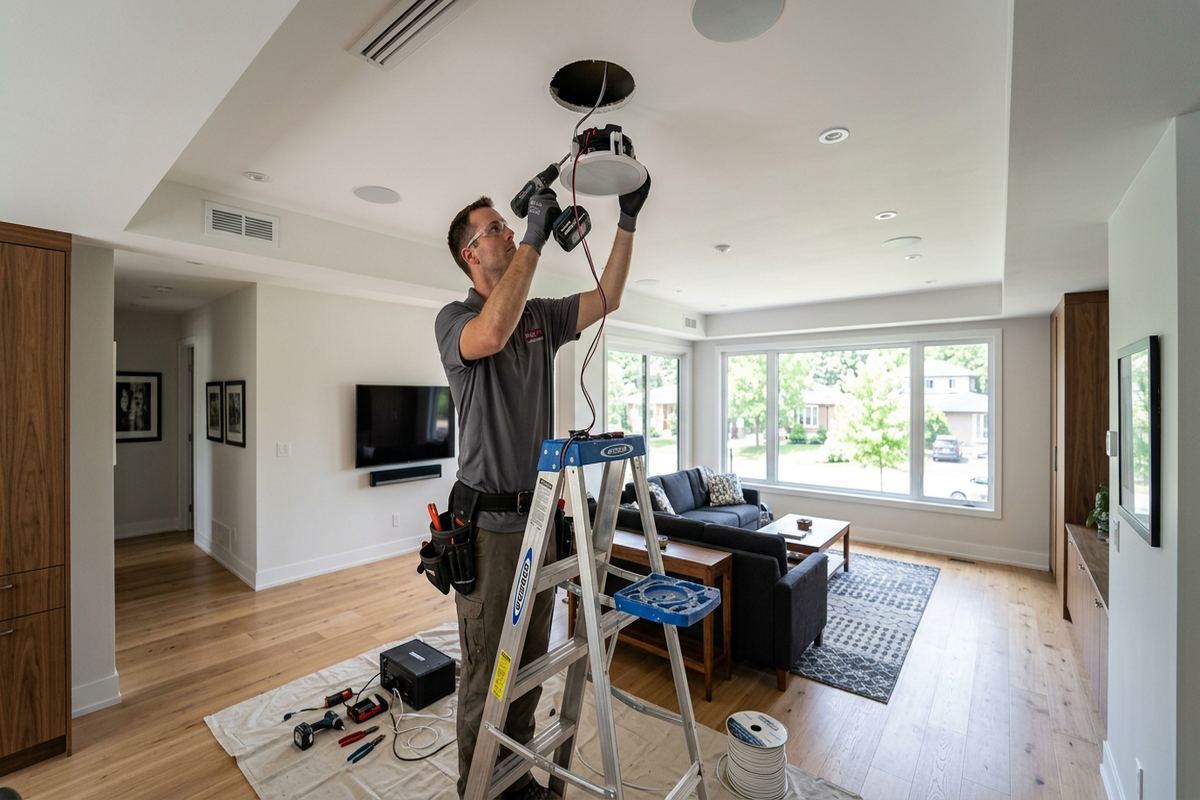
UnifiedLink installs outdoor speaker systems for homes and businesses across Aurora. We plan coverage, cable routes, mounting, amplification and controls around the property rather than treating exterior audio as an indoor system moved outside. Each project starts with a site assessment and finishes with on-site configuration, labelled wiring, customer-owned credentials and a clear as-built record.
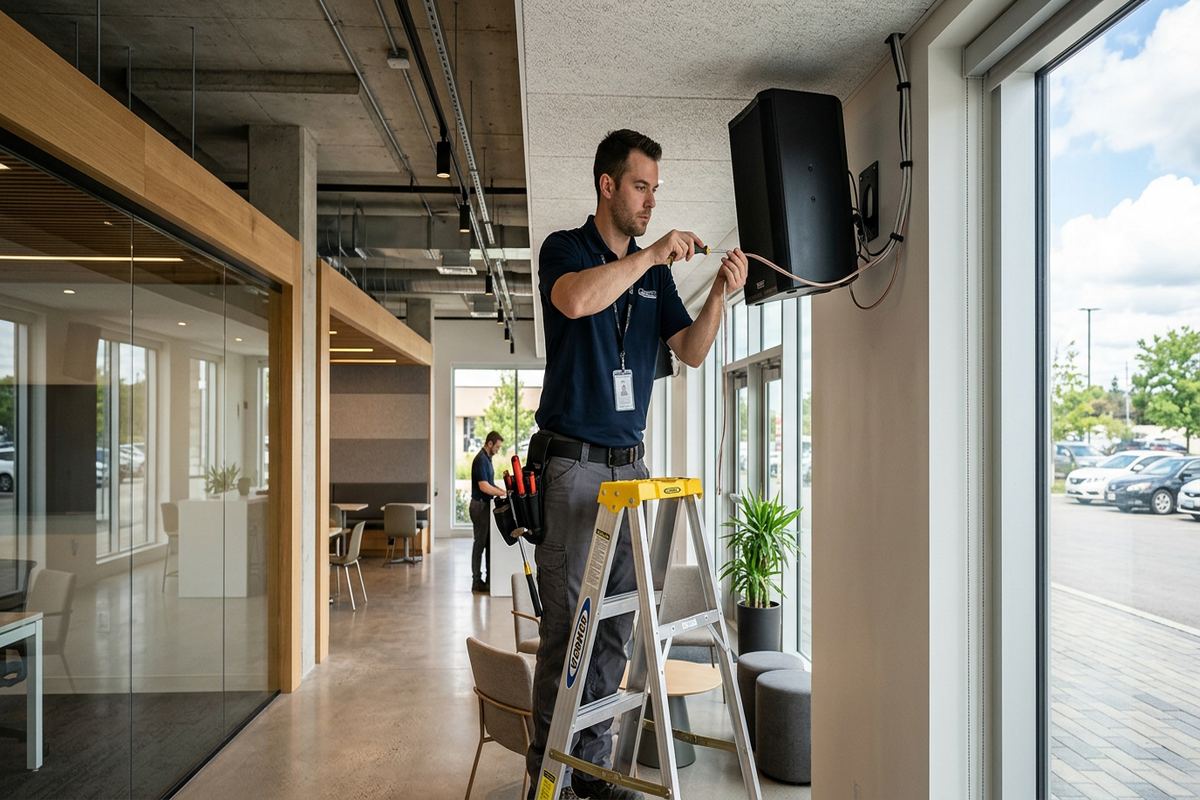
Outdoor Speaker Planning for Aurora Properties
A useful outdoor audio system begins with the listening areas, not a speaker count. During an Aurora site assessment, we identify patios, pools, decks, gardens, walkways and covered structures where consistent sound is required. We also note where sound should be limited, including neighbouring yards and bedrooms. Speaker type, direction and spacing are then selected around those zones. This approach creates even coverage at moderate volume instead of relying on one loud pair mounted to the house, which often produces harsh sound nearby and weak sound farther across the property.
Property character changes the design considerably across Aurora. Heritage homes near Yonge Street can have finished interiors, older wall assemblies and exterior details that should not be disturbed unnecessarily. Larger estate properties east of town may require longer cable routes, multiple listening zones and equipment placed far from the main building. We examine available pathways through basements, attics, garages, mechanical rooms and exterior structures. The goal is a practical route that supports reliable audio while keeping visible cable, unnecessary penetrations and disruption to established landscaping to a minimum.
The written scope prepared after assessment defines the proposed speakers, amplification, controls and cable routes. It also records device placement, exclusions, equipment ownership and warranty details so the installation is clear before work begins. If landscaping, trenching, electrical work or another trade is required, those responsibilities can be identified rather than assumed. Site assessment timing depends on the service and travel distance. Requests submitted during business hours are answered the same day, while after-hours requests are answered the next business day.
- Patio, deck and garden listening-zone review
- Speaker spacing and direction planning
- Amplifier and source compatibility checks
- Proposed cable routes and penetrations
- Written equipment and installation scope
Choosing Weather-Rated Outdoor Audio Equipment
Ontario weather affects every component mounted outside. Aurora systems must tolerate summer heat, driven rain, snow, ice and repeated freeze-thaw cycles without depending on temporary covers or exposed indoor connectors. We select purpose-built outdoor speakers, appropriate mounting hardware and connection methods suited to the location. A speaker beneath a deep roof overhang faces different exposure than one attached to a pergola or placed in a garden bed. Product selection therefore considers direct precipitation, sunlight, drainage, wind exposure and the possibility of snow accumulation around low-mounted equipment.
Wall-mounted speakers suit many decks and compact yards because they can direct sound toward a defined seating area. Landscape speakers can distribute audio across larger grounds at lower levels, while buried or partially buried subwoofers can add bass without placing a large cabinet on the patio. Covered outdoor kitchens and cabanas may use architectural speakers where the ceiling assembly and moisture exposure permit. In Aurora Highlands or Rural Aurora, a combination of speaker types may be appropriate when the property includes several separated areas rather than one simple deck.
Amplification must match the number of speakers, intended zones and wiring method. Small residential systems may use conventional low-impedance speakers, while extensive grounds or commercial areas can benefit from distributed audio designs that support longer runs and multiple devices. We verify load, channel allocation, ventilation and source compatibility before connecting equipment. Indoor amplifiers are installed in a suitable protected location, not left in an exterior cabinet unless that enclosure and its environment are specifically appropriate. Control options are planned around straightforward daily operation rather than unnecessary complexity.
- Purpose-built exterior speaker models
- Corrosion-resistant mounting hardware
- Suitable low-impedance or distributed design
- Protected amplifier and source location
- Controls matched to daily use
Exterior Mounting and Sealing in Aurora
Secure mounting depends on what is behind the exterior finish. Aurora buildings may combine brick veneer, solid masonry, siding, stucco, wood trim and framed additions, each requiring a different fastening and penetration method. We identify a stable substrate rather than relying on cladding alone. Brackets are positioned to support the speaker load, preserve adjustment and reduce avoidable vibration. On heritage properties near Yonge Street, mounting locations also need closer consideration so prominent masonry, decorative woodwork and visible elevations are not altered without a clear reason and owner approval.
Every exterior cable entry needs to resist water over the long term. Penetrations are planned with direction, drip management and compatible sealants in mind, then finished so water is not encouraged toward the wall assembly. Connections remain protected from direct exposure and are arranged to avoid becoming low points where moisture can collect. Aurora’s freeze-thaw conditions make this important because trapped water can expand, loosen finishes and worsen small gaps. Surface cable, where necessary, is supported neatly and kept away from sharp edges, drainage paths and locations vulnerable to shovels or ladders.
Speaker orientation affects both durability and performance. Mounting beneath an overhang can reduce exposure, but the bracket still needs room for adjustment and the speaker should not discharge directly into a soffit or wall corner. Garden units require stable placement above conditions that promote standing water, soil movement or winter damage. We also consider future access for inspection and replacement. A technically sound installation should not require dismantling finished construction simply to tighten a bracket, service a connector or remove a speaker at the end of its useful life.
- Fasteners selected for the wall assembly
- Exterior entries sealed against moisture
- Brackets positioned for service access
- Cable protected from tools and drainage
- Speaker angles set after secure mounting
Aurora, Ontario
Outdoor speaker installation in Aurora, scoped in writing first
Book a site assessment and get equipment, routes, exclusions, and warranty on paper before anything is installed.
Cable Routes for Patios, Gardens and Estates
Outdoor speaker performance depends on wiring that is selected and routed for the actual distance and environment. UnifiedLink installs continuous labelled cable runs wherever practical, avoiding hidden intermediate splices that make future faults difficult to locate. Cable gauge and construction are matched to the audio design, route length and installation setting. Runs inside a building may transition to appropriately protected exterior pathways before reaching speakers. We do not treat ordinary indoor patch cable as a permanent outdoor solution, particularly where sunlight, moisture, landscaping activity or temperature changes can damage its jacket.
Established Aurora yards often require a different routing strategy from new construction. In Aurora Village, access may be constrained by finished basements, older framing and compact lots. Estate properties east of town can involve detached garages, pool houses, gates, long gardens or several entertainment areas. We compare routes through existing structures with carefully planned exterior pathways. Where trenching is appropriate, the scope identifies who will complete it and what coordination is needed around irrigation, lighting, drainage, utilities, hardscaping and mature planting before ground is disturbed.
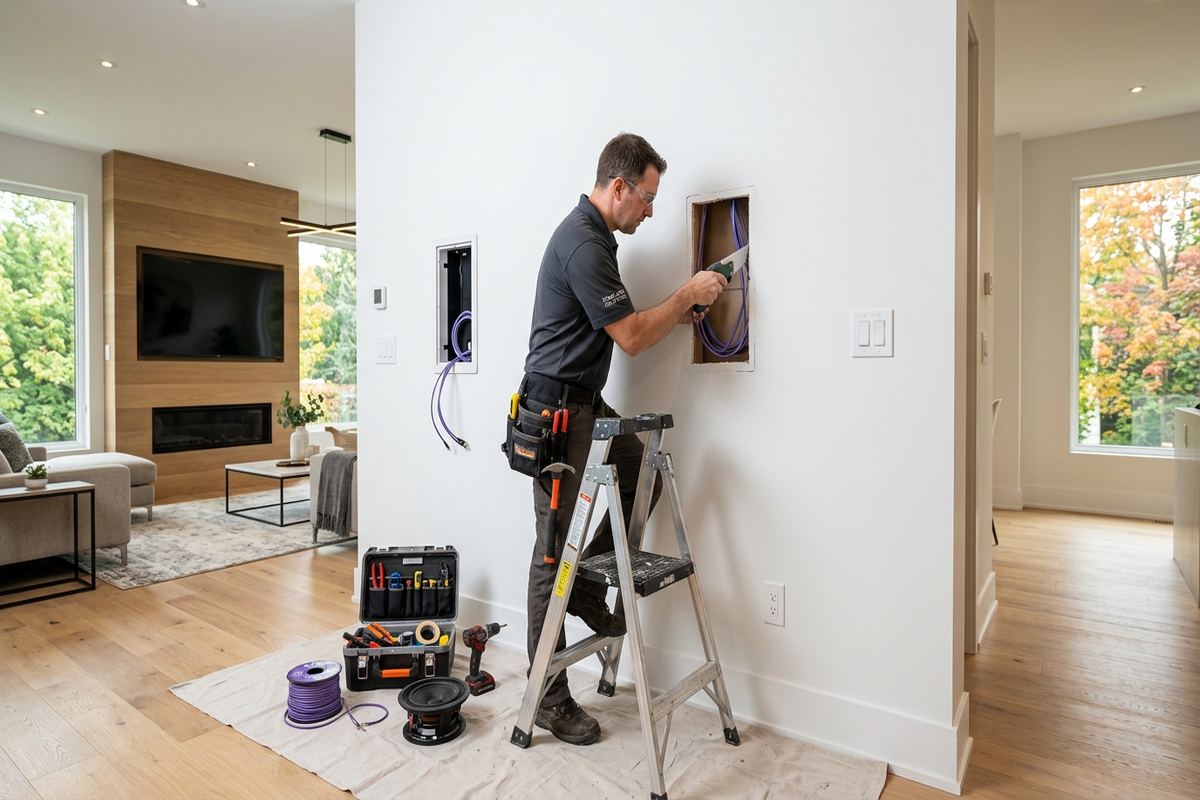
Labels are applied at the equipment end and relevant termination points so each run can be identified without trial and error. The as-built record documents speaker locations, cable destinations and installed equipment, giving the owner a practical reference for maintenance or later expansion. If spare capacity or pathways are included, that is noted as well. Keeping records is particularly useful on larger Aurora properties, where cables may cross several rooms or structures before reaching an outdoor zone. Clear documentation reduces guesswork when landscaping, renovations or equipment changes happen later.
- Continuous labelled speaker cable runs
- Cable gauge based on route length
- Routes coordinated with finished areas
- Outdoor pathways protected from damage
- As-built cable and device record
Multi-Zone Audio and System Control
Different outdoor spaces rarely need identical audio at the same time. A patio may require conversational background music while a pool or distant garden needs independent level control. Multi-zone design allows those areas to operate together or separately, subject to the selected amplifier and control platform. We establish how household members or staff expect to use the system before assigning channels. This prevents a technically capable system from becoming awkward because every speaker turns on at once or because basic volume changes require access to a remote equipment room.
Source integration can include network streaming devices, television audio, dedicated music players or an existing whole-home audio platform. Compatibility is checked rather than assumed, including physical inputs, network requirements, app support and account ownership. On-site configuration uses the customer’s own credentials, so access remains with the owner at handover. Where an app or network service is involved, we explain which features depend on third-party platforms. The installation scope distinguishes installed hardware from subscriptions, content services and customer-supplied devices that remain outside the contractor’s control.
For businesses along commercial strips or in Aurora industrial units, control may need to be simpler and more restricted than a residential setup. Staff might require a defined source and volume range without access to broader network settings. Outdoor customer areas may also need schedules or separate zones from indoor music, subject to the chosen equipment. We configure and test the agreed functions on site, then review ordinary operation with the designated user. One accountable contractor handles the low-voltage audio scope, reducing gaps between cabling, speaker placement and final setup.
- Independent volume by listening zone
- Streaming and local source integration
- Customer-owned accounts and credentials
- Simple controls for staff or residents
- On-site configuration and operating review
Neighbour-Aware Audio Across Aurora
Good coverage is usually quieter than poor coverage. When a single pair of speakers is expected to reach an entire yard, listeners near the building receive excessive volume while distant areas still sound thin. Adding appropriately placed speakers can create a more consistent level and direct energy toward occupied areas. In Aurora neighbourhoods with closer lot lines, such as parts of Aurora Village and Bayview Wellington, careful placement helps reduce unnecessary spill. Outdoor audio still requires considerate use, but the physical design can support lower, more even listening levels.
Large Rural Aurora and Hills of St. Andrew properties present another issue: distance. Sound levels fall as listeners move away from a source, and open areas do not provide the same reflections as indoor rooms. Rather than increasing volume from the house, a distributed landscape design can place sound nearer to seating, pathways or activity zones. Speaker direction is chosen around the property layout, neighbouring residences and natural boundaries. Bass coverage is also considered because low frequencies travel differently and may remain noticeable beyond the intended listening area if equipment is poorly located.
During commissioning, we confirm speaker polarity, channel assignment, zone operation and practical volume balance. Equalization or level adjustments are used where supported, but electronic tuning cannot correct a speaker aimed at the wrong surface or mounted in an unsuitable place. We listen from the actual seating and circulation areas rather than testing only beside the equipment rack. Final settings provide a usable starting point for everyday operation. Owners remain responsible for how loudly and when they use the system, including compliance with applicable property, lease and noise requirements.
- Even coverage at moderate listening levels
- Speaker direction away from nearby homes
- Separate levels for distinct outdoor areas
- Commissioning from actual seating positions
- Polarity and channel assignment verification
Approvals, Renovations and Commercial Sites
Not every exterior wall can be altered immediately. Condominium corporations may regulate balcony equipment, common-element penetrations, visible wiring and changes to exterior finishes. Tenants generally need written landlord approval before speakers, brackets or cable pathways are installed. UnifiedLink can provide a defined proposed scope and equipment information for the customer’s approval process, but the property owner, tenant or condominium representative remains responsible for obtaining permission. Work proceeds only within the approved area and does not assume that an exclusive-use terrace is automatically available for permanent modification.
Renovation timing can create better routes for outdoor audio. Before drywall closes, cables can often be placed between the equipment location and planned exterior exits with less visible disruption. Finished heritage homes near Yonge Street require a more conservative approach, particularly where original trim, masonry or plaster could be affected. Frame additions may offer accessible cavities, while masonry walls may call for surface routing or carefully placed penetrations. We coordinate the low-voltage scope with the customer and relevant trades so speaker wiring is not confused with electrical, landscape-lighting or data cabling.
Commercial patios, storefronts and industrial units in Aurora add operational considerations. Equipment placement must avoid interfering with doors, loading activity, signs, service access and customer circulation. Cable routes may cross suspended ceilings, service rooms or exterior façades, requiring permission and coordination with building management. The audio design should also suit the space’s real purpose, whether that is low-level background music, staff communication support or audio for a defined customer area. We document exclusions and dependencies so electrical power, network access and mounting approvals are addressed by the proper party.
- Condo and landlord approval support documents
- Routes planned around renovation stages
- Coordination with building management
- Commercial mounting and access review
- Scope separates low-voltage trade responsibilities
Installation, Testing and Handover in Aurora
Installation follows the agreed written scope, beginning with cable pathways and mounting locations before equipment is fixed permanently. Continuous runs are labelled, exterior penetrations are sealed and brackets are secured to suitable structure. Speakers, amplification and source components are then connected according to the planned zones. If site conditions differ materially from what could be seen during assessment, the issue is reviewed before the scope changes. This process is especially important on older Aurora properties, where concealed framing, previous renovations or blocked cavities can affect an otherwise reasonable cable route.
Testing covers more than confirming that music plays. Each speaker is checked for correct channel, polarity and stable operation, while zones are tested separately and together. We inspect accessible terminations, review control behaviour and listen for obvious imbalance or vibration at normal operating levels. Network-connected sources are configured on site using the customer’s own credentials where required. The final tuning reflects the intended patio, garden or commercial area rather than maximum output. Any operating limitations arising from customer-supplied equipment or third-party services are explained during handover.
At completion, the customer receives an operating review and an as-built record covering installed equipment, device placement and cable destinations. Equipment ownership and warranty details follow the written scope, avoiding uncertainty about which components belong to the customer and which manufacturer terms apply. We also identify practical care points, such as keeping landscape speakers clear of soil buildup and avoiding pressure washing around connectors or wall penetrations. Aurora owners then have a documented system that can be maintained, expanded or changed without starting from an undocumented collection of exterior wires.
- Installation to the approved written scope
- Speaker-by-speaker operational testing
- Customer credentials used at setup
- As-built device and cable record
- Equipment ownership and warranty documented
Aurora neighbourhoods we cover
- Aurora Village
- Bayview Wellington
- Aurora Highlands
- Hills of St. Andrew
- Rural Aurora
Outdoor speaker installation in Aurora — common questions
Can outdoor speakers stay installed through an Aurora winter?
Yes, when the speakers are designed for permanent exterior use and installed in a suitable location. Aurora winters bring snow, ice and freeze-thaw cycles, so mounting, drainage, connection protection and sealing all matter. Indoor speakers should not simply be placed under a small overhang. We assess exposure and select weather-rated equipment and hardware appropriate to the proposed mounting area.
Will outdoor speakers disturb my neighbours?
Any system can create excessive noise if operated too loudly, but layout makes a substantial difference. In Aurora, we aim speakers toward the intended listening areas and use several well-positioned units where appropriate rather than forcing one pair to cover the whole yard. More even coverage generally allows comfortable listening at lower levels. Owners remain responsible for operating hours, volume and applicable noise or property requirements.
Can you install speakers on an older brick home?
Older brick and masonry require suitable fasteners, careful drilling and properly sealed penetrations. Heritage homes near Yonge Street may also have decorative details or wall assemblies that limit acceptable mounting locations. We inspect the exterior and possible interior cable routes before proposing work. The written scope identifies planned placement and pathways, allowing the owner to review any effect on masonry, trim or finished interior areas.
Do I need approval for a condo terrace or rental property?
Usually, exterior mounting and cable penetrations should be approved before installation. Aurora condominium corporations may regulate common elements, visible equipment and balcony modifications, while tenants should obtain written landlord consent. We can provide a proposed equipment list, placement and cable scope for review. The customer is responsible for securing the necessary authorization, and installation is limited to the work and locations that have been approved.
Can my outdoor speakers use my existing music system?
Possibly. We check the existing amplifier, available outputs, speaker load, control platform and source connections before confirming compatibility. Some Aurora homes already have whole-home audio that can support another zone, while others need separate amplification or a streaming source. Any account-based setup is completed using your own credentials. The scope clearly identifies reused, customer-supplied and newly installed equipment.
How does pricing and scheduling work?
UnifiedLink completes a site assessment before pricing because cable access, construction, distance, speaker count and zone requirements vary across Aurora properties. You then receive a written scope covering equipment, routes, placement, exclusions, ownership and warranty. Assessment timing depends on the service and travel distance. Requests sent during business hours are answered the same day; after-hours requests are answered the next business day.
Coverage in Aurora is confirmed against the address before we quote. See everything we install in Aurora or the province-wide outdoor speaker installation page.