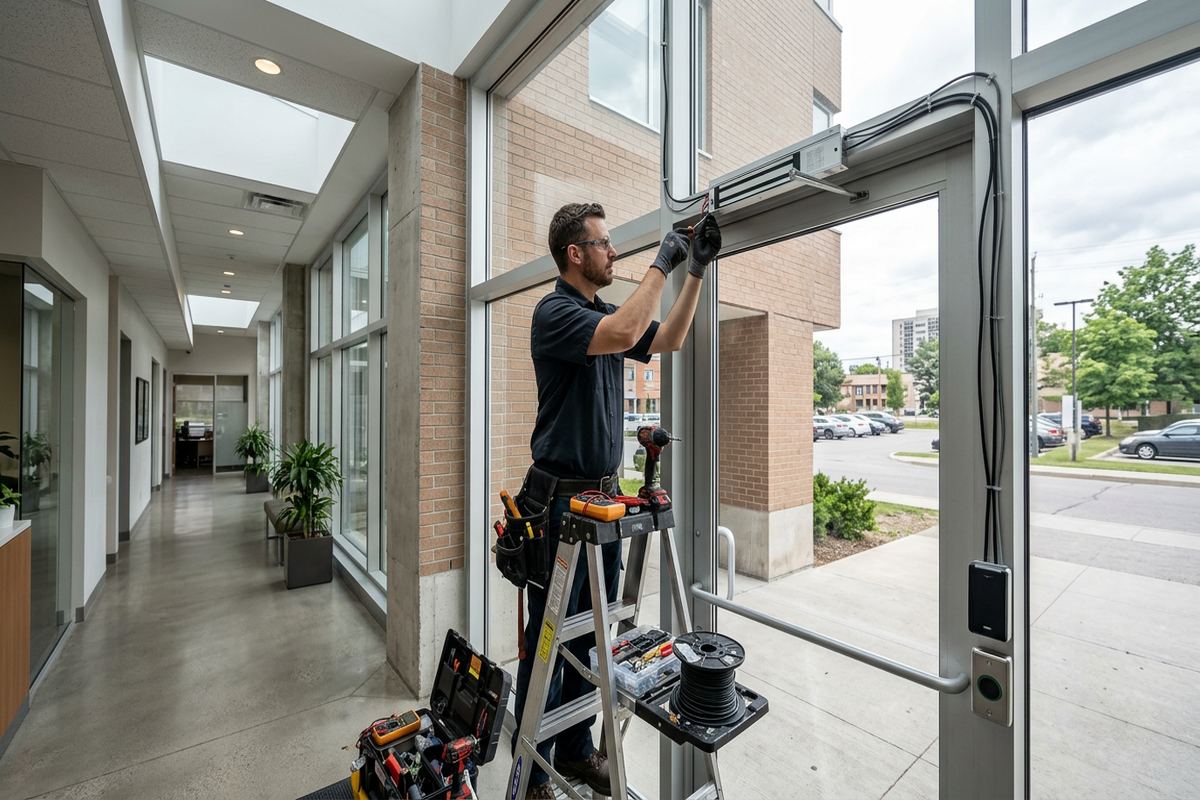
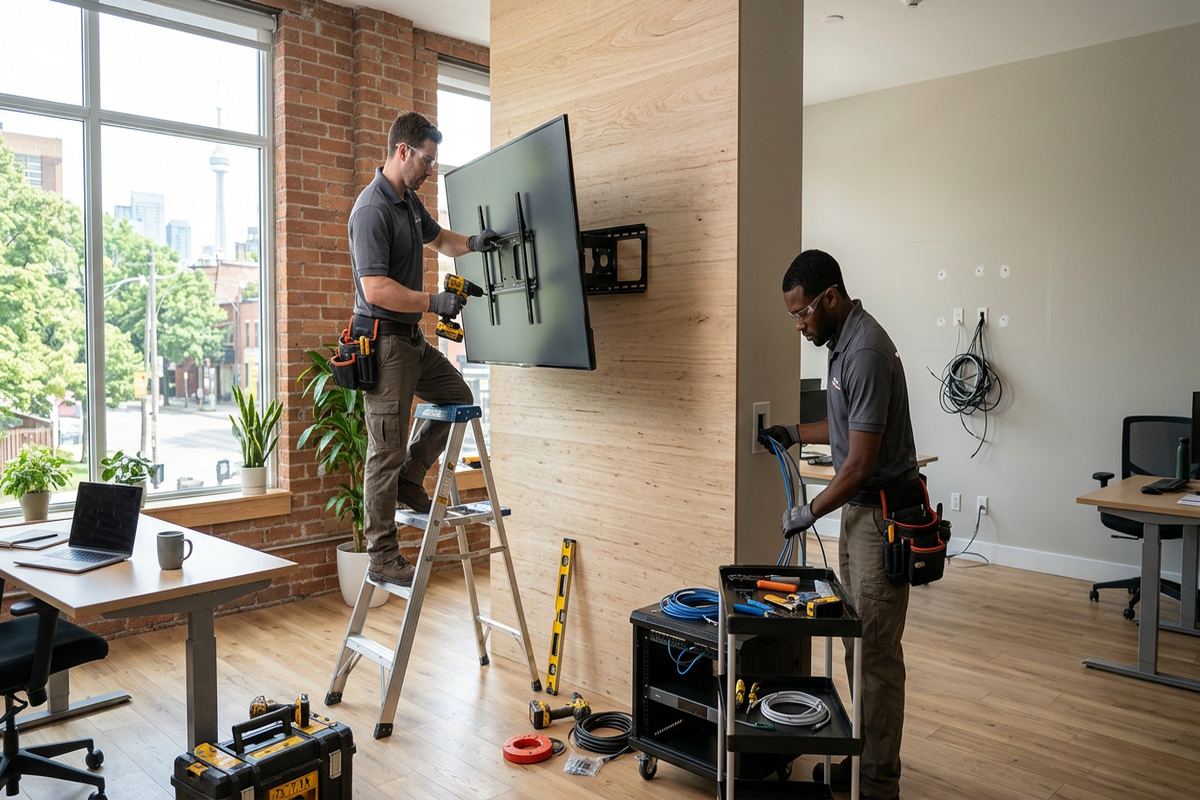
UnifiedLink plans and installs fireplace TV mounts for Aurora homes and businesses. We assess heat exposure, viewing height, wall construction, cable routes and equipment placement before pricing. Each installation is scoped around the fireplace, room layout and building materials, with on-site configuration and a clear handover using your own credentials.
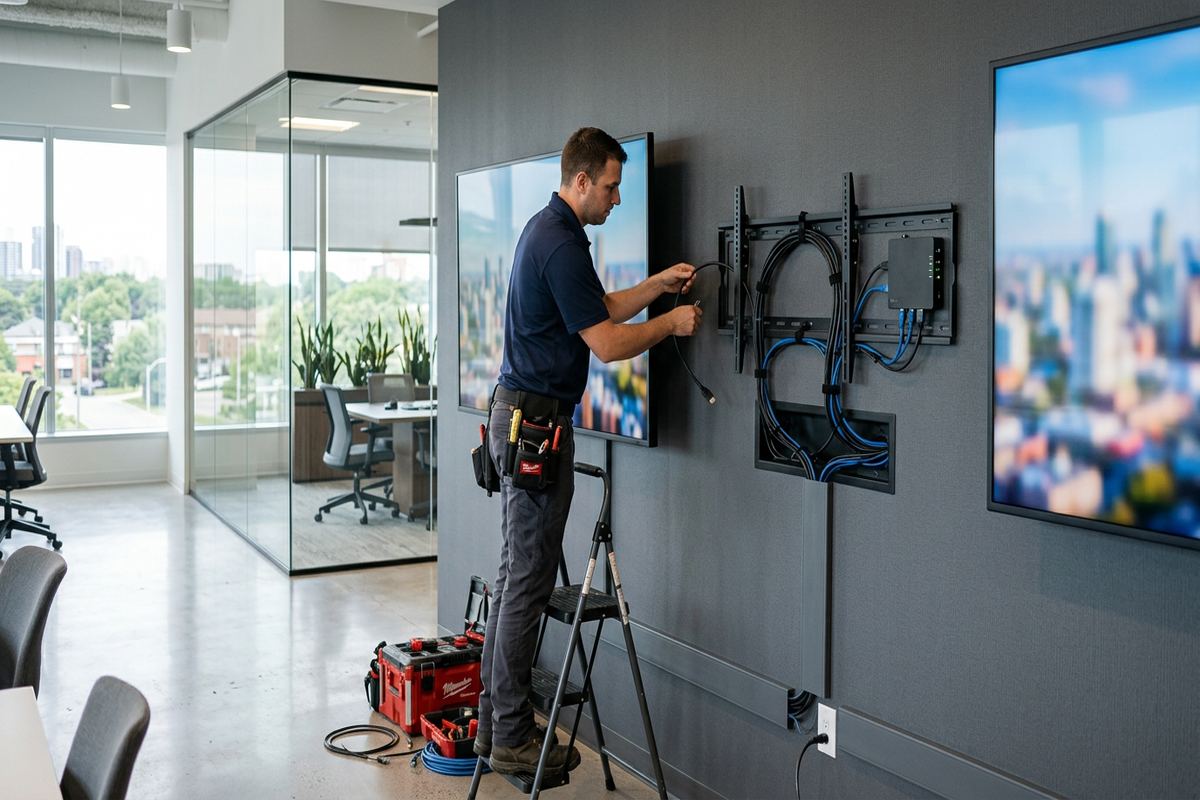
Fireplace TV Mounting Planning in Aurora
Mounting a television above a fireplace involves more than centring a bracket on the wall. The installer must consider heat, viewing height, wall composition, fireplace clearances, cable access and the television manufacturer’s mounting requirements. In Aurora, those conditions vary considerably between heritage homes near Yonge Street and larger estate properties east of town. A site assessment identifies what is behind the finished surface, where power and low-voltage connections can run, and whether the proposed position will be comfortable, serviceable and appropriate for the particular fireplace assembly over regular daily use.
Before pricing, UnifiedLink examines the fireplace type, mantel depth, wall finish, available ventilation and expected television size. We also look for construction drawings, fireplace manuals and any existing conduit or recessed boxes. Surface temperature can change with operating time, fuel type and room airflow, so appearance alone is not enough to approve a location. If the proposed position conflicts with stated clearances or creates unsuitable heat exposure, we explain practical alternatives, such as mounting beside the fireplace, changing the height or using a mantel arrangement that redirects rising heat away from the display.
The written scope records equipment, bracket type, cable routes, device placement, exclusions, equipment ownership and warranty details. This prevents assumptions about whether drywall repair, electrical work, fireplace alterations, cabinetry or painting are included. Where another trade is required, that dependency is identified before installation begins. UnifiedLink remains the accountable contractor for the display, mount and low-voltage portion of the work. Requests submitted during business hours are answered the same day; after-hours requests are answered the next business day. Assessment timing depends on the service requirements and travel distance within or around Aurora.
- Fireplace type and clearance review
- Proposed screen height and alignment
- Wall and finish assessment
- Cable and equipment route planning
- Written scope before installation
Heat, Clearances and Viewing Height
Heat management determines whether an above-fireplace location is reasonable. Fireplace manuals and television instructions may specify separation distances, temperature limits or restrictions on nearby materials. A mantel can influence the path of rising heat, but its presence does not automatically make every mounting position suitable. During assessment, we review available documentation and consider how the fireplace is actually operated. A display should not cover vents, interfere with access panels or obstruct required service areas. When conditions remain uncertain, installation should wait until the fireplace manufacturer or an appropriate fireplace professional confirms the intended arrangement in writing.
Viewing comfort matters because fireplace installations naturally push screens higher than conventional media-wall installations. The correct decision depends on seating distance, seating posture, screen size, mantel position and room use. A tilting mount can improve the viewing angle, while a pull-down mount may lower the screen during use if the wall, fireplace and clearances support that mechanism. Moving brackets have deeper profiles and different load forces, so they require careful anchoring. We discuss these trade-offs rather than treating a specialized bracket as a universal solution for every Aurora living room or commercial seating area.
Equipment also needs protection from concentrated heat and limited airflow. Streaming players, control devices, small amplifiers and cable boxes should not be packed into an unventilated recess simply to keep them out of sight. We can locate suitable low-voltage devices in cabinetry or another accessible position, then run continuous labelled cables to the display. Remote-control behaviour, Bluetooth performance and Wi-Fi strength are considered before equipment is moved. The resulting layout should permit routine resets, replacement and troubleshooting without removing masonry, dismantling a mantel or taking the television off its bracket for every minor service task.
- Manufacturer clearance requirements reviewed
- Mantel and vent positions considered
- Seating angle checked before drilling
- Tilting or pull-down options assessed
- Accessible equipment locations planned
Masonry and Frame Walls in Aurora
Aurora’s varied housing stock requires different fastening methods. A brick or stone fireplace surround may be structural masonry, a thin adhered veneer or a decorative finish installed over framing. Those assemblies cannot be treated as interchangeable. We investigate accessible edges, drawings and wall details to determine where a suitable connection can be made without relying on fragile facing material. Anchor selection depends on the verified substrate, mount geometry and anticipated loading. Drilling locations are planned to reduce avoidable damage, preserve service access and keep the bracket aligned with the fireplace rather than merely following irregular joints or surface patterns.
Frame construction presents its own constraints. Studs may not line up with the fireplace centre, and the wall can contain flues, metal framing, plumbing, electrical wiring, ducts or factory-built fireplace components. Heritage homes near Yonge Street may also include plaster, lath, older framing layouts and renovations completed in several stages. We do not assume that a stud finder tells the complete story. The mounting plan combines available records, careful inspection and suitable detection methods, with limited exploratory access discussed where necessary. Decorative finishes are protected, but concealed conditions can still affect the final position or scope.
Larger estate properties east of town often have broad fireplace walls, built-in cabinetry and long cable paths to centralized equipment. These rooms may need additional planning for HDMI distance, control signals, network connections and audio routing. A cable that works across a short open room may not be appropriate for a long concealed run. UnifiedLink specifies the connection method for the actual route and equipment. Continuous labelled cable runs simplify future identification, while accessible terminations help avoid hidden couplers. Any proposed wall openings, cabinetry access points or visible surface sections are documented before the installation is approved.
- Anchors matched to verified substrate
- Brick veneer distinguished from masonry
- Stud and obstruction locations checked
- Long signal routes assessed
- Openings documented in the scope
Aurora, Ontario
Fireplace TV mounting in Aurora, scoped in writing first
Book a site assessment and get equipment, routes, exclusions, and warranty on paper before anything is installed.
Concealed Cabling and Device Placement
A clean fireplace installation depends on a cable path that remains safe and serviceable. Low-voltage lines may travel through framing cavities, conduit, cabinetry, an adjacent wall or a prepared chase, depending on the fireplace assembly. Cables are not routed through prohibited fireplace spaces or placed where heat, sharp edges or moving hardware can damage them. Existing conduit is checked for size, route and usability before it becomes part of the plan. If concealment is not practical, we explain surface raceway or cabinetry options and show where visible transitions will occur rather than making that decision during drilling.
Power and low-voltage work must be planned as separate requirements. UnifiedLink does not hide flexible power cords inside a wall or substitute low-voltage cabling for a compliant receptacle arrangement. If a new receptacle, relocation or other electrical work is necessary, it must be completed by the appropriate electrical trade. The project sequence is recorded so the wall does not need to be opened repeatedly. Signal cabling, network links and control connections are then installed to the scoped locations, labelled at both ends where practical, tested and left with enough access for television installation and future replacement.
Device placement should support both appearance and maintenance. Equipment can sometimes sit in nearby cabinetry, but doors, shelving and distance may affect infrared control, airflow and wireless signals. In Aurora Village homes with compact rooms and established millwork, the best route may differ from one used in an open-plan Rural Aurora property. We assess how the customer uses streaming services, external speakers, game systems or business presentation sources. The plan identifies which devices stay at the television, which move elsewhere, and how each device connects, receives control commands and remains reachable for updates or resets.
- Continuous labelled low-voltage runs
- No concealed flexible power cords
- Conduit capacity checked before use
- Surface routes disclosed in advance
- Devices remain accessible for service
Aurora Installations, Finishes and Exterior Conditions
Finished fireplace walls may include natural stone, manufactured stone, brick, tile, wood panels, plaster or painted drywall. Each material affects drilling, bracket spacing and the possibility of minor chips or irregular openings. We discuss finish risks before work starts and select methods suited to the identified surface and backing. The television is levelled to the room and fireplace geometry, recognizing that older mantels or masonry courses may not be perfectly square. Final placement balances visual alignment with secure fastening, required clearances and bracket adjustment, rather than forcing an unsafe anchor location to match a decorative joint.
Exterior fireplace walls and covered outdoor living areas require additional review. Aurora winters, moisture and repeated freeze-thaw cycles can stress masonry, seals, fasteners and exposed connections. A sheltered wall is not automatically a dry indoor environment, and indoor-only televisions or mounts may be unsuitable for the location. We assess exposure, equipment ratings, cable entry points and drainage paths before proposing work. Exterior penetrations need compatible sealing and a route that does not direct water into the wall. Any existing cracks, failed joints or questionable masonry should be addressed before mounting equipment to that surface.
In Bayview Wellington and Aurora Highlands, renovations often combine original framing with newer fireplace surrounds, cabinets or media components. That layered construction can conceal gaps between the visible finish and structural backing. Rural Aurora properties may add longer equipment routes, outbuildings or exterior entertainment areas where environmental exposure and network reach require separate planning. UnifiedLink bases the installation on observed conditions rather than neighbourhood assumptions. When concealed construction differs from what the assessment reasonably indicated, work pauses long enough to review the change, update the method and confirm any effect on scope before proceeding further.
- Finish-specific drilling approach
- Exterior-rated equipment requirements checked
- Penetrations sealed against moisture
- Freeze-thaw exposure considered
- Hidden construction changes reviewed
Mount Selection and Display Configuration
The mount must fit the television’s size, weight, mounting pattern and connection layout while supporting the intended movement. Fixed mounts keep the screen close to the wall but leave less space for plugs and servicing. Tilting mounts can improve a high viewing angle, while articulating models need clearance to move without contacting stone, shelves or mantel details. Pull-down fireplace mounts introduce additional motion, leverage and operating space. We confirm compatibility using current equipment information and inspect customer-supplied brackets before installation, but unsuitable or incomplete hardware is not installed simply because it is already on site.
Connection depth is easy to overlook on a shallow fireplace wall. HDMI plugs, power connections, optical cables and network leads can project behind the screen or bend sharply when the television is placed close to the finish. Recessed connection points may help in some assemblies, but their location cannot conflict with the fireplace enclosure or prohibited spaces. We measure the available clearance and plan plug orientation before selecting the final bracket position. Service loops are controlled rather than crushed, and cables are secured so they cannot fall onto hot surfaces or become pinched by moving mount components.
After physical installation, UnifiedLink completes on-site configuration for the scoped display connections and related low-voltage devices. That can include source selection, network connection, basic display setup and confirmation that connected equipment operates as intended. Customers retain their own account credentials; passwords are not converted into installer-owned accounts. Handover includes an as-built record showing device placement and cable information relevant to future service. We also explain mount movement, access limitations and safe operating considerations. Fireplace operation remains subject to its manufacturer’s instructions and any conditions identified during the assessment or by the appropriate fireplace professional.
- Mount compatibility confirmed
- Plug and connector depth measured
- Moving parts checked for clearance
- Customer-owned credentials retained
- As-built information provided
Approvals for Aurora Homes and Businesses
Condominium, rental and managed properties can require written approval before drilling, cable routing or changes to common elements. An owner, landlord, condominium corporation or property manager may request drawings, contractor information, work-hour compliance or specific restoration procedures. UnifiedLink identifies known approval dependencies in the written scope, but the customer remains responsible for obtaining property authorization unless another arrangement is documented. Work does not proceed through a shared wall or regulated building component based only on verbal permission. This approach protects the planned installation from delays and helps clarify who approves openings, electrical coordination and finish restoration.
Commercial strips and industrial units in Aurora may use fireplace-style feature walls in reception areas, lounges, restaurants or presentation spaces. These installations still require secure mounting, suitable heat separation and accessible equipment, but business operations add scheduling, public-area control and content-source considerations. The assessment reviews wall construction, device security, network availability and shutdown requirements. Where tenants occupy the unit, landlord approval may be necessary before penetrating masonry or routing above ceilings. Shared services, rated assemblies and base-building rules must be identified rather than assumed to match the conditions found in a detached home.
Hills of St. Andrew properties and other larger homes may involve interior designers, cabinetmakers, fireplace contractors, electricians or renovation contractors. A coordinated sequence prevents the mount location from being covered, cabling from ending behind structural elements, or connection boxes from conflicting with bracket rails. UnifiedLink provides one accountable contractor for the scoped display and low-voltage installation, while documenting interfaces with other trades. Decisions about fireplace construction, gas work, electrical supply or structural modification stay with the appropriate party. Clear responsibilities are especially important when equipment is installed during a broader renovation rather than after finishes are complete.
- Condo or landlord approval identified
- Base-building rules considered
- Commercial scheduling coordinated
- Other-trade dependencies documented
- Rated assemblies not assumed accessible
Assessment, Installation and Handover in Aurora
Every Aurora fireplace TV project starts with enough information to define the work accurately. Useful details include television model, fireplace type, wall photographs, mantel dimensions, room layout and any available construction or equipment manuals. Photographs support initial discussion but do not replace an on-site assessment where wall structure, clearances or cable routing must be verified. During the visit, we review the preferred screen position, connected devices and finish expectations. Assessment timing depends on the service and travel distance. Pricing follows the assessment rather than relying on an incomplete description of the visible fireplace wall.
On installation day, the work area is prepared and the documented position is confirmed before permanent openings are made. The bracket is fastened to the verified supporting construction, cables are installed along the approved routes, and the display is attached using compatible hardware. Mount movement, level, connection clearance and basic source operation are checked on site. If unexpected framing, masonry or fireplace components prevent the scoped method, we stop and explain the available options. Changes are not concealed inside the job without discussing their effect on placement, finish, equipment needs or involvement from another trade.
Handover gives the owner practical information for operating and maintaining the installation. UnifiedLink records cable routes and device placement in an as-built record, confirms equipment ownership, and leaves account access under the customer’s own credentials. Warranty information follows the written scope and applicable equipment terms. We identify any movement limits, heat-related operating conditions and access method for connected devices. Future television replacement may still require compatibility checks because mounting patterns, weight, plug positions and screen dimensions change. A documented installation makes that later assessment more direct for Aurora homeowners, landlords, property managers and business operators.
- Site assessment before pricing
- Position confirmed before drilling
- Installation tested on site
- Customer credentials used for handover
- As-built record supplied
Aurora neighbourhoods we cover
- Aurora Village
- Bayview Wellington
- Aurora Highlands
- Hills of St. Andrew
- Rural Aurora
Fireplace TV mounting in Aurora — common questions
Can any TV be mounted above my Aurora fireplace?
No. The television, mount, fireplace and wall must be assessed together. Manufacturer clearances, heat exposure, mantel position, ventilation, wall structure and viewing height can all limit the installation. If an above-fireplace position is unsuitable, UnifiedLink will explain alternatives such as an adjacent wall, a revised height or a different room layout before preparing the written scope.
How do you know if fireplace heat is too high?
We review available fireplace and television documentation, clearances, vent positions, mantel geometry and normal fireplace use. Surface appearance alone cannot establish safe operating conditions. For an Aurora installation with missing documentation or uncertain heat behaviour, confirmation may be required from the fireplace manufacturer or an appropriate fireplace professional before mounting proceeds.
Can you hide the cables behind stone or brick?
Sometimes, but the route depends on whether the finish is structural masonry, adhered veneer or material installed over framing. We also need to avoid the fireplace enclosure, vents and prohibited spaces. In Aurora homes where concealment is not practical, the scope can identify cabinetry, conduit or surface raceway options and clearly show any visible transition points.
Do I need condo or landlord approval in Aurora?
Approval may be required before drilling, adding cable routes or changing a shared or regulated building component. Condo corporations, landlords and property managers can also impose work hours or restoration rules. The written scope identifies known dependencies, while the customer normally obtains property authorization unless another arrangement is documented. Verbal permission is not treated as approval for restricted work.
Can you install a pull-down fireplace TV mount?
A pull-down mount can be considered when the television is compatible and the wall provides suitable support, movement clearance and fireplace separation. These mounts create different loads and need space around mantels, stonework and nearby shelving. UnifiedLink assesses the specific Aurora room before recommending one; a pull-down mechanism is not an automatic solution for excessive heat or inadequate clearances.
What do I receive after installation?
The Aurora handover includes on-site confirmation of the scoped connections, customer-controlled credentials and an as-built record covering relevant cable routes and device placement. We explain mount movement, access points and identified operating limits. The written scope also records equipment ownership, exclusions and warranty information, helping the owner plan future service or television replacement.
Coverage in Aurora is confirmed against the address before we quote. See everything we install in Aurora or the province-wide fireplace tv mounting page.