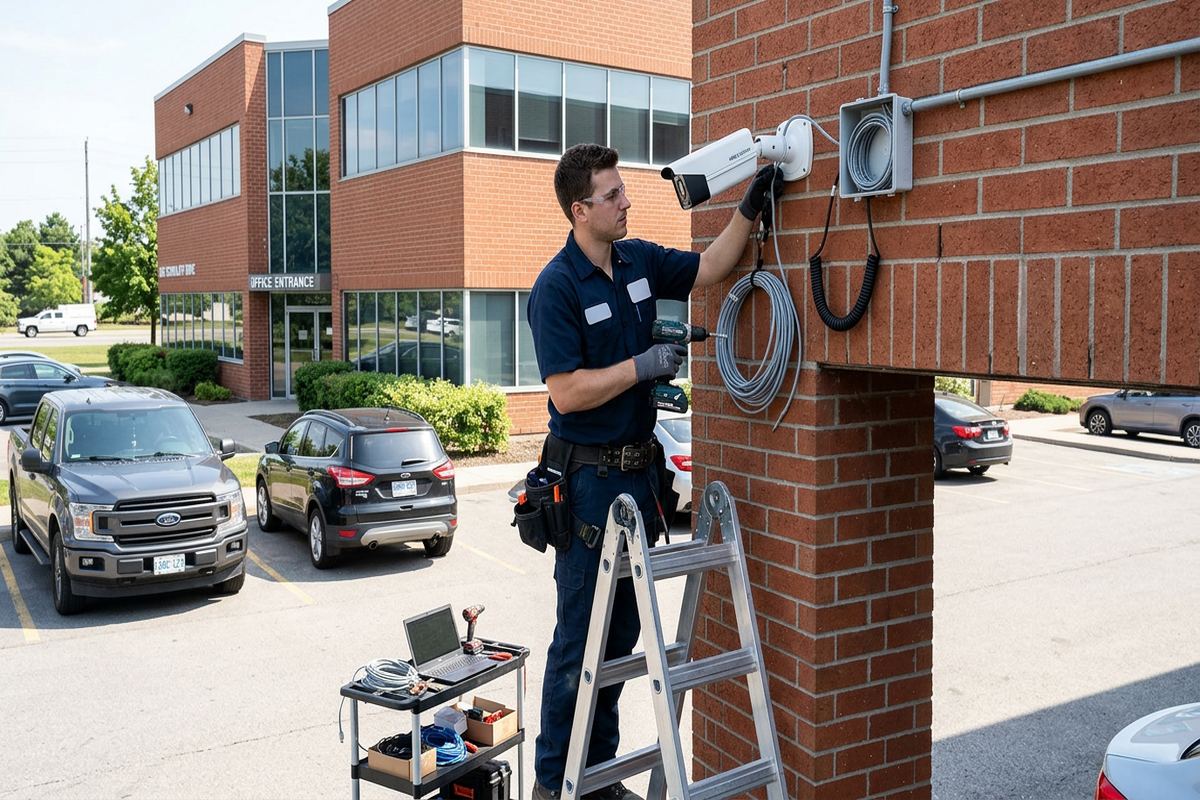
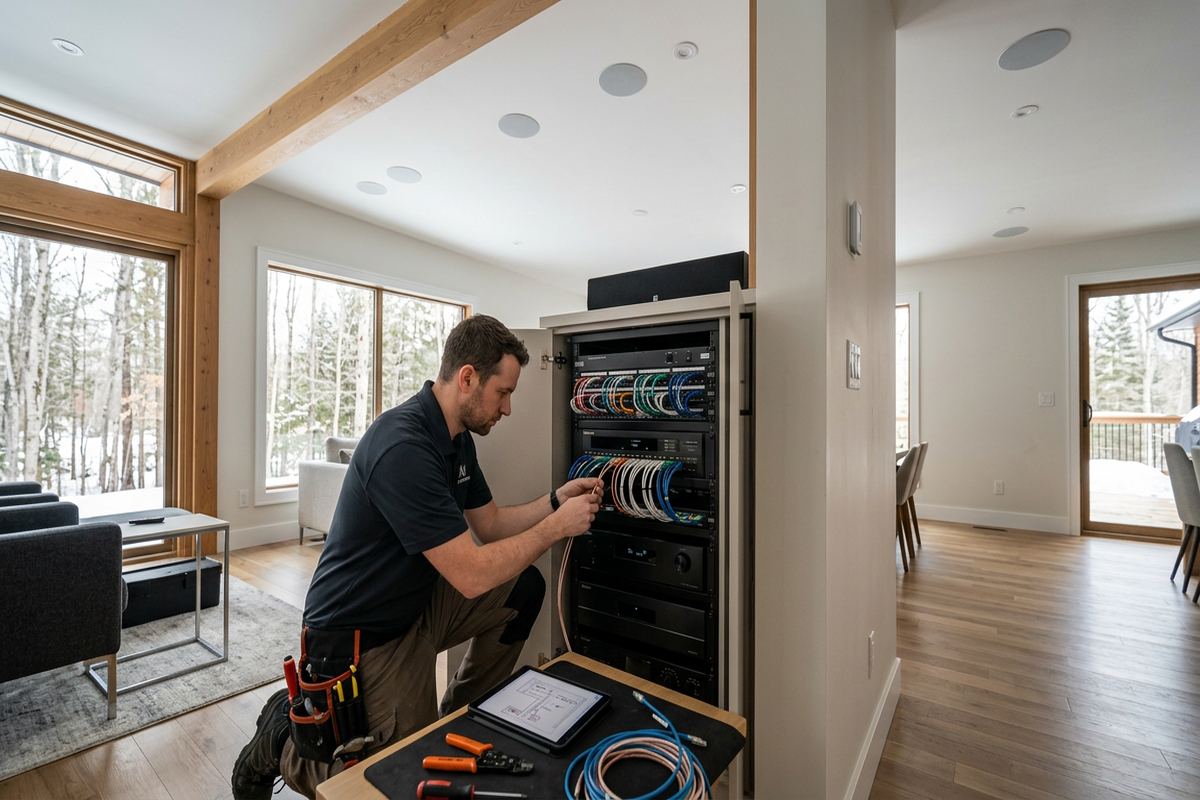
UnifiedLink installs outdoor speaker systems for homes and businesses in Ajax, Ontario. We plan speaker coverage, cable routes, mounting, zoning and controls around the property’s construction and intended use. Each project starts with a site assessment and proceeds from a written scope, helping avoid exposed wiring, weak coverage and equipment that is unsuitable for Ontario weather.
Outdoor Speaker Planning for Ajax Properties
Outdoor audio works best when the design begins with how the space is actually used. A covered deck needs a different layout from a pool, open lawn, restaurant patio or loading area. During an Ajax site assessment, we review listening zones, likely seating positions, neighbouring properties, available mounting surfaces and practical cable routes. The objective is even, useful sound at moderate levels rather than excessive volume from one or two speakers. We also identify where amplifiers, network equipment and source devices can be placed indoors, protected from moisture and accessible for future service.
Ajax includes newer subdivisions, lakefront homes and properties with finished basements, which can make an outdoor audio retrofit straightforward but detail-heavy. Finished ceilings, insulated walls, stone veneers and completed landscaping often limit where cable can be concealed without unnecessary disturbance. We inspect the building before proposing a route, rather than assuming that every soffit, basement joist space or utility room is open. The written scope identifies proposed speaker positions, equipment locations, cable paths and exclusions so the customer can understand what will be installed and what surrounding finish work may remain outside the project.
Coverage planning also considers the direction in which each speaker projects sound. Speakers aimed toward the house or downward over a seating area generally provide more controlled listening than units pointed toward adjacent yards. For larger Ajax properties, several speakers operating at lower output may produce more consistent coverage than a small number driven loudly. We account for changes in elevation, fences, vegetation, hard masonry surfaces and open lakefront exposure. Final placement remains subject to safe access, suitable structure and confirmation that chosen positions will not interfere with doors, windows, lighting or drainage components.
- Patio, deck, pool and garden coverage planning
- Speaker positions matched to seating and property boundaries
- Indoor amplifier and source equipment locations
- Written equipment, placement and cable-route scope
Choosing Outdoor Speakers and Audio Equipment in Ajax
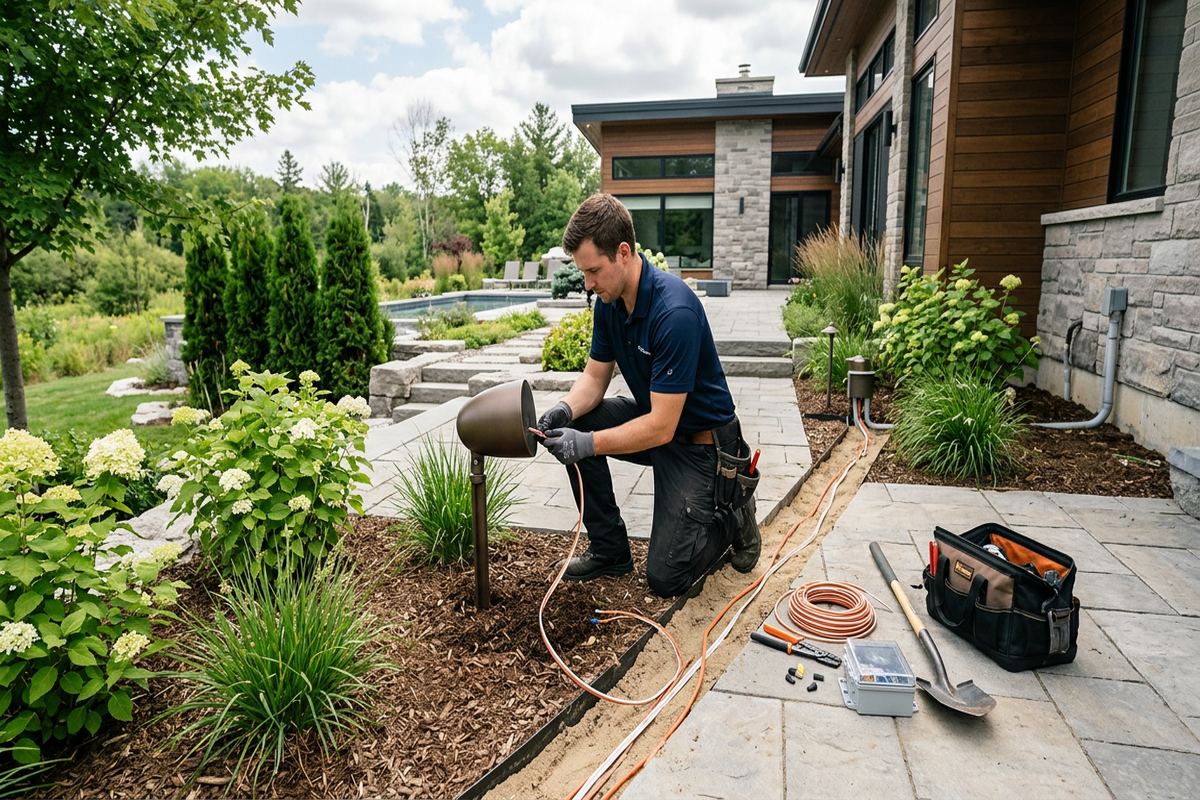
Equipment selection should follow the environment and the expected listening level, not appearance alone. Outdoor-rated surface speakers are commonly used beneath soffits, on walls or around covered patios. Landscape speakers can distribute sound through gardens, while buried or partially concealed subwoofers may support low-frequency coverage where the site permits. We match the proposed speaker type to mounting access, exposure, available amplification and the number of zones. The scope also states who owns supplied equipment and identifies warranty terms, avoiding uncertainty when customer-provided receivers, streaming devices or existing speakers become part of the finished Ajax system.
An amplifier must support the speaker arrangement and the way the customer expects to control it. A simple patio may use one stereo zone, while a pool, dining area and garden may need independent volume control. Larger distributed systems can require impedance-matching hardware or constant-voltage designs, depending on cable distance and speaker quantity. UnifiedLink evaluates those requirements before installation rather than adding speakers to an unsuitable receiver. We also confirm how music sources connect, whether through a network streamer, television, commercial audio player or customer-provided device, and document compatibility assumptions within the proposed scope.
Existing indoor audio equipment can sometimes support an outdoor zone, but its location and available outputs must be verified. A receiver inside a finished basement may have unused channels yet lack an appropriate control method from the patio. Older equipment may also depend on unsupported applications or have limited network connectivity. In Ajax homes, we review the existing rack, cabinet, media room or utility area and determine whether reuse is practical. Recommendations distinguish retained equipment from new components, and exclusions identify any unsupported third-party services, subscriptions or devices that cannot be fully tested during the installation visit.
- Surface, landscape and distributed speaker options
- Amplification matched to load and cable distance
- Separate volume zones where required
- Compatibility review for existing audio equipment
Weather-Resistant Mounting for Ajax Winters
Ontario weather affects more than the speaker enclosure. Mounting hardware, fasteners, cable entries and connectors must tolerate rain, snow, summer heat and repeated freeze-thaw cycles. Around Ajax lakefront properties, exposed locations may also receive stronger wind and wind-driven precipitation than sheltered subdivision yards. We select mounting methods according to the speaker manufacturer’s requirements and the actual substrate. Speaker orientation should allow drainage and avoid trapping water against terminals or brackets. Outdoor-rated products still need careful installation; a weather rating does not make every mounting position, connection method or building penetration equally suitable.
Exterior attachment changes with the construction beneath the finish. Frame walls, masonry, poured concrete and brick veneer each require appropriate anchors and drilling methods. Brick veneer is not treated as though it were solid structural masonry, and thin cladding should not carry loads without suitable backing. Before drilling, we consider visible services, likely concealed wiring, drainage paths and the condition of the mounting area. Ajax homes with mixed stone, brick and siding often require different methods on the same property. Where structural suitability cannot be confirmed visually, speaker placement may need adjustment or additional investigation before work proceeds.
Any exterior penetration needs a deliberate path and a compatible sealing approach. Cables should enter in a way that limits water tracking toward the building interior, while service loops and drip paths are managed without leaving untidy coils. Sealants and fittings must suit the surrounding material and expected movement through seasonal temperature changes. We do not describe a penetration as permanent or maintenance-free because exterior finishes and sealants require periodic inspection. At handover, the customer receives the documented cable route and device placement, making it easier to identify installed penetrations during later roofing, siding, window or renovation work.
- Mounting suited to masonry or frame construction
- Outdoor-rated cable and connection protection
- Penetrations planned for drainage and sealing
- Hardware positioned for seasonal exposure
Ajax, Ontario
Outdoor speaker installation in Ajax, scoped in writing first
Book a site assessment and get equipment, routes, exclusions, and warranty on paper before anything is installed.
Concealed Speaker Cabling in Finished Ajax Homes
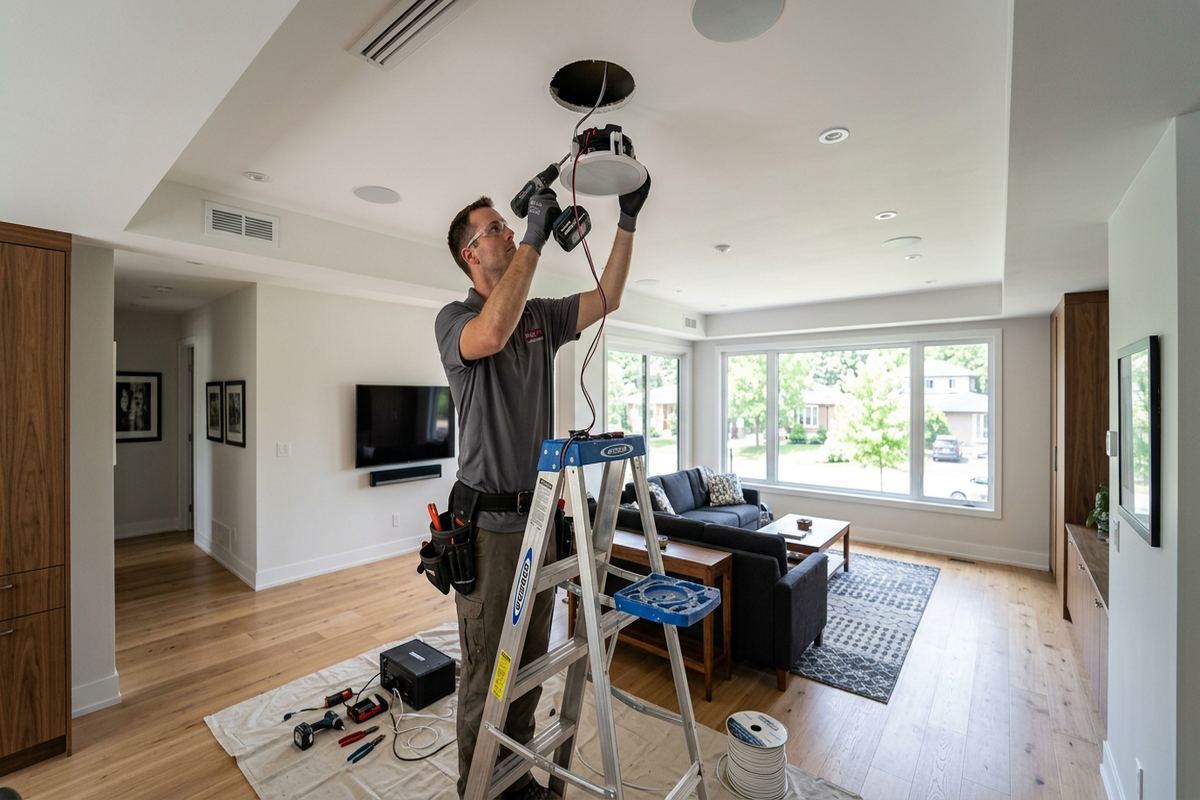
Finished basements are common in Ajax’s newer subdivisions, and they change how exterior speaker wiring can reach an equipment location. Open joists may be unavailable, bulkheads may interrupt routes and mechanical systems can occupy the most direct path. A site assessment lets us examine utility rooms, unfinished storage areas, recessed-light openings and accessible ceiling sections before setting expectations. We favour continuous labelled cable runs between defined termination points, reducing hidden junctions that complicate troubleshooting. If fully concealed routing is not practical, the written scope can identify a controlled surface route, exterior-rated pathway or limited-access requirement for customer approval.
Cable type depends on location, pathway and electrical characteristics. Wire passing outdoors, underground or through damp locations must be suitable for that use, while indoor portions must follow applicable installation requirements. Long runs also introduce resistance, so conductor size and amplifier configuration need consideration before cable is pulled. Low-voltage audio cable is kept sensibly separated from power wiring, and penetrations are not shared casually with unrelated services. For landscape systems, routes should avoid obvious future digging areas where practical, although customers must retain records and arrange proper utility locating before later excavation around any buried services or wiring.
Retrofit work sometimes requires small access openings, even when a route appears clear from the basement or attic. Finished surfaces can conceal blocking, insulation, ducts and plumbing that cannot be mapped from outside. We discuss foreseeable access requirements before work and record finish repairs as included or excluded rather than leaving the issue ambiguous. In Southwood, Nottingham or Applecroft, similar-looking homes may have different basement layouts and renovation histories, so cable plans remain property-specific. The aim is a neat route with limited disruption, but no installer should promise completely invisible wiring before inspecting the actual construction.
- Continuous labelled speaker cable runs
- Routes reviewed through finished interior spaces
- Outdoor or underground cable selected by location
- Access and finish-repair exclusions documented
Audio Zones, Volume and Everyday Control
Outdoor sound should be easy to operate without requiring access to a basement equipment cabinet every time. Depending on the system, control may come from a wall keypad, amplifier application, network streamer, handheld device or existing automation platform. We confirm which functions are available, including source selection, zone grouping and volume adjustment. Network-based controls also depend on reliable Wi-Fi coverage where the user stands. If the patio has weak connectivity, that limitation should be identified rather than mistaken for an audio fault. Network improvements can be scoped separately when outdoor control depends on stronger wireless service.
Multiple zones help users direct audio only where it is needed. A deck and pool may share a source but require separate volume, while a front commercial patio may need independent scheduling from an indoor dining area. We design zone boundaries around normal use rather than simply dividing speakers by physical distance. Volume controls and applications have practical limits, and municipal rules, lease terms or condominium policies still govern acceptable noise. An outdoor speaker system does not provide permission to disturb neighbouring properties. Sensible coverage and speaker direction can support lower operating levels across the intended listening area.
UnifiedLink configures the installed equipment on site and demonstrates normal operation at handover. Where accounts or applications are required, setup uses the customer’s own credentials rather than installer-owned logins. Customers should retain subscription details and understand which functions depend on internet access, third-party cloud services or mobile operating systems. We record configured zones, speaker connections and equipment locations in the as-built information. That record is particularly useful when several outdoor areas share one amplifier, because future owners or service providers can identify channel assignments without tracing every cable from the beginning.
- Independent control for defined outdoor zones
- Source and volume configuration on site
- Customer-owned accounts and credentials
- As-built channel and connection records
Outdoor Audio for Ajax Neighbourhoods and Lakefront Homes
Property layout varies across Ajax, even where homes were built within similar development periods. In Nottingham and Applecroft, closely spaced yards may call for compact coverage directed inward toward a deck or seating area. Duffin's Bay and Pickering Beach properties can present more open exposure, mature landscaping or lakefront conditions that affect mounting and sound travel. Central Ajax may include additions, renovated basements and mixed exterior materials that make cable routing less predictable. We use neighbourhood context as a planning clue, but speaker quantity and placement are determined from the individual site rather than a generic package.
Pools and landscaped yards need special attention because listening positions can be spread across several surfaces. Speakers mounted only on the back wall may sound loud near the house and weak at the far edge of the yard. Distributed landscape speakers can improve consistency, provided there are suitable cable routes and protected positions away from routine maintenance. Pool equipment, irrigation, drainage and future planting plans should be discussed before trenching. Audio equipment is also kept out of unsuitable wet locations, and electrical work associated with receptacles or power supplies must be addressed by the appropriate trade where required.
Renovations can create useful pathways, but coordination needs to happen before walls and ceilings are closed. If an Ajax homeowner is finishing a basement, rebuilding a deck or replacing exterior cladding, speaker cable and conduit planning can be included while access is available. Pre-wiring does not require every audio component to be selected immediately, but termination points and future system assumptions should be documented. We label both ends of each installed run and provide an as-built record. This reduces guesswork when speakers or amplification are installed later and helps prevent renovation crews from treating concealed low-voltage wiring as abandoned cable.
- Layouts adapted to close or open yards
- Planning for pools, decks and landscaping
- Pre-wiring during renovations where practical
- Neighbour-conscious speaker direction and coverage
Ajax Commercial, Rental and Condominium Installations
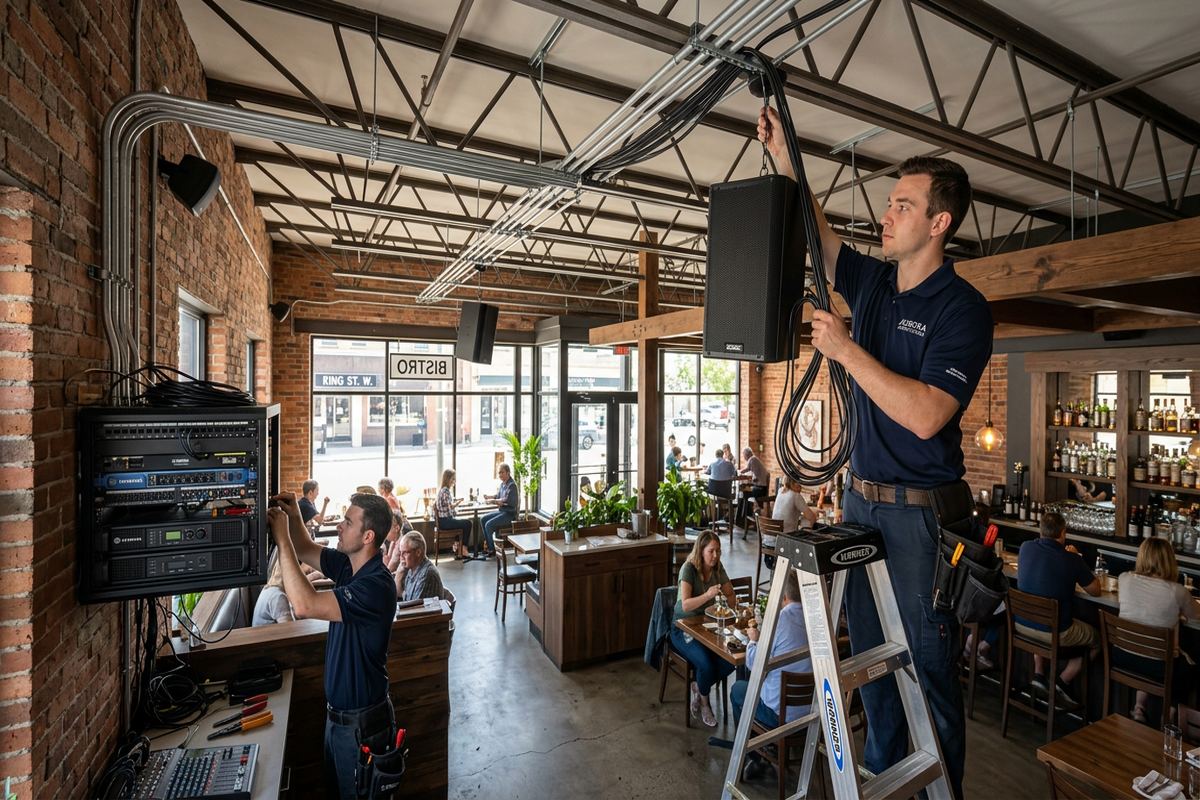
Restaurants, offices, commercial strips and industrial units use outdoor audio differently from homes. A customer patio may need even background music, while an industrial entrance or staff area may require clear, limited coverage during defined hours. Commercial projects can also involve landlord standards, shared walls, fire separations and restricted pathways above finished ceilings. We review the intended use, equipment location and available cable routes before pricing. The written scope can identify work that depends on building access, electrical provisions, lift access or coordination with other contractors, helping the business and property manager understand responsibilities before installation begins.
Tenants should obtain written landlord approval before authorizing drilling, cabling or equipment attachment. Condominium owners may also need approval from the corporation for speakers on balconies, terraces or common-element walls, even when the equipment is removable. Rules can address appearance, penetrations, operating hours and noise, and those permissions remain the customer’s responsibility. UnifiedLink can provide proposed device positions and cable routes for an approval request, but cannot guarantee that a landlord, board or property manager will accept them. Installation proceeds only within the access and mounting conditions included in the agreed scope.
Commercial audio may need simple controls that staff can use without changing system settings. We can define permitted source and volume functions, locate equipment away from casual access and label controls clearly. Where an existing business network supports streaming, we coordinate connection requirements without assuming unrestricted administrative access. Customer-owned accounts are used for supported services, and recurring subscriptions remain under the customer’s control. At handover, designated personnel receive an operational walkthrough and as-built information. One accountable contractor manages the included low-voltage audio work, while excluded electrical, structural, network or finish work is identified in writing.
- Patio and staff-area audio planning
- Landlord or condominium approval support details
- Clearly labelled business controls
- Scope coordination with other site contractors
Our Outdoor Speaker Installation Process in Ajax
Every project begins with a request and enough information to arrange the appropriate next step. Requests sent during business hours are answered the same day, while after-hours requests are answered the next business day. Site assessment timing depends on the service and travel distance. For an Ajax outdoor audio project, helpful initial details include photographs, approximate listening areas, preferred control method, existing audio equipment and any planned renovations. These details support preparation, but final pricing follows a site assessment because construction, access and cable-routing conditions cannot be confirmed reliably from a short description alone.
After assessment, UnifiedLink provides a written scope covering equipment, cable routes, device placement, exclusions, equipment ownership and warranty. This document also identifies assumptions involving customer-provided hardware, network access, power, approvals and finish repairs. Once accepted and scheduled, installation follows the defined route using continuous labelled cable runs. Speakers and related equipment are mounted in the agreed locations, connections are terminated and the system is configured on site. If concealed conditions differ materially from what could be inspected, we discuss the effect before changing the agreed work rather than silently improvising a different pathway.
Handover confirms that the included zones, sources and controls operate as scoped. We demonstrate routine use, identify equipment locations and provide the customer with their own credentials for supported applications or services. An as-built record documents speaker positions, cable routes, terminations and relevant configuration details. The customer should retain that information with property records and review exterior hardware and seals periodically, especially after severe weather or building work. By keeping assessment, cabling, mounting, configuration and documentation with one accountable contractor, Ajax customers have a clear contact for the completed low-voltage audio scope.
- Site assessment completed before pricing
- Detailed written scope before installation
- On-site configuration and operational walkthrough
- Customer credentials and as-built documentation
Ajax neighbourhoods we cover
- Southwood
- Nottingham
- Duffin's Bay
- Applecroft
- Pickering Beach
- Central Ajax
Outdoor speaker installation in Ajax — common questions
Can outdoor speakers stay installed through an Ajax winter?
Yes, when the selected speakers and mounting hardware are rated for the intended outdoor exposure. Installation still needs to account for snow, moisture, temperature changes and freeze-thaw cycles. Speaker orientation, terminal protection, fastening and sealed cable entries all matter. Exterior hardware and sealant should be inspected periodically because no outdoor installation is maintenance-free, particularly after severe weather or exterior renovation work.
Can you hide speaker wiring in my finished basement?
Often, but the route must be assessed at the Ajax property. Finished ceilings can conceal blocking, ducts, plumbing and insulation, while utility rooms or unfinished storage spaces may provide partial access. We explain likely access points and any finish-repair exclusions in the written scope. Where a fully concealed route is impractical, we can discuss a controlled surface pathway or suitable exterior route rather than making an unsupported promise.
How many speakers does my patio or yard need?
The quantity depends on the listening area, speaker type, mounting positions, landscaping and distance to neighbouring properties. Several speakers operating at moderate output can provide more consistent coverage than one pair playing loudly. During the Ajax site assessment, we review seating areas, deck levels, pools, fences and likely sound direction before recommending speaker positions, amplification and any separate audio zones.
Do I need Wi-Fi outside to control the system?
Wi-Fi is usually needed when control relies on a mobile application, network streamer or cloud-connected amplifier. The speakers themselves may use wired audio cable, but the controlling device still needs a reliable network connection. We can test practical control from the intended Ajax patio or yard location and identify weak coverage. Any required Wi-Fi improvement can be defined separately rather than treated as part of the speaker wiring automatically.
Can you install speakers at a condo or rental property?
Installation may be possible, but the owner, tenant or business must obtain required approval before work begins. Ajax condominium corporations and landlords may restrict balcony equipment, exterior drilling, visible cable, noise or work on common elements. We can document proposed speaker locations and cable routes to support an approval request. Approval by a board, landlord or property manager cannot be guaranteed and remains outside the installation scope.
Can you connect outdoor speakers to my existing receiver?
Possibly. We need to check the receiver’s available channels, supported speaker load, zone functions, equipment location and control options. Existing hardware may be reusable but unsuitable for the planned quantity or cable distance. At an Ajax assessment, we identify what can remain, what needs replacement and which third-party applications or subscriptions affect operation. Customer-provided equipment and related warranty responsibilities are clearly recorded in the written scope.
Coverage in Ajax is confirmed against the address before we quote. See everything we install in Ajax or the province-wide outdoor speaker installation page.